
Ivica Ivušić Scout Report: Hajduk Split’s World Cup Goalkeeper


Quick scout answer: Ivica Ivušić is Hajduk Split’s 31-year-old Croatian goalkeeper (born 1 February 1995 in Rijeka, 1.95 m), wearing the number 1 shirt. After starting out in Inter Milan’s academy, he built his career through Prato, Istra 1961, Olympiacos and a stable five-year spell at Osijek (114 appearances) before a 2023 move to Cypriot side Pafos FC (Transfermarkt-listed fee around €2.0m). He signed for Hajduk Split in July 2025 for a reported fee of roughly €800k and is contracted until 2029. An ankle injury sidelined him for roughly six months between October 2025 and April 2026; since returning he has reclaimed the starting spot, posting a 58.1% save rate and 8 clean sheets across 14 league matches this season. In the same week as this report, national coach Zlatko Dalić called him up for Croatia’s September 2026 World Cup qualifiers. His height, ball-playing feet and multi-country experience make him a realistic profile for a Süper Lig club looking for an experienced rotation or starting goalkeeper — though the long injury layoff and thin senior-cap record (six caps) are risk factors worth weighing.
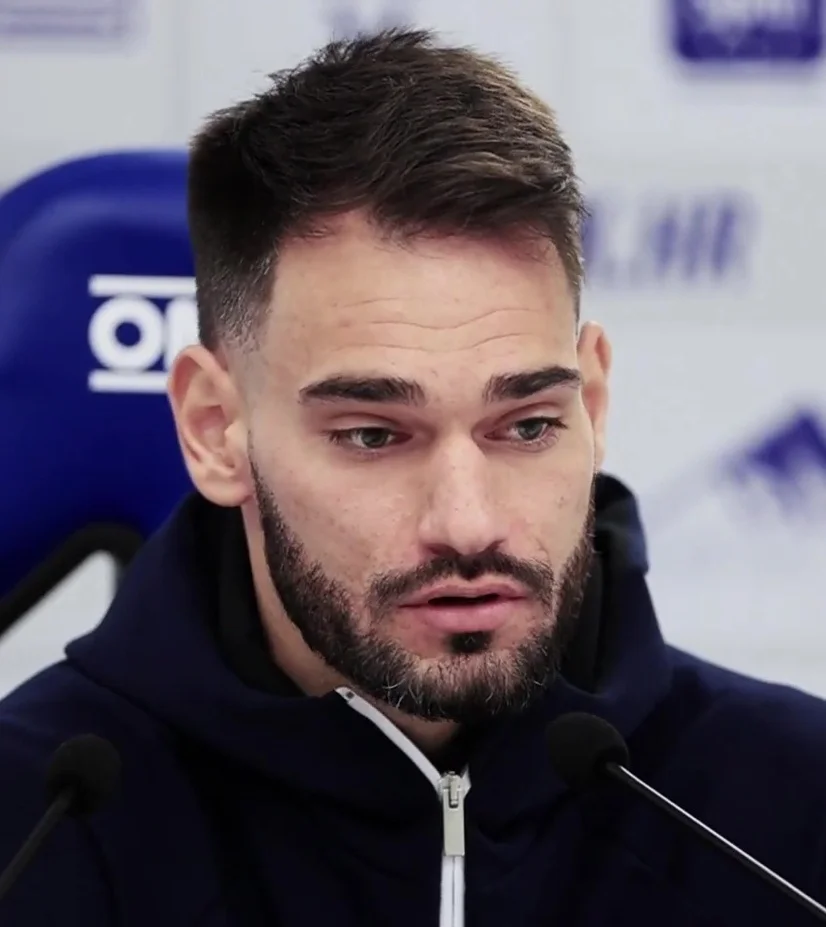
Photo: Ivica Ivušić at a press conference. Credit: Davor Javorović/PIXSELL (CC BY 3.0, Wikimedia Commons).
Profile & Biography
| Full Name | Ivica Ivušić |
| Date of Birth | 1 February 1995 (age 31) |
| Place of Birth | Rijeka, Croatia |
| Nationality | Croatia |
| Height | 1.95 m |
| Position | Goalkeeper |
| Club / Shirt No. | HNK Hajduk Split / 1 |
| Contract Until | 30 June 2029 |
| Market Value | ~€990k (Transfermarkt estimate, a moving figure) |
| National Team | Croatia senior team — 6 caps |
Career & Transfer History
Ivušić came through the ranks at his hometown club before joining Inter Milan’s academy in 2009, where he never made a first-team appearance. A 2014 loan to Italian lower-league side Prato (11 appearances) was followed by a return home to NK Istra 1961 in 2015, where he became a regular starter. A brief 2018 spell at Olympiacos preceded a move to NK Osijek the same year, where he made 114 appearances across five seasons and established himself as one of the HNL’s most dependable stoppers. In January 2023 he moved to Cyprus, joining Pafos FC, where he gained experience in both the domestic league and European competition. On 14 July 2025 he returned to Croatia, signing for Hajduk Split.
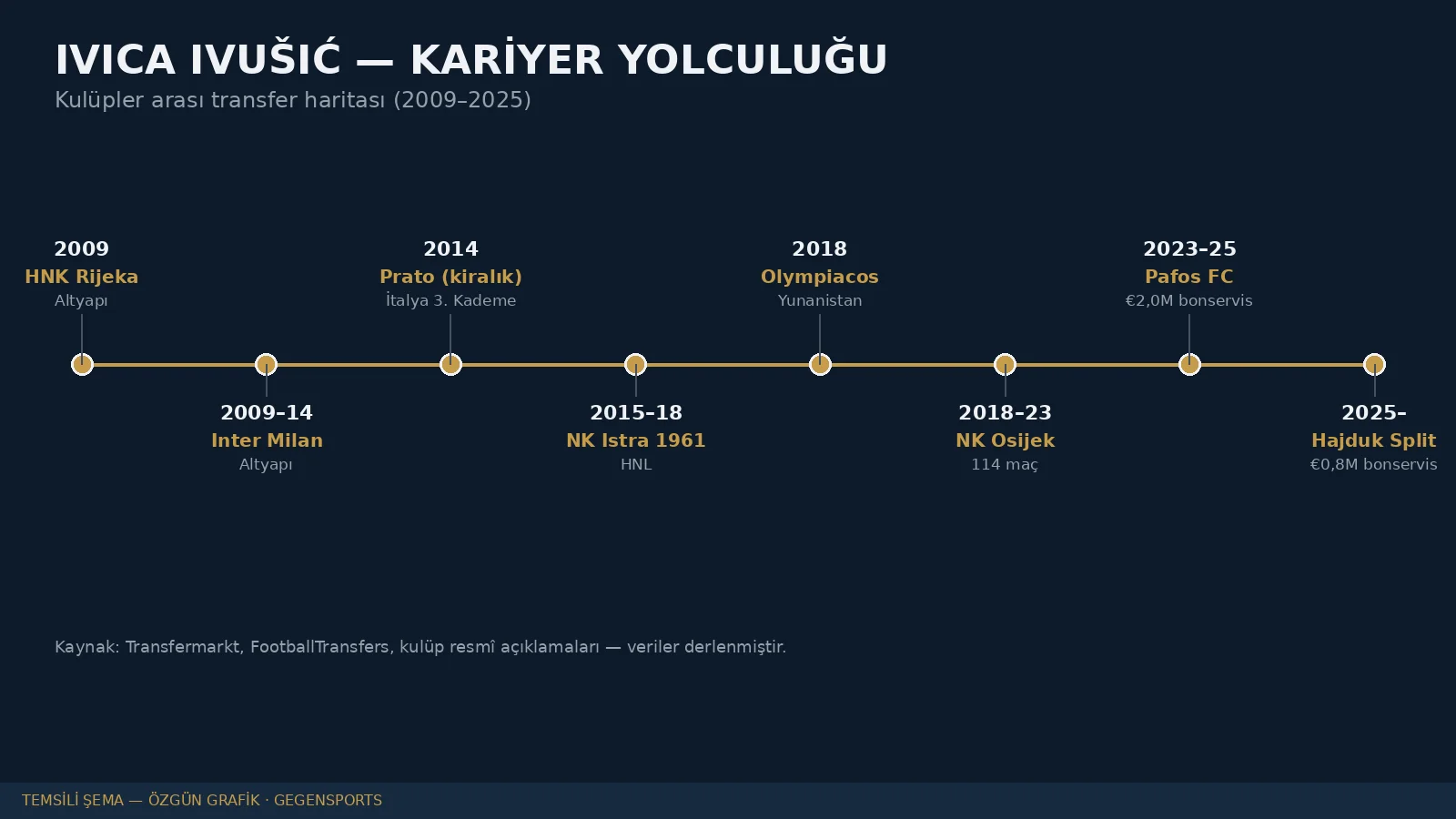
Graphic: original GegenSports illustration (representative diagram), not a photograph. Based on Transfermarkt and FootballTransfers data.
| Period | Club | Detail | Fee |
| –2009 | HNK Rijeka (youth) | Started at his hometown club | — |
| 2009-2014 | Inter Milan (youth) | No first-team appearances | Undisclosed |
| 2014 | Prato (loan) | Italian tier-3, 11 appearances | Loan |
| 2015-2018 | NK Istra 1961 | First regular run in the HNL | Transfermarkt record: undisclosed |
| 2018 | Olympiacos | Brief Greek spell | Transfermarkt record |
| 2018-2023 | NK Osijek | 114 official appearances | Transfermarkt record |
| 2023-2025 | Pafos FC (Cyprus) | Transfer from Osijek | ~€2.0m (reported/Transfermarkt record, Jan 2023) |
| 2025– | Hajduk Split | Signed 14 July 2025 | ~€800k (reported/Transfermarkt record) |
Note: transfer fees are compiled from Transfermarkt and FootballTransfers; since clubs rarely confirm exact figures, these are “reported/estimated record” values.
Season Statistics (2026-27 HNL, as of 5 September 2026)
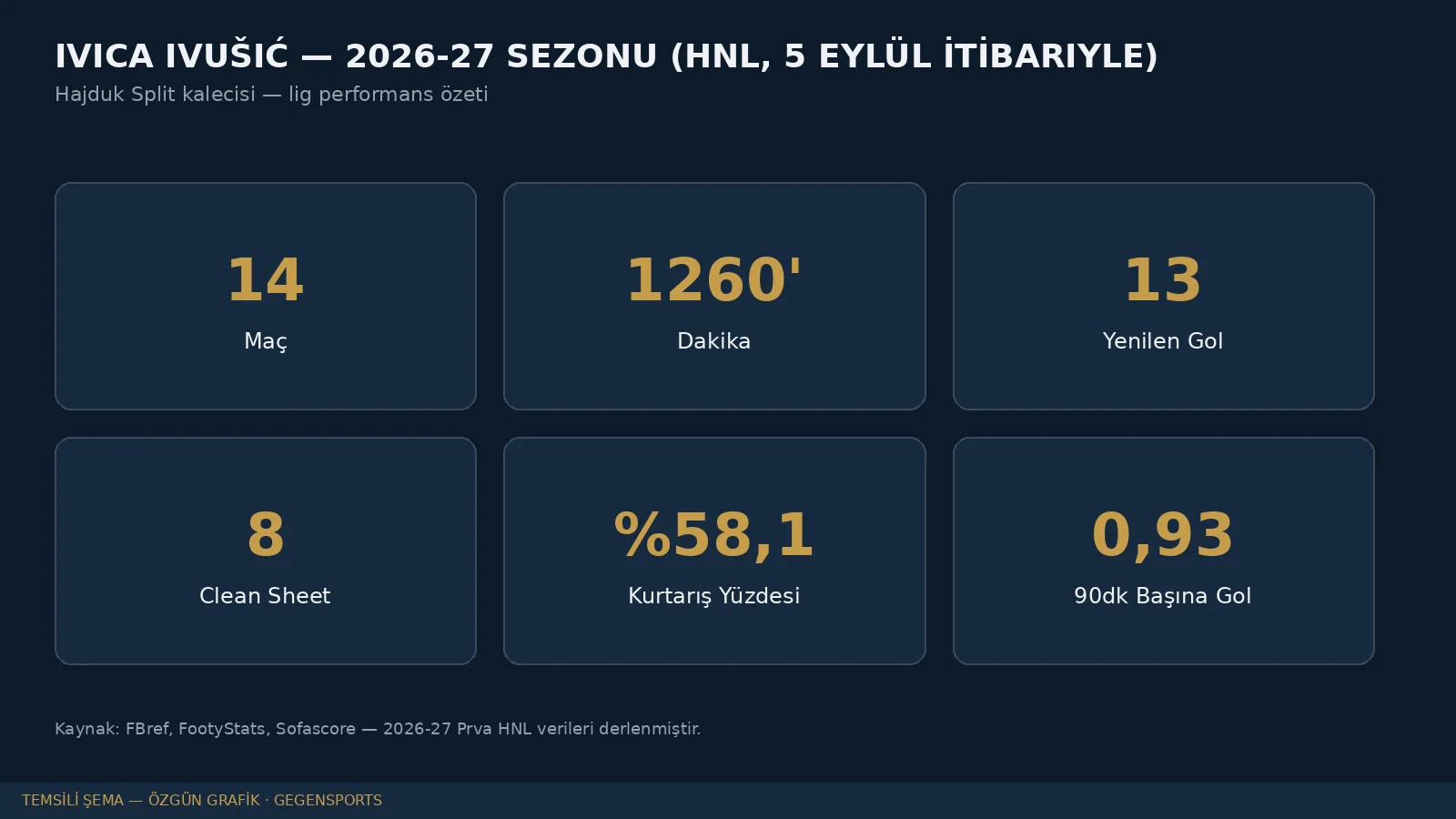
Graphic: original GegenSports illustration (representative diagram). Source data: FBref, FootyStats, Sofascore — compiled as of September 2026.
| Metric | Value |
| Appearances | 14 |
| Minutes Played | 1,260 |
| Goals Conceded | 13 |
| Clean Sheets | 8 |
| Save Percentage | 58.1% (18 saves from 31 shots) |
| Goals Conceded per 90 | 0.93 |
| Yellow Cards | 1 |
This table is cross-referenced from FBref, FootyStats and Sofascore. Providers sometimes count matches differently (league only vs. league plus cup competitions), so the figures should be read as an approximate current-season snapshot rather than an exact official record.
Playing Style Analysis
Having spent his career across Italy, Greece, Croatia and Cyprus, Ivušić’s game blends classic shot-stopping instincts with some modern goalkeeping traits.
Shot-stopping: His 1.95 m frame gives him wide coverage on long-range efforts and set pieces. Scouting sources describe him as a largely reactive keeper — one who reads and reacts to the strike rather than aggressively narrowing angles beforehand.
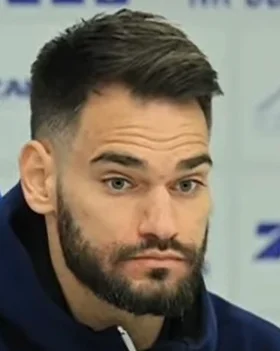
Photo: Ivica Ivušić during an interview. Credit: PIXSELL (CC BY 3.0, Wikimedia Commons).
Aerial command and coming off his line: His height helps him dominate crosses and corners inside the box, though local reporting has occasionally flagged hesitant timing when rushing out during fast transitions.
Distribution (build-up contribution): FootballTransfers profiles him as a “ball-playing keeper” — someone comfortable playing short passes into central defenders and midfielders rather than defaulting to long clearances, letting him take part in the first phase of build-up play. That’s a meaningful fit criterion for Süper Lig clubs that prioritise playing out from the back.
Leadership and organisation: Approaching his mid-thirties, he has accumulated real experience directing a back line vocally and reading danger early — his stable 114-appearance run at Osijek is the clearest reference point for this trait.
Where He Sits in Hajduk’s Goalkeeping Pecking Order
Hajduk Split’s squad includes alternatives such as Toni Šilić and Dante Stipica, but Ivušić has been the club’s clear first choice since his 2025 arrival. The fact that the backups got minutes during his injury layoff shows the internal competition stays live — meaning Ivušić needs to keep performing to hold onto the shirt. With Hajduk targeting both domestic and European competition in 2026-27, goalkeeping depth remains high on the club’s sporting-planning agenda.
Strengths
- Physical height advantage: 1.95 m gives him wide coverage on aerial balls and long-range shots.
- Multi-country experience: Spells in Italy, Greece, Croatia and Cyprus show an ability to adapt to different tempos and pressure levels.
- Distribution quality: A modern “ball-playing keeper” profile who contributes to build-up with short passing.
- Current form and international trust: A September 2026 call-up from Dalić signals technical staff have signed off on his post-injury recovery.
- Contract security: A deal running to 2029 shows the club sees him as a long-term project.
Weaknesses
- Long injury history: An ankle injury kept him out for roughly six months between October 2025 and April 2026 — a real durability concern.
- Thin senior international sample: Just six caps despite being part of the 2022 World Cup squad means limited exposure to top-level match pressure.
- Age window: At 31, he should be assessed for level maintenance rather than development upside.
- Sweeping/timing questions: Occasional local criticism of late decision-making when rushing out could be exploited by fast-transition opponents.
GegenSports Rating: 76/100
This score is GegenSports’ own composite — independent of FM or any third-party rating platform — built from Reflexes/Shot-Stopping (high), Aerial Command (medium-high), Distribution (medium-high), Leadership/Experience (high) and Durability/Injury Risk (low-medium, pulled down by the past year’s injury). The overall picture: a reliably solid week-to-week keeper carrying real durability risk.
Comparable Players
- Dominik Livaković (Fenerbahçe) — from the same Croatian goalkeeping pipeline, known for reflex-based shot-stopping and big-match experience, though at a much higher international profile.
- Ivo Grbić — another Croatian product with a similar physical build and comparable mid-to-upper-tier league career arc.
- Karlo Letica (Panathinaikos) — a similar-age product of the same Croatian development system, sharing an emphasis on distribution from the back.
These comparisons are stylistic groupings based on national goalkeeping school, physical type and career trajectory — not claims of equivalent output.
Tactical Comparison: HNL Goalkeeping Standards
Croatia’s 1.HNL runs at a lower technical tempo than the Süper Lig but shares a similar emphasis on positional discipline. Ivušić’s 58.1% save rate sits in a band comparable to the league’s better keepers, though that number alone can mislead since Hajduk’s defensive shape already limits shots faced per game. A keeper’s real value shows up in clutch-moment performance (post-shot expected goals, for instance) more than raw save percentage — with public data limited on that front, GegenSports keeps this assessment appropriately cautious.
Süper Lig Fit
The Süper Lig is known for crossing- and set-piece-heavy football, which suits Ivušić’s height and aerial presence. The growing number of Süper Lig clubs building out from the back also raises the value of his distribution game. But at 31 and coming off a long injury, the realistic framing for any interested club is “experienced rotation/starting option,” not “guaranteed marquee starter.”
Which Turkish Clubs Could Fit?
The following is a speculative profile-fit read, not based on any confirmed transfer talks:
- Kasımpaşa: A club historically open to rotating foreign goalkeepers; Ivušić’s experience could be a reasonable mid-budget option.
- Gaziantep FK: A fit for mid-table sides looking to add an experienced last line to a younger squad.
- Rizespor: A club without European ambitions this season, where cost/performance balance could work.
Ideal Teammates
Ivušić works best behind press-resistant centre-backs — defenders who stay calm under pressure and find the right pass rather than panicking — who can receive his short distribution. A vocal defensive midfielder comfortable holding a high line would also help him make full use of his aerial presence.
Adaptation Score: 7.5/10
His multi-country club experience (Italy, Greece, Cyprus) is a strong reference for settling into a new league or culture. Two factors cap the score: age may lengthen the adaptation window, and the recent injury could affect his physical preparation cycle.
Cost & Value-for-Money Scenarios
No confirmed offer or negotiation exists; the following are hypothetical ranges built from his current market value (~€990k) and his last two transfer fees (€2.0m / €800k):
- Low scenario: A loan, or a fee in the €300-500k range as his contract nears its final stretch.
- Mid scenario: A fee close to current market value, roughly €700k-€1.2m.
- High scenario: Sustained national-team form and an injury-free season could push demand above €1.5m.
Development Potential
For a 31-year-old goalkeeper, “development potential” should be measured through sustained experience and stability rather than technical growth. The contribution expected from Ivušić is more likely mentorship of younger keepers and leadership organising the back line, rather than a rising performance ceiling.
Injury History & Durability
Records show Ivušić missed roughly six months, from 25 October 2025 to 20 April 2026, with an ankle injury — covering most of the 2025-26 season. His return to regular action at both club and international level since April 2026 suggests he has reached full physical capacity again. Still, any transfer evaluation should flag that six-month gap as a line item requiring a closer medical review.
Foreign-Player Status & UK Work Permit Analysis
Süper Lig clubs operate under a foreign-player quota that changes season to season; as a Croatian citizen, Ivušić would count against that quota at any Süper Lig club — the exact number varies by club and season, so current TFF regulations would need checking before any transfer.
On a potential move to England: post-Brexit, non-EU (from England’s perspective) players are assessed under the Governing Body Endorsement (GBE) points system, which weighs the percentage of senior international matches played over the past two years against the FA’s league banding. With just six senior caps in total and Croatia’s 1.HNL sitting in a relatively lower-scoring league band, Ivušić would likely struggle to clear the automatic GBE threshold, making an Exceptions Panel application the more probable route. This is a general framework, not legal advice — the final outcome depends on the FA’s current points table and application process.
Suitable Leagues
- Croatia’s 1.HNL (current league)
- Turkey’s Süper Lig
- Greece’s Super League (prior Olympiacos experience)
- Cyprus’ First Division (familiar territory from his Pafos spell)
- US MLS (a common late-career alternative for veteran goalkeepers)
Sporting Director Summary
Ivušić should be read as a “buy trust and experience” signing, not a marquee transfer. His physical profile and distribution quality fit the Süper Lig technically, but the recent long-term injury and his age mean contract length and bonus structure need careful design. The ideal scenario positions him not as a headline arrival but as a strong rotation option competing with an existing No. 1.
Frequently Asked Questions
1. Who is Ivica Ivušić?
An experienced Croatian goalkeeper, born in 1995, who plays for Hajduk Split and the Croatia national team.
2. Which club did Ivušić join Hajduk Split from?
Cypriot side Pafos FC, in July 2025.
3. When does his Hajduk Split contract expire?
30 June 2029.
4. Was Ivušić in Croatia’s 2022 World Cup squad?
Yes, part of the squad that finished third at the 2022 World Cup.
5. How long was Ivušić’s most recent injury?
Roughly six months, from October 2025 to April 2026, due to an ankle injury.
6. What is Ivušić’s market value?
An estimated ~€990k (Transfermarkt-based, a figure that shifts over time).
7. Would Ivušić fit the Süper Lig?
His physical profile and distribution suit the league technically, but his age and injury history call for careful evaluation.
8. Could Ivušić play in England?
Automatic clearance looks difficult under the post-Brexit GBE points system; an Exceptions Panel route is more likely.
9. How is Ivušić’s playing style described?
As a “ball-playing keeper” who contributes to build-up play with short passing.
10. How many senior caps does Ivušić have?
Six.
11. What is Ivušić’s shirt number at Hajduk?
Number 1.
12. What is Ivušić’s biggest strength?
His physical height advantage and the composure built from multi-country experience.
Related GegenSports Reports
- Dario Melnjak Scout Report: Hajduk Split’s Experienced Left-Back
- Dario Marešić Scout Report: Why Is the 2,833-Minute Fixture Still Cheap?
- Dennis Hadžikadunić Scout Report: Hajduk Split’s World Cup Centre-Back
- Marino Skelin Scout Report: Hajduk’s Centre-Back After Injury
- Marko Livaja Scout Report: Is the King of Poljud Still the League’s Most Dangerous at 32?
Sources
- Transfermarkt — career, transfer fees and market value data
- FootballTransfers — transfer history and playing-style profile
- FBref / FootyStats / Sofascore — 2026-27 season statistics
- Soccerway — injury history
- Croatian Football Federation (HNS) — September 2026 national squad announcement
- ESPN — biographical data
- Wikimedia Commons (PIXSELL, CC BY 3.0) — photographs