


Álex Padilla Scout Report: From the Basque Country to Mexico


When Unai Simón landed back in Bilbao after lifting the 2026 World Cup with Spain, the man who had been minding Athletic Club’s goal for two months was barely 22. Álex Padilla started six of Athletic’s pre-season friendlies, kept five clean sheets, dragged the club to a Copa del Rey semi-final the previous spring, and turns 23 on 1 September — days after arguably the best pre-season of his career. Born to a Basque father and a Mexican mother, raised for part of his childhood in Chihuahua, and now a Mexico international rather than a Spanish one, his file is one of the more unusual in Athletic’s academy pipeline. GegenSports breaks it down.
Quick Scout Take
Álex Padilla is a 1.90m, right-footed goalkeeper born in 2003, product of Athletic Bilbao’s Basque-only academy system via Zarautz and Lezama. He spent four seasons in the lower tiers with CD Basconia and Bilbao Athletic before making his La Liga debut away at Getafe on 15 August 2024. The defining chapter of his development so far came in January 2025, when Athletic sent him on loan to Mexican side Pumas UNAM: across Liga MX and the CONCACAF Champions Cup he logged 18 competitive appearances, the first sustained senior run of his career. Back in Bilbao for 2025-26, he settled into life as Simón’s understudy and Athletic’s clear No.1 for the Copa del Rey, carrying the club to the semi-finals before Real Sociedad ended the run. His 2026-27 pre-season — six starts, five wins, five clean sheets while a World Cup-winning Simón rested — did nothing to hurt his stock. The most unusual line in his file is international: capped six times for Spain’s U19s, he later switched allegiance through his mother’s nationality to Mexico’s U23s and received his first senior Mexico call-up in August 2024. On the pitch he is a brave, agile shot-stopper who is comfortable building with his feet and can play a sweeper-keeper role behind a high line, though his long-range distribution and command of crosses are both still works in progress. A Süper Lig move is not remotely realistic in the short term — he is contracted to Athletic until 2029 and is clearly viewed as a long-term project — but the profile itself, a young, foot-savvy keeper hungry for regular minutes, fits the kind of project several Turkish clubs like to run.
Photo: Harold9595959 — CC0 1.0 (Public Domain), Wikimedia Commons. Athletic Bilbao v Aston Villa friendly, August 2024 (cropped).
Player Identity & Bio
| Full Name | Alejandro “Álex” Padilla Pérez |
| Date of Birth | 1 September 2003 (22; turns 23 on 1 September 2026) |
| Place of Birth | Zarautz, Gipuzkoa, Basque Country, Spain |
| Height | 1.90 m |
| Position | Goalkeeper |
| Preferred Foot | Right |
| Current Club | Athletic Club (Bilbao) |
| Shirt Number | 27 |
| Contract Until | 30 June 2029 |
| Market Value | ~€2.7m (Transfermarkt, August 2026) |
| International | Spain U19 (2021-22, 6 caps) → Mexico U23 (2024-, 2 caps); first senior Mexico call-up August 2024 |
Career & Transfer History
| Period | Club | Transfer Type | Fee |
|---|---|---|---|
| 2019–2021 | Zarautz KE → Athletic Club academy (Lezama) | Academy move | — |
| 2021–2022 | CD Basconia | Internal promotion (one tier below the B side) | — |
| 2022–2024 | Bilbao Athletic (Athletic Club B) | Internal promotion | — |
| August 2024 | Athletic Club (first team) | Squad integration, first pro contract | — |
| January 2025 – 2026 | Pumas UNAM (loan) | Loan with extension, purchase and buy-back options | Loan fee undisclosed |
| 2026 (ongoing) | Athletic Club | Return from loan, contract extension to 2029 | Internal renewal, free |
Padilla’s path is a textbook example of the patience Athletic’s Basque-only recruitment model demands at the goalkeeper position. He started at Zarautz, moved into the Lezama academy system, and made his senior bow for Tercera Federación side CD Basconia on 15 September 2021 in a 2-2 draw with CD Anaitasuna. Two seasons with Bilbao Athletic followed, including a Segunda Federación title in 2023-24. His La Liga debut at Getafe on 15 August 2024 drew praise locally for the composure of his distribution in helping Athletic dictate tempo. The real turning point, though, was January 2025: Athletic loaned him to Pumas UNAM in Mexico to accelerate his development, in a deal that gave both clubs a one-year extension option, Pumas a purchase clause and Athletic a buy-back right. He began as Pumas’ backup but took over as starter during the 2025 Clausura, with the club publicly backing him as their undisputed No.1. On his return to Bilbao in the summer of 2025, Athletic extended his contract to 2029 — a rare show of faith for a player straight off a loan spell.
Season Statistics
| Season | Club | Competition | Apps | Conceded | Saves | Clean Sheets |
|---|---|---|---|---|---|---|
| 2021-22 | CD Basconia | Tercera Federación | 24 | — | — | — |
| 2022-23 | Bilbao Athletic | Primera Federación | 25 | — | — | — |
| 2023-24 | Bilbao Athletic | Segunda Federación (champions) | 26 | — | — | — |
| 2024-25 / 2025-26 (combined) | Athletic Club | La Liga | 6 | — | — | — |
| 2025 (Clausura, loan) | Pumas UNAM | Liga MX | 8 | 15 | 15 | — |
| 2025 (loan, total) | Pumas UNAM | Liga MX + CONCACAF Champions Cup | 18 | 26 | — | 4 |
| 2025-26 | Athletic Club | Copa del Rey | Starter through the semi-final | — | — | — |
| 2026-27 (pre-season) | Athletic Club | Friendlies | 6 (starts) | — | — | 5 |
Note: sources diverge on the total number of Pumas loan appearances, ranging from 12 to 18. Mexican outlets covering the 2025 Clausura specifically (Récord, El Universal) cite an 8-game subset within that competition, while club-side archives put the full loan tally, including the CONCACAF Champions Cup, at 18. His La Liga minutes at Athletic remain a small sample — six appearances spread across two seasons — and should be read with appropriate caution.
Playing Style Analysis
Padilla’s goalkeeping identity sits somewhere between two archetypes: a classic reflex-based shot-stopper and a modern sweeper-keeper willing to step off his line. Scouting notes consistently describe him as a “brave, agile shot-stopper” — someone who commits early in one-on-one situations rather than waiting on the line, which cuts down the angle for the attacker before the shot is even struck. His 1.90m frame and strong spring give him solid coverage on crosses and from range.
The sweeper-keeper element — stepping out of the box to snuff out danger behind a high defensive line — is central to how he’s used at Athletic, whose system under the current coaching staff (following Ernesto Valverde) leans on exactly that kind of aggressive defensive positioning. His footwork is a genuine asset in build-up: short and medium-range passing out to the centre-backs and full-backs is safe and composed, giving Athletic an extra outlet when they try to play through pressure. Where he still lags is longer, more ambitious distribution — pinging accurate diagonals into the opposition half — an area where he isn’t yet at Unai Simón’s level of consistency; his kicking remains reliable but conservative rather than a genuine weapon.
Command of the box — the timing and conviction to attack crosses and corners — was tested and sharpened during the Pumas loan, where Liga MX’s fast, physical transitions forced quicker decision-making and better spatial reading. That experience visibly carried over into his Copa del Rey form back at Athletic, where he is credited with a handful of single-handed rescue acts across the run to the semi-final. In one-on-ones he tends to close the angle early rather than “block” passively, marking him out as a positional keeper rather than a pure reaction shot-stopper. The obvious question mark is sustaining that level of concentration over 90 minutes at the highest intensity — with such a small La Liga sample, it simply hasn’t been tested enough yet.
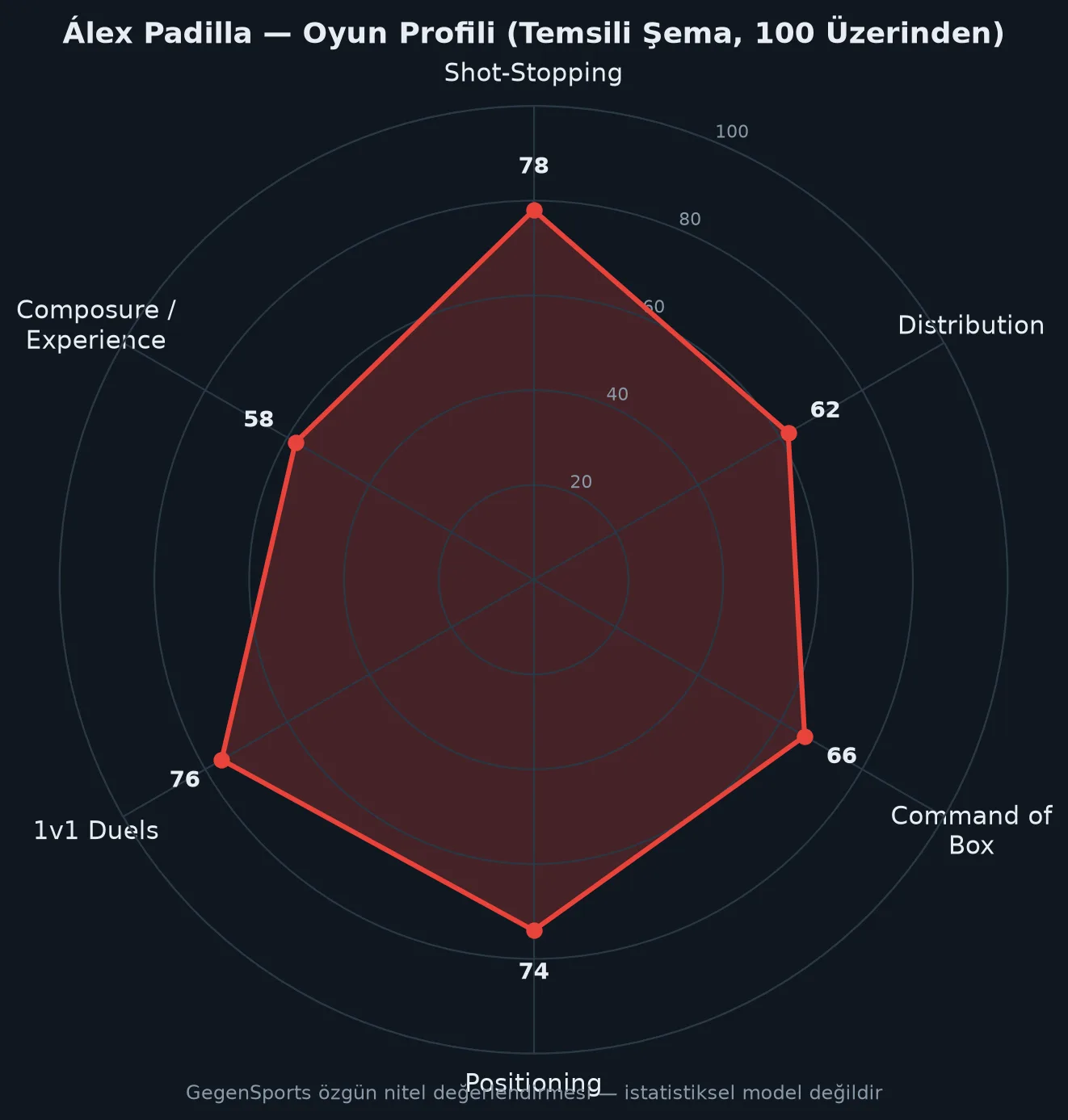
Illustrative chart — GegenSports original qualitative assessment, not a statistical model.
Strengths
- Reflexes and shot-stopping: Early movement and wide coverage in close-range situations; five clean sheets in six pre-season starts is a tangible marker of current form.
- Footwork and short distribution: A reliable outlet in build-up play; specifically praised in the local press after his La Liga debut.
- Sweeper-keeper upside: The bravery to step outside the box in systems that play a high defensive line.
- Big-game experience for his age: Carrying a team through a Copa del Rey run to the semi-final as first-choice keeper is an early sign he can handle pressure.
- Track record adapting abroad: Rising to undisputed starter status during a loan spell in a different football culture (Liga MX) points to fast adaptability.
Weaknesses
- Tiny La Liga sample: Just six league appearances across two seasons makes it hard to judge week-to-week top-flight consistency.
- Inconsistent long-range distribution: Unlike his short passing, longer diagonals and driven kicks haven’t yet reached an elite accuracy level.
- Box command still developing: Timing on high balls is occasionally shaky — a specific focus area in his training alongside Unai Simón.
- Structural competition: With a World Cup-winning, undroppable Simón ahead of him, regular league minutes will remain hard to come by for the foreseeable future.
GegenSports Score
66 / 100 — a rating that reflects a “high ceiling, small sample” young goalkeeper. The pre-season form, the Copa del Rey semi-final run and the Pumas loan pull the number up; limited La Liga minutes and unfinished long-range distribution hold it back. In GegenSports’ methodology, the 60-69 band reads as “a reliable backup at an upper-mid-table club, a plausible starter at a lower-mid-table one.” The score is built from career stability and development trajectory (20%), technical-tactical contribution (30%), physical profile (15%), current form and role risk (20%), and big-game/pressure experience (15%).
Similar Players
- Iñaki Peña (Barcelona): Spent years patiently waiting behind a superstar (Marc-André ter Stegen) while sharpening his footwork — a near-direct parallel to Padilla’s situation behind Simón.
- Diego Conde (Villarreal, developed through loans): A young Spanish goalkeeper archetype maturing through successive loan spells with medium-term starter potential.
- Luis Malagón (Club América / Mexico national team): Mexican football’s modern-generation goalkeeper — an interesting reference point given Padilla’s Mexican ties and Liga MX experience.
For a deeper look at the comparison, see GegenSports’ Unai Simón profile and, for another captain-goalkeeper case study in La Liga, our Antonio Sivera scout report.

Illustrative chart — GegenSports original graphic. Source: Athletic Club, Wikipedia, Pumas press releases.
Süper Lig Fit
Padilla’s profile has to be read on two different timelines when it comes to the Süper Lig. In the short term, a move simply isn’t realistic: his contract runs to 2029, the club clearly treats him as a long-term project, and his 2026-27 pre-season form justifies that investment. Stylistically, though, a young, foot-comfortable, brave goalkeeper fits the growing Süper Lig trend of wanting keepers who can build from the back rather than just clear their lines. In a longer-term scenario — say, a point in his career where he’s actively chasing regular first-team football — his physical profile and age would travel well to the Süper Lig’s high-tempo, physically combative environment. Having already proven he can handle pressure in a Copa del Rey run gives some reassurance against the intensity of a big-city Turkish club’s fanbase.
Suitable Turkish Clubs
- Samsunspor: A club that has recently invested in young, developable profiles and could realistically offer a No.1 guarantee.
- Kasımpaşa: Has a track record of giving young goalkeepers a chance, in a competitive but less suffocating Istanbul environment.
- Gaziantep FK: Known for a development-first recruitment approach that tends to offer young foreign signings regular game time.
These are not claims about any club’s actual transfer plans — they are scenario-based suggestions built around profile fit.
Ideal Teammates
Padilla would benefit most from a communicative centre-back pairing capable of recovering quickly in transition (to offset his still-developing box command), a comfortable holding midfielder who can make use of his short distribution, and a fast full-back pairing confident enough to operate behind a high defensive line. In that kind of environment he could display both his sweeper-keeper instincts and his classic shot-stopping in balance.
Adaptation Score
6 / 10 — his rapid rise to starter status on loan in Mexico is a good reference point for adaptability. But the small La Liga sample means his readiness for the week-to-week rhythm and pressure of a top European league is still unproven at scale. A Spanish-speaking dressing room wouldn’t be an issue; adapting to a different language and culture like Turkey’s, at his age, is plausible but not guaranteed.
Cost & Value-for-Money Scenarios
Athletic extending his contract to 2029 is a strong signal he isn’t for sale in the short term. Still, purely as scenarios:
- Optimistic (for the seller): If his development continues and Simón eventually moves on, Athletic could command a fee well above his current market value — but that’s a two-to-three-year horizon at best.
- Middle scenario: At this stage of his career, a loan with an option to buy — the exact structure used for the Pumas move — would be low-risk for both club and player if he’s chasing regular minutes elsewhere.
- Low-probability scenario: Should Athletic unexpectedly restructure their goalkeeping department, a permanent transfer near his current valuation (~€3m range) is theoretically possible.
Note: these figures are not confirmed offers or negotiations — they are scenario examples based on publicly available market data.
Development Potential
For a goalkeeper about to turn 23, the development ceiling should be rated high — goalkeepers typically peak between 25 and 29, meaning Padilla is entering the most important developmental window of his career. The priority areas are consistency in long-range distribution and timing on crosses, both of which are exactly what daily training alongside Unai Simón is designed to sharpen. As the Pumas loan demonstrated, he adapts quickly once he gets a run of games — which suggests that wherever he finds regular football next, whether at Athletic or elsewhere on loan, his development curve should stay steep.
Injury & Fitness History
Public sources report no long-term or chronic injury history for Padilla. Regular game time throughout the academy and B-team years, holding onto the No.1 shirt at Pumas once he won it, and six consecutive pre-season starts in 2026-27 all paint a positive durability picture. That said, he hasn’t yet completed a full season as a starting La Liga goalkeeper, so his resilience against top-flight match congestion remains a limited sample.
Foreign Player Status & UK Work Permit Analysis
In a hypothetical Süper Lig move, Padilla would count against the foreign-player quota as a Spanish citizen — the Süper Lig applies no EU exemption, and his Mexican citizenship through his mother doesn’t change that. As for a move to England: under the post-Brexit Governing Body Endorsement (GBE) points system, automatic qualification generally hinges on senior international caps; Padilla has not yet made a competitive senior appearance for Mexico (only a call-up is publicly confirmed), which currently closes off that route. On the club-based points track, playing in La Liga — one of the top-banded leagues — helps, but his limited total of La Liga minutes works against him. This is a general framework, not legal advice; any real transfer scenario would require clubs to work with immigration specialists.
Suitable Leagues
- La Liga (Spain): Staying at Athletic as Simón’s understudy remains the most likely, lowest-risk path.
- Liga MX (Mexico): Given how well the Pumas loan went, a second Mexican loan spell is a reasonable option.
- Süper Lig (Turkey): A medium-term option for an upper-mid-table club able to guarantee regular starts to a young, foot-comfortable goalkeeper.
- Segunda División (Spain): A realistic short-term loan alternative for anyone seeking a run of regular starting minutes.
- Eredivisie (Netherlands): A market known for handing young goalkeepers early responsibility and a development-focused club culture — a stylistically interesting alternative.
Sporting Director Summary
Álex Padilla isn’t a finished product, but he’s an intriguing profile for a sporting director hunting a high-upside development project: 1.90m, brave in his reflexes, comfortable on the ball, and already carrying a Copa del Rey run to the semi-final as a first-choice keeper at his age is a rare combination. On the risk side, the small La Liga sample and Athletic tying him down to 2029 make a short-term transfer close to impossible — this report should be read as “a profile worth tracking,” not an active transfer recommendation. If a Süper Lig club were genuinely interested, the most realistic route would likely be a loan from around 2027-28 onward, once Padilla himself is actively seeking regular first-team football.
Three practical notes for decision-makers: (1) this profile should be evaluated as a two-to-three-season development investment, not an immediate-impact signing; (2) his quick adaptation at Pumas shows an openness to different football cultures — a positive signal for an environment as physically and emotionally intense as the Süper Lig; (3) since Athletic’s goalkeeping hierarchy isn’t changing anytime soon, any real interest should first explore a loan structure rather than a direct permanent offer.
From the Basque Country to Mexico: An International Story
The most unusual detail in Padilla’s file is the reversal in his international career. Born to a Basque father and a Mexican mother, he moved with his family to Camargo, in Mexico’s Chihuahua state, just three months after birth and lived there until he was seven, before returning to the Basque Country. That dual identity later played out on the pitch: in 2021-22 he made six appearances for Spain’s U19s, debuting on 2 September 2021 in a 5-1 win over Mexico’s U18s — an ironic footnote given what followed. In 2024, using the Mexican citizenship inherited from his mother, he switched allegiance: he debuted for Mexico’s U23s on 22 March 2024 in a 4-2 loss to Argentina and featured at that year’s Maurice Revello Tournament in June. On 29 August 2024, he received his first call-up to the senior Mexico squad. The switch reads as much as an identity choice as a sporting one — a player raised between two countries choosing, at this stage of his career, to commit to Mexico.
Frequently Asked Questions
Who is Álex Padilla?
Álex Padilla is a 2003-born goalkeeper who came through Athletic Bilbao’s academy, with ties to both Spain and Mexico. He is Unai Simón’s understudy and Athletic’s first-choice Copa del Rey goalkeeper.
Which club does Álex Padilla play for?
Athletic Club (Bilbao), wearing squad number 27, under contract until 2029.
How did Álex Padilla’s loan at Pumas go?
He joined Mexico’s Pumas UNAM on loan in January 2025, started as backup, then became undisputed starter during the 2025 Clausura, finishing with 18 competitive appearances across Liga MX and the CONCACAF Champions Cup.
What is Álex Padilla’s market value?
Around €2.7m per Transfermarkt (August 2026); this figure can shift with current market conditions.
Which national team does Álex Padilla represent?
He played six times for Spain’s U19s before switching, through his mother’s Mexican nationality, to Mexico’s U23s; he received his first senior Mexico call-up in August 2024.
Would Álex Padilla suit the Süper Lig?
Stylistically, yes — his footwork and youth fit clubs focused on development. But his contract with Athletic (until 2029) and the club’s clear long-term plans make a short-term move unrealistic.
How old is Álex Padilla?
Born 1 September 2003; 22 as of August 2026, turning 23 on 1 September 2026.
How tall is Álex Padilla?
1.90 metres.
Is Álex Padilla Unai Simón’s backup?
Yes — since 2025-26 he has been Athletic’s clear second-choice keeper in La Liga and their first-choice in the Copa del Rey.
How did Álex Padilla perform in the Copa del Rey?
He started the 2025-26 campaign as first-choice keeper and carried the team to the semi-finals, where Athletic were eliminated by Real Sociedad.
What are Álex Padilla’s main strengths?
Reflexes and shot-stopping, footwork, sweeper-keeper upside, and big-game experience relative to his age.
What are Álex Padilla’s main weaknesses?
A small La Liga sample, inconsistent long-range distribution, and a still-developing command of the box.
Which players is Álex Padilla comparable to?
In career arc and style, he draws comparisons with Iñaki Peña (Barcelona), Diego Conde (Villarreal) and Luis Malagón (Club América).
Sources
- Athletic Club official website — player profile and press releases
- Wikipedia (English and Spanish) — Álex Padilla player profile
- Goal.com — club squad lists and player profile
- ESPN Deportes — Pumas loan spell and Mexico national team coverage
- Récord (Mexico) — Pumas UNAM Clausura 2025 statistics
- El Universal, Mediotiempo (Mexico) — Pumas loan transfer coverage
- Infobae, Excélsior (Mexico) — 2025-26 Copa del Rey coverage
- Transfermarkt — market value record (cross-checked via third-party sources)
- Wikimedia Commons — CC0-licensed photo source
This report was prepared by the GegenSports scout team using multi-source research and original tactical analysis. For related reading: Andoni Gorosabel scout report, Unai Simón profile, Antonio Sivera scout report, Mateusz Kochalski scout report and our Spain’s Top 5 Players piece. For more goalkeeper analysis, browse our Goalkeeper category, our La Liga category, and our Athletic Club category for related coverage.


[…] Álex Padilla Scout Report — Athletic Club’s Backup Goalkeeper […]