
Yutaka Michiwaki Scout Report: A Professional at 16, on a Development Loan at 20

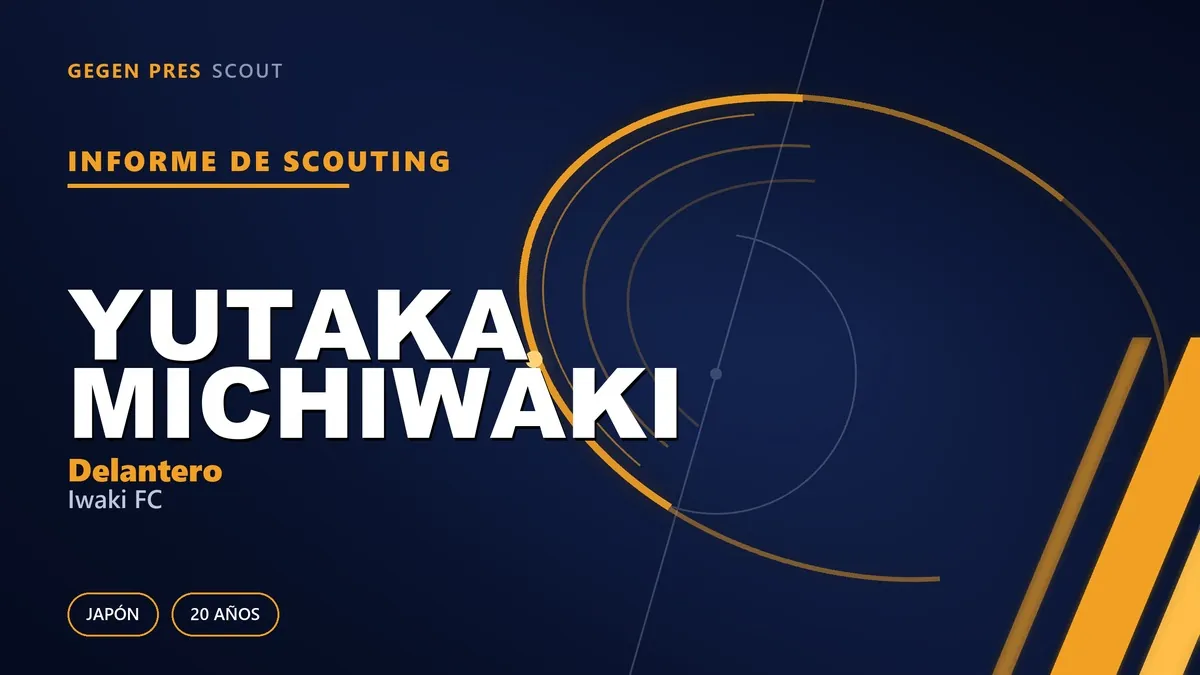

Reading the career curve of a young striker in Japan requires a different kind of patience than it does in Europe. Clubs deliberately feed a player they signed at sixteen slowly until he is twenty-one: a European loan here, a full season in a lower tier there. That does not mean the career has stalled — it is the programme. Yutaka Michiwaki is moving through exactly that programme: the youngest professional contract in Roasso Kumamoto’s history, a season in Belgium at eighteen, a move to the J1 League this January and a development loan in June. This report examines what the 1.90 m, twenty-year-old Japanese striker has accumulated along that route.
| Mevki | Striker |
|---|---|
| Kulüp | Iwaki FC (development loan from Avispa Fukuoka) |
| Uyruk | Japan |
| Yaş | 20 |
| Doğum | 05.04.2006 |
| Boy | 1.90 m |
| Ayak | Left |
| Piyasa Değeri | Unconfirmed |
| Sözleşme | Permanent transfer to Avispa Fukuoka (January 2026); development loan to Iwaki FC (June 2026) |
The framework: he was born on 5 April 2006 in Kumamoto and stands 1.90 m. His academy route runs in a single line: Taiyou SC, then Roasso Kumamoto’s junior youth and youth levels. In December 2022, while still sixteen, he signed a professional contract with Roasso Kumamoto and was recorded as the youngest professional in the club’s history. He made his professional debut on 19 February 2023 against Tochigi SC, coming off the bench. He spent the 2024-25 season on loan at SK Beveren in Belgium, registering four goals in 28 appearances. In January 2026 he joined J1 League side Avispa Fukuoka on a permanent transfer from Roasso Kumamoto and took the number 27 shirt. On 17 June 2026 Avispa Fukuoka announced that the player had been sent to Iwaki FC on a development loan; he wears number 9 at Iwaki. Internationally he was part of the Japan squad that won the 2023 AFC U-17 Asian Cup, scoring the final goal in a 3-0 win over South Korea in the final. On 31 July 2026 he was called into the Japan U-21 squad.
Strengths
- Signing the youngest professional contract in his club’s history at sixteen: early maturity registered institutionally.
- A 1.90 m frame that stands out markedly within the Japanese striker pool.
- Twenty-eight Belgian Pro League appearances at eighteen: the European contact threshold tested early.
- A 2023 AFC U-17 Asian Cup title and a goal in the final.
- No extended injury interruption on record.
Weaknesses
- Goal production lagging behind the résumé: four in 28 at Beveren, one in 13 during the 2026 season.
- Being sent on a development loan six months after moving to the J1 League indicates he has not yet earned a role in the top tier.
- No public broken-down data available for aerial duels or finishing.
- Despite playing in four different contexts, he has not produced a sustained scoring run in any of them.
- No market value record verifiable in public sources.
Development Areas
For a twenty-year-old striker one heading sits ahead of all the others: goals per minute. Every item on Michiwaki’s résumé — early professional status, a European loan, an U-17 title — signals strongly on the potential side; but what turns those signals into a forward’s file is the goal count, and that category has not yet crossed the critical threshold. The first development area is therefore decision speed inside the box: the choice between finishing a chance and taking an extra touch usually settles later in a player of 1.90 m, and full-match minutes at Iwaki FC are the right ground for that category. The second is aerial production: a forward of that height is expected to generate a measurable threat from set pieces and crosses, and the absence of that category from public data suggests this side of his game has not yet settled into the centre of the profile. The third is physical filling out: among tall forwards, the muscle mass gained between twenty and twenty-three is a category that directly changes back-to-goal play.
Contract Situation
The player’s registration passed to Avispa Fukuoka with the permanent transfer in January 2026, ending his relationship with Roasso Kumamoto. On 17 June 2026 Avispa Fukuoka announced on its official site that the player had been sent to Iwaki FC under development loan status. In Japanese football that status keeps the player within the parent club’s development plan for the duration of the loan and generally allows a recall during the season; it carries no intention of a permanent sale. Neither the loan’s end date nor the length of the contract signed with Avispa Fukuoka is clearly stated in public sources, and it should be noted that both items are unconfirmed. The practical meaning of the structure is this: the player’s medium-term career is tied to Avispa Fukuoka’s plan, and there is no open entry point for outside clubs today.
Career Projection
The decisive question over the next twelve months is whether full-match minutes at Iwaki FC convert into goals. If he closes the season in double figures, the likelihood strengthens of returning to the Avispa Fukuoka squad in 2027 as a forward capable of taking a role at J1 level; that would mean a first full J1 season at twenty-one, a standard rung on the curve by which Japanese forwards open onto Europe. If goal production stays at its current level, the file remains in the category of a forward with high physical equipment but unsettled finishing, and a second development loan comes onto the agenda. The U-21 line on the international side is the fixed element preserving his visibility through that process; but permanence in age-group national teams also depends largely on the goal count at club level.
A 1.90 m, twenty-year-old Japanese striker who turned professional at sixteen, played 28 matches in Belgium at eighteen and scored in an U-17 Asian Cup final, but whose club-level goal production still lags behind the résumé.
Closing the season in double figures at Iwaki FC and aerial production turning into measurable data.
This report was prepared by cross-checking the English and Japanese Wikipedia entries, Avispa Fukuoka’s official club announcements, Iwaki FC’s official site, J.League player records and FotMob data. The 2026 season appearance count stands at 13 in club sources while the data platform’s breakdown shows a narrower minutes range; both records are stated in the report. GEGEN SCORE is an editorial assessment score combining technical, tactical, mental, physical, potential and risk components; it is a comparison tool, not a transfer decision on its own. Last updated: 21 September 2026.
Hakan Nural — Gegen Pres Japan and South Korea correspondent. He follows profiles approaching the European threshold in the J.League and K League throughout the season.