


Marino Skelin Scout Report: Hajduk’s Centre-Back After Injury

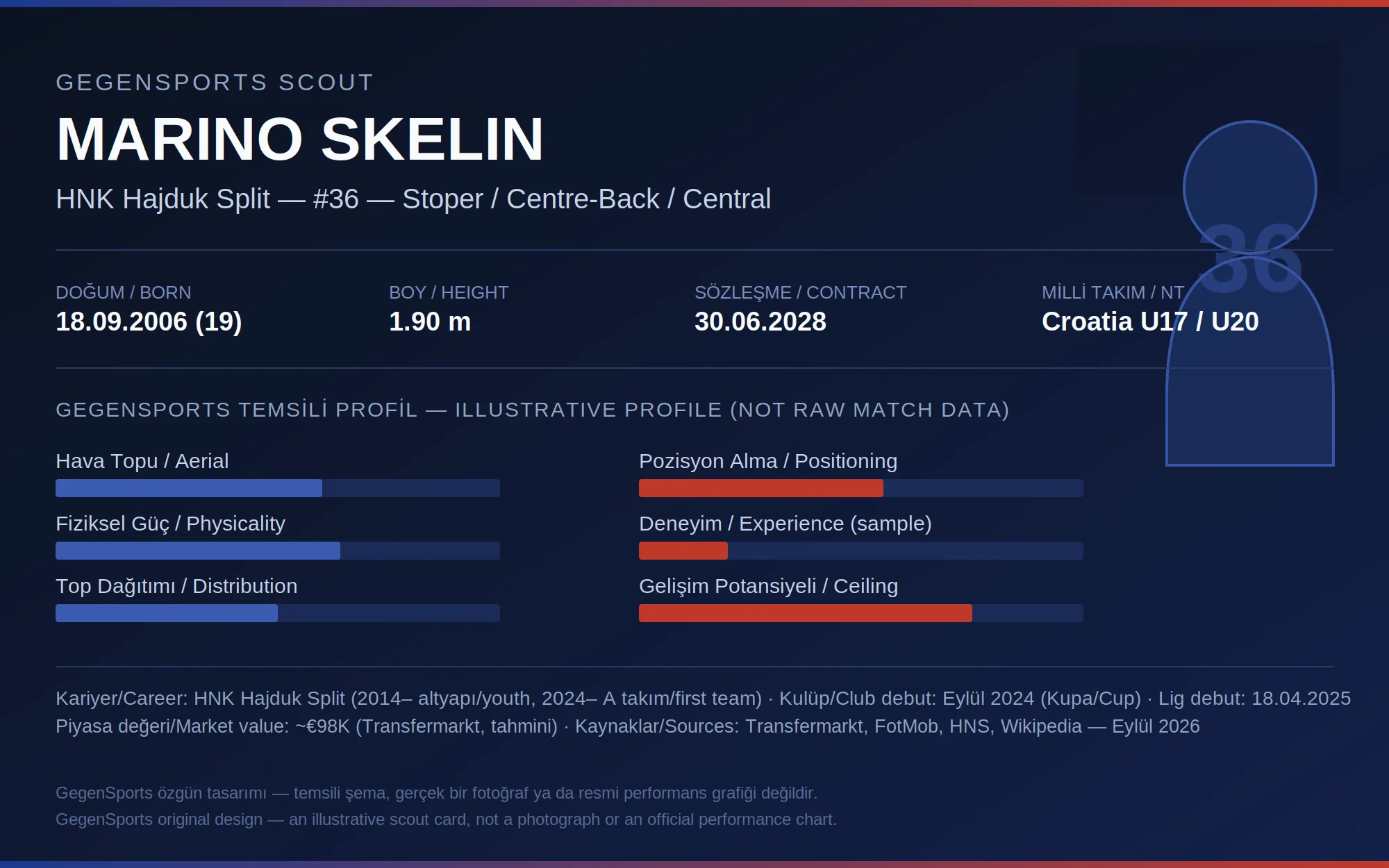

Scout verdict in brief: Marino Skelin is a homegrown, 1.90m, right-footed centre-back who came through Hajduk Split’s own “Luka Kaliterna” academy. He is 19 (born 18 September 2006), wears No.36, and is contracted until the summer of 2028. His first-team career only began in April 2025, and it was then interrupted for roughly six months by a serious knee injury (collateral ligament damage requiring surgery) between July 2025 and January 2026. He has represented Croatia at U17 and U20 level but has not yet been called into the senior squad. Transfermarkt lists his market value at around €98,000. The sample size here is small, and much of it sits either side of a long injury layoff, so any technical verdict has to stay provisional — but the physical profile, the club’s evident trust in him, and his age all describe a development project worth tracking rather than a finished product.
Born in Split, Skelin joined Hajduk’s “Luka Kaliterna” academy at the age of seven and worked his way through every youth category at the club — a pure academy product with no other stops on his CV. His first taste of first-team football came in September 2024, in a 4-0 Croatian Cup win over Bilogora’91, and by February 2025 the club had moved to lock him into his first professional contract, running to June 2028. A league debut followed in April 2025, but the development arc got cut short that summer by a significant knee injury. What follows is a grounded look at where a still very lightly-tested young centre-back actually stands.
Identity Card
| Full Name | Marino Skelin |
| Date of Birth | 18 September 2006 (age 19) |
| Place of Birth | Split, Croatia |
| Height | 1.90 m |
| Preferred Foot | Right |
| Position | Centre-back |
| Current Club | HNK Hajduk Split |
| Shirt Number | 36 |
| Contract Until | 30 June 2028 |
| International | Croatia U17 (15 caps, 1 goal) and U20 (1 cap); no senior call-up yet |
| Market Value | ~€98,000 (Transfermarkt); FotMob’s own ETV model, which uses a different methodology, produces a notably higher figure (roughly €300-340K) — the two are not directly comparable |
| Agent | Not publicly disclosed |
Career and Transfer History
| Period | Club | Note |
|---|---|---|
| 2013-2014 | NK Spinut Split (youth) | First steps |
| 2014-2024 | HNK Hajduk Split (“Luka Kaliterna” academy) | Every youth category at the club |
| September 2024 | Hajduk Split (first team) | Official debut: 4-0 Croatian Cup win over Bilogora’91 |
| 20 February 2025 | Hajduk Split | First professional contract, through June 2028 |
| 18 April 2025 | Hajduk Split | HNL league debut (1-1 vs NK Varaždin, on as extra-time substitute) |
| 18 May 2025 | Hajduk Split | First starting XI appearance (2-1 win over HNK Rijeka) |
| 23 July 2025 | Hajduk Split | European debut, UEFA Conference League, 1-1 vs Zira FK |
| 24 July 2025 – 10 January 2026 | Hajduk Split | Sidelined by a knee injury (see below) |
| 2026-present | Hajduk Split | Gradual return, working back into the squad |
Skelin has never changed clubs — a textbook single-club academy story. No transfer fee has ever been involved, because this is entirely an in-house development case.
Image: GegenSports original design (illustrative scheme). Underlying data compiled from Transfermarkt, FotMob, the Croatian Football Federation (HNS) and Wikipedia as of September 2026. This is not a real performance chart, but an illustrative graphic produced by GegenSports based on the player’s profile.
Season Numbers
Skelin’s first-team sample is both small and irregular, for two compounding reasons: he only debuted in April 2025 at 19 years old, and he then lost roughly six months to injury between July 2025 and January 2026. Across his career to date, his total number of competitive appearances (all competitions included) sits around a dozen. Following his injury return, he worked back into HNL matchday squads late in the 2025-26 campaign, picking up a short run of games — sources put this in the region of four appearances and 289 minutes, though a narrower 180-minute subset has also been reported depending on which matches are counted.
| Season | Club | Apps (approx.) | G/A | Note |
|---|---|---|---|---|
| 2024-25 | Hajduk Split | 3-4 (cup + league) | 0 / 0 | Cup and league debuts, first start |
| 2025-26 | Hajduk Split | ~4-8 (total) | 0 / 0 | European debut, then a 6-month injury, partial return late season |
| 2026-27 (ongoing) | Hajduk Split | Season start | – | Still working toward full squad integration |
Sources: FotMob, Playmakerstats, Soccerway, Wikipedia, official HNS match data (as of September 2026). Small discrepancies between platforms come down to whether cup and pre-season fixtures are counted.
FotMob’s percentile comparison against other centre-backs shows Skelin sitting in low bands for touches, aerial duels won and overall defensive contribution. Taking those numbers at face value as evidence of weakness would be a mistake: the sample is so small — single digits of matches, most of it played immediately after a long layoff — that statistical noise dominates any real signal. A properly healthy full season is needed before those figures mean much.
Style of Play
Skelin’s most obvious physical trait is his 1.90m frame — a solid baseline for a modern centre-back and, in theory, an asset in aerial duels. Being right-footed also makes him a natural fit on the right side of a back three, or as the right-sided centre-back in a back four.
Two qualities scouts look for most in young centre-backs are press resistance (the ability to keep possession and keep the move going under opponent pressure) and the line-breaking pass (a pass from the back line that cuts through a layer of opposition players to advance the ball into midfield). Skelin’s real level in either area cannot be measured reliably from his current match sample. What can be said is that the club’s trust in him — starting him at 18, using him in European competition — points to an acceptable technical floor at academy level, even if a stronger claim would be premature.
Positionally, a centre-back’s discipline in rest defense (the defensive shape and spacing a team holds in the moments it has the ball, guarding against a possible turnover) is a critical marker. Hajduk’s general approach with young defenders — get them onto the pitch early and hand over responsibility in stages — gives Skelin room to learn these positional concepts in live matches, though that should be read as an environmental advantage rather than a proven strength in itself.
Physically, the step up from academy football to HNL senior competition is a real jump for any young player, and in Skelin’s case that transition was further interrupted by a long injury layoff — so his capacity for physical duels remains an area to observe rather than a settled conclusion. Similar uncertainty applies to his use of the half-space (the tactical zone between the wide channel and the centre of the pitch) and his role in build-up play (moving the ball safely from the back line into midfield): these are concepts academy graduates are typically drilled on, but whether he can execute them consistently at first-team level hasn’t yet been tested.
Beyond individual duels, a centre-back’s ability to move as a coordinated unit with his defensive partner matters just as much. In mechanisms like the offside trap (a synchronised step forward by the back line designed to catch opposing attackers out of position), the biggest risk for a young defender is a timing mismatch with a more experienced partner. Skelin’s true level here is again obscured by the small sample, but academy graduates generally arrive with some grounding in these collective concepts — and Hajduk’s academy is built around getting players to a certain tactical baseline before pushing them into senior football, so this shouldn’t be treated as a total unknown.
Strengths
- Physical baseline: a 1.90m frame gives him a strong theoretical starting point for aerial duels and ground coverage.
- Club trust and staged development: starting in the first XI at 18 and then featuring in European competition reflects real confidence from the coaching staff.
- Pure academy product: being at Hajduk since age seven means he absorbed the club’s playing philosophy and standards from an early age.
- On the national-team radar: caps at Croatia U17 and U20 level show he is being evaluated at international level too.
- Long-term contract security: a deal running to 2028 signals the club sees him as a long-term investment, not a quick-sale asset.
Weaknesses
- Very small first-team sample: total competitive appearances sit around a dozen for his entire career, which forces caution on any technical or tactical claim.
- Injury interruption: the roughly six-month knee injury between July 2025 and January 2026 cost him reps and match rhythm at a critical development stage.
- Unproven physical adaptation: the limited data points available so far don’t yet demonstrate full adaptation to HNL physical intensity.
- Still far from the senior national team: only a single U20 cap to date, with no senior-level pressure test yet.
GegenSports Scout Rating
Overall Rating: 58/100
- Technical (ball control, passing): 54/100
- Tactical intelligence (positioning, reading the game): 55/100
- Physical (strength, speed, aerial): 58/100
- Mentality (leadership, discipline, injury recovery): 62/100
- Potential (development trajectory): 74/100
This rating was produced using GegenSports’ own original evaluation methodology and does not reflect any third-party rating system. An overall score of 58/100 describes a category best summarised as “sample still far too small to judge, but worth tracking given age, physical profile and internal club trust.” The potential score (74), notably higher than the other categories, reflects the fact that Skelin is 19 and hasn’t yet been able to show his real level either side of the injury — a modest overall score here signals limited evidence, not a weak player.
Comparable Players
For profile comparison only, without claiming direct equivalence:
- Josip Šutalo (Ajax, Croatia) — a Croatian academy product whose career arc reached the senior national team; a useful theoretical “ceiling” scenario for how Skelin’s path could develop, though his level is currently far ahead.
- Marin Pongračić (Fiorentina, Croatia) — an HNL-raised, physically imposing Croatian centre-back; a useful reference point for the physical duel adaptation Skelin still has to prove.
- Ron Rači (Hajduk Split, Kosovo) — a fellow young centre-back at the same club and in a similar age bracket; the two developing in parallel creates a direct internal competition dynamic that will shape Hajduk’s back-line planning.
Süper Lig Fit
At this stage, Skelin’s profile suits clubs looking for a long-term “develop and evaluate” investment rather than an immediate squad solution. The small sample and the recent injury make a short-term loan or transfer decision genuinely risky; but his age, physical measurements and the trust the club has shown in him describe a profile that could work as academy/B-team depth or squad rotation cover. A top-half TFF First League club, or a Süper Lig side running a patient development programme, offers a more realistic landing spot than an immediate first-choice role.
Suitable Turkish Clubs
- Gaziantep FK: a club with a track record of integrating young defenders into the system in stages.
- Çaykur Rizespor: known for giving young players early responsibility, with mid-table ambitions.
- Kayserispor: a management approach known for budget-friendly, high-upside signings.
- Top-half TFF First League clubs (e.g. Boluspor, Sakaryaspor): for a player who might benefit from a more gradual route into Süper Lig football, these offer a real minutes guarantee.
Ideal Teammates
For a young, lightly-tested centre-back like Skelin, the single most important environmental factor is the experienced partner alongside him. A vocal, positionally reliable senior centre-back — one able to flag positioning errors early — whether at Hajduk or at a future club, could meaningfully accelerate his development curve. A defensive midfielder who offers safe outlets in build-up, and a goalkeeper comfortable stepping off his line to sweep, would also reduce the pressure on Skelin and create a more forgiving environment for confident ball-playing.
Adaptation Score
Adaptation to a new league/club environment: 7/10. Skelin has spent his entire career in a single club and a single city (Split); he has no experience abroad. That raises the “unknown factor” on one hand, but on the other, never having changed clubs or leagues also reflects a disciplined, stable development environment. The long injury he’s just come through amounts to a separate test of physical and mental adaptation capacity in its own right; coming through it successfully offers indirect evidence about his readiness for a future club or league change.
Cost and Value Scenarios
- Low scenario (€150-400K): a loan, or a loan with a purchase option, spreading the risk between Hajduk and a buying club — the most realistic band given the currently tiny sample.
- Mid scenario (€500K-1M): an outright transfer, plausible should Skelin stay healthy and see regular minutes through 2026-27.
- High scenario (€1.5M+): possible only if catalysts like proximity to the senior national team or consistent European-competition performances materialise — speculative at this stage.
On wages, the typical range for a player at Hajduk with this age and experience level isn’t publicly disclosed. In a Süper Lig transfer scenario, a development-oriented contract structure — a modest base salary plus performance-linked clauses — is the more likely approach.
Development Potential
Skelin’s ceiling depends heavily on two factors: staying healthy, and accumulating regular minutes. For a 19-year-old at 1.90m who has come through academy discipline and earned the club’s trust, the theoretical ceiling is high — but reaching it requires a stable, injury-free run and rising responsibility over the next 12-18 months. In the short term, a realistic goal is moving from rotation-squad status to a regular starting role at Hajduk; in the medium term, that could extend to Croatia’s U21 level and, potentially, interest from abroad.
A useful reference point when reading his trajectory is how Hajduk has handled other academy defenders in recent years. The club’s tendency to bring young centre-backs into the first team early and hand over responsibility gradually makes a similar path plausible for Skelin: rotation or backup status in the first seasons, followed by rising minutes as the injury risk is managed. If that plays out, he could be a regular HNL name and a player on foreign clubs’ radar by around age 21-22 (roughly 2027-2028); if it doesn’t, a more modest scenario — a career at a second-tier HNL club, development stalled — shouldn’t be ruled out either.
Injury History and Durability
The single most defining negative event in Skelin’s career so far is the knee injury he suffered in July 2025. It occurred in training ahead of a UEFA Conference League return leg against Zira FK, initially assessed as a minor patellar issue, but subsequent examination revealed damage to the knee’s collateral ligaments, requiring surgery. Head coach Gonzalo García summed up the situation at the time: “Skelin bi u petak trebao na operaciju pa će se vidjeti. Sigurno će biti duže od dva mjeseca” (“Skelin is expected to have surgery on Friday, and we’ll know more after that — it will definitely be longer than two months”). Club statements put the expected recovery in a 4-6 month range; Wikipedia’s compiled data has Skelin returning to the pitch on 10 January 2026, roughly six months later.
Outside of this injury, no other significant injury history for Skelin is documented in public sources. Still, a single long-term knee injury occurring this early in a career is a risk factor worth flagging for anyone tracking his physical development going forward.
Foreign Player Quota and UK Work Permit Analysis
Under Süper Lig’s foreign-player quota rules, Skelin would be classed as a standard “foreign” player; Croatia’s EU membership does not translate into an automatic exemption under Turkey’s quota system.
On the UK side, the picture is clearly unfavourable as things stand. The FA’s Governing Body Endorsement (GBE) points system is built largely on two pillars: senior national-team caps (weighted by the national team’s FIFA ranking band) and club-level league/minutes data (weighted by the league’s own GBE band). Skelin has zero senior Croatia caps to date — only appearances at U17 and U20 level, and GBE scoring does not count youth-level caps. On the club side, his total HNL minutes fall well short of the automatic-approval threshold, both because of the league’s band and his own very limited playing time. In short: a move to England is not practically viable today under GBE rules; that could change meaningfully only if he moves closer to the senior national team and/or builds up a far larger body of HNL minutes.
Suitable Leagues
- Croatian HNL (current league): the most natural environment to regain full health and rebuild regular playing time — top priority in the short term.
- Austrian Bundesliga: a reasonable intermediate step, known for giving young Balkan players regular opportunities.
- TFF First League / Süper Lig (Turkey): suitable for a scenario of staged responsibility at a development-focused club.
- Belgian Pro League: another intermediate option, known for a club culture open to trading in and developing young players.
- Czech / Slovak top divisions: worth considering for a lower-risk strategy focused on regular minutes.
Sporting Director Summary
As of this report, Marino Skelin is best filed under “project to monitor” rather than “ready-made asset.” His physical measurements (1.90m), academy discipline and the trust the club has shown him — an early first-team start, European minutes, a long contract — are all positive signals; but the serious knee injury between July 2025 and January 2026, and the correspondingly tiny first-team sample it has left behind, mean any transfer decision should stay at the “early contact and monitoring” stage for now. Should he stay healthy and see regular minutes through 2026-27, interest both within HNL and abroad should naturally increase. The sensible next step for a sporting director here isn’t a direct bid — it’s a 6-12 month performance-and-health watch.
Frequently Asked Questions
1. Who is Marino Skelin?
A homegrown Hajduk Split product, 19 years old, a 1.90m right-footed Croatian centre-back.
2. What position does he play?
Primarily centre-back; being right-footed also suits him to the right-sided centre-back role in a back three.
3. When does his contract expire?
He is contracted to Hajduk Split until 30 June 2028.
4. What is his current market value?
Around €98,000 per Transfermarkt; this is an estimate and can vary between platforms using different models.
5. When did his first-team career start?
His official debut came in September 2024 in the Croatian Cup; his league debut followed on 18 April 2025.
6. Does he have an injury history?
Yes — a serious knee (collateral ligament) injury in July 2025 required surgery and kept him out for roughly six months, with a return in January 2026.
7. Has he played for Croatia’s national team?
He has caps at U17 (15 appearances, 1 goal) and U20 (1 appearance) level; he has not yet been called up to the senior side.
8. Is he suitable for the Süper Lig?
Given the small sample and recent injury, he fits better as a long-term development/monitoring profile than an immediate squad solution.
9. Which Turkish clubs would suit him?
Clubs open to developing young players such as Gaziantep FK, Çaykur Rizespor and Kayserispor, plus top-half TFF First League sides, are reasonable candidates.
10. Could he play in England?
Not under the current GBE points system — he lacks both senior national-team experience and sufficient club minutes to clear the automatic-approval threshold.
11. Who are his comparable players?
Josip Šutalo, Marin Pongračić, and Hajduk teammate Ron Rači stand out as stylistic and career-path reference points.
12. What is his GegenSports scout rating?
58 out of 100 under GegenSports’ own methodology; the modest overall score reflects the small sample, not a weak player.
13. What is his biggest weakness?
The very small first-team sample accumulated so far, and the correspondingly unproven adaptation to physical duels at HNL level.
14. How is his development potential assessed?
His age, physical profile and club trust point to a high ceiling, but reaching it depends on staying injury-free and getting regular minutes going forward.
Related GegenSports Reports
- Ron Raçi Scout Report — Hajduk Split
- Šimun Hrgović Scout Report — Hajduk Split
- Niko Sigur Scout Report — Hajduk Split
- Marko Livaja Scout Report — Hajduk Split
- Ante Erceg Scout Report — HNK Gorica
References
- HNK Hajduk Split — official club information and news (hajduk.hr)
- Wikipedia (EN) — Marino Skelin biography and career data
- FotMob — player profile, season statistics, percentile data, market value model
- Transfermarkt — market value reference
- Playmakerstats.com, Soccerway — season-by-season statistics
- Croatian Football Federation (HNS) — national team (U17/U20) caps and statistics
- Telegram.hr — injury news and head coach Gonzalo García’s statement
- Net.hr, Index.hr, gol.dnevnik.hr, Dalmacija News — injury timeline and contract news
- The FA (thefa.com) — GBE points system and league banding
[…] Marino Skelin Scout Report — Hajduk Split […]