


Robin Le Normand Scout Report: Inside Atlético Madrid’s Spanish Wall

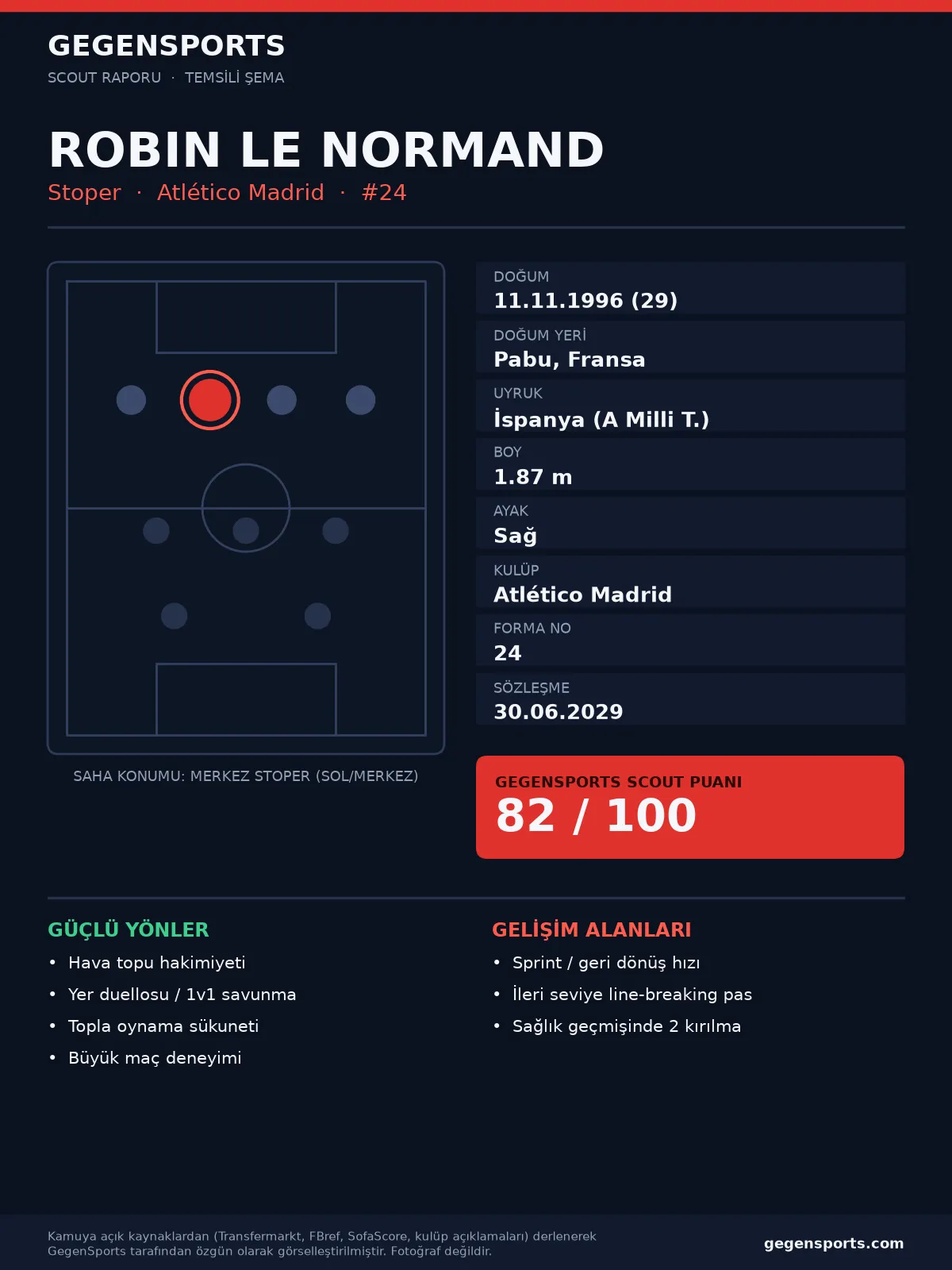

Sources: club statements, Transfermarkt, SofaScore, FBref, FotMob, Football Transfers, ESPN and other reliable outlets. Full bibliography at the end of this report.
Published: 15 September 2026 — GegenSports Scout Desk
The Quick Verdict
A 29-year-old centre-back born in Brittany who now marches out for Spain, Robin Le Normand carries two of the sport’s biggest recent honours on his CV: the 2023 UEFA Nations League and Euro 2024. Six settled seasons at Real Sociedad (2018-2024) built his reputation before Atlético Madrid paid to bring him to the capital in July 2024, and he has since worked his way into the backbone of Diego Simeone’s defence. At 1.87m and naturally right-footed, he looks the part of a traditional stopper, but what actually defines him is a trio of qualities: dominance in the air, efficiency in ground duels, and a composure on the ball that traces straight back to his years in San Sebastián’s possession-based system. That Real Sociedad grounding is precisely why he reads less like a pure destroyer and more like a centre-back capable of starting attacks from deep. The trade-off shows up in his legs rather than his positioning sense: recovery pace against top-tier wingers is the one department where he can be stretched. Two serious health scares — a head injury in October 2024 and a significant knee injury in November 2025 — punctuate an otherwise durable career, and by September 2026 he was back in the XI wearing the number 24 shirt, tied to Atlético through a contract that runs to 30 June 2029 and sitting squarely inside the club’s long-term defensive planning.
1. Profile and Biography
| Detail | Information |
|---|---|
| Full Name | Robin Aimé Robert Le Normand |
| Date of Birth | 11 November 1996 (age 29) |
| Place of Birth | Pabu, Côtes-d’Armor, France |
| Nationality | Born in France; holds Spanish citizenship and represents the Spain senior national team |
| Height | 1.87 m (6’2″) |
| Preferred Foot | Right |
| Position | Centre-back (left or central in a back four; can also play right centre-back in a back three) |
| Current Club | Atlético Madrid |
| Shirt Number | 24 |
| Contract Expiry | 30 June 2029 |
| Agent/Representation | No current, publicly verifiable agency information could be confirmed at the time of writing, so it has been omitted rather than guessed |
| Market Value | Estimates diverge by source: Transfermarkt lists him in the roughly €35-40M range, while Football Transfers’ ETV model places him closer to €27-33M |
2. Career and Transfer History
| Period | Club | Transfer Type / Fee | Confidence Label |
|---|---|---|---|
| 2011-2013 | Stade Brestois 29 (Youth) | Academy product | — |
| 2013-2016 | Stade Brestois 29 B (Reserves, CFA/National 3) | Internal promotion | — |
| 2016 (brief) | Stade Brestois 29 (First team, Ligue 2) | One league appearance, first-team call-up | — |
| 5 July 2016 | Real Sociedad B (Segunda División B) | Free or low-cost move; exact terms never made public | undisclosed |
| 2018 | Real Sociedad (First team) | Promoted from the B side (not a fresh transfer) | — |
| 2018-2024 | Real Sociedad (First team) | 167 La Liga appearances, 4 goals | — |
| 27 July 2024 | Deal between clubs announced | Move to Atlético Madrid reported at roughly €30M plus around €5M in add-ons (Fabrizio Romano, ESPN) | reported |
| July-August 2024 | Formal signing at Atlético Madrid | Transfermarkt records the fee at €34.5M; neither club ever confirmed an official figure | Transfermarkt-listed |
| 2024-present | Atlético Madrid | Five-year deal, running to 30 June 2029 | official (contract length only) |
Note on the fee: Both Atlético Madrid and Real Sociedad confirmed publicly that a transfer had taken place, but at no point did either club release an official fee. That gap is exactly why figures ranging from roughly €30M to €34.5M circulate depending on the outlet — readers should treat every number in this range as a reported or Transfermarkt-sourced estimate, never as a confirmed transfer fee.
3. Season-by-Season Statistics (Last Three Seasons)
| Season | Club | Competitions | Apps | Goals | Assists | Minutes | Tackles | Interceptions | Aerial Duels Won % | Pass Accuracy % |
|---|---|---|---|---|---|---|---|---|---|---|
| 2023-24 | Real Sociedad | La Liga + Champions League (all competitions) | 58 | 3 | Not consistently reported across sources | ~4,700′ (approx.) | Data limited | Data limited | ~65% | ~89-90% |
| 2024-25 | Atlético Madrid | La Liga + Champions League (all competitions) | 27 (24 in La Liga) | 1 | 0 | ~2,100′ (approx.) | 51 (all competitions) | 31 (all competitions) / 11 (La Liga only) | ~66% | ~88% |
| 2025-26 | Atlético Madrid | La Liga | ~14-15 (large chunk of the season missed after the November 2025 knee injury) | 1 | 0 | 1,194 | Data limited | Data limited | 68.9% | ~87% |
A note on the data: providers such as FBref, Sofascore, FotMob and WhoScored do not always agree on all-competitions versus league-only splits, or on exact minute counts. The figures above reflect the most consistent readings across sources; anything not fully settled is marked “approx.” As of the start of the 2026-27 campaign (September 2026), Le Normand had reclaimed a regular starting spot in Atlético’s XI.
4. Tactical Style — Explained for an International Audience
Placing Le Normand within modern centre-back typology requires unpacking a handful of tactical terms that non-Spanish readers may not use every day:
- Ball-playing centre-back: a defender who does not merely stop attacks but is trusted to keep the ball and initiate his team’s build-up from the first phase of possession. Le Normand filled this role inside Imanol Alguacil’s pass-oriented Real Sociedad and has carried the same instinct into his Atlético game.
- Press resistance: the ability to retain the ball and choose the right pass even while an opponent is closing him down. Le Normand rates above average here — he generally stays composed against high-pressing sides — though he does not offer the same standout edge as the league’s very best ball-playing centre-backs, such as Rodri or Aymeric Laporte.
- Line-breaking pass: a pass threaded behind or between opposition lines that eliminates one or more defenders in a single action. Le Normand’s output in this category sits at limited-to-moderate; he leans toward safe, short-to-medium passing to move the ball forward rather than routinely attempting the riskier vertical ball that “breaks” a defensive line.
- 1v1 defending: duelling an attacker alone, with no covering teammate. This is genuinely strong territory for him — body positioning, timing of the challenge and raw physical strength let him win the large majority of his individual ground duels.
- Third-man movement: rather than receiving the ball directly, positioning as the third option in a passing sequence between two teammates to advance play a stage further. Le Normand contributes to this pattern occasionally during Atlético’s build-up, but it is not a dominant trait of his game; he functions more often as a direct receiver-and-distributor.
- Off-the-ball zonal awareness: reading dangerous spaces and adjusting position before the ball arrives. Several advanced data providers rank his “sense of space” metrics below league average, which reflects a tendency to step out early and occasionally leave space behind him.
Taken as a whole, Le Normand offers a hybrid profile: a defender schooled in Spain’s pass-first defensive culture but carrying a physical and duel-winning dimension well above what that description usually implies. At Real Sociedad he was regularly the one stepping out of the back line with the ball, at times pushing into midfield. At Atlético, Simeone’s more compact, lower-risk, “safety-first” structure has him initiating less often and prioritising duel-winning and covering the space behind the line instead. When deployed as the right-sided centre-back in a back three, the gaps left by an advancing wing-back put his relatively modest recovery speed under greater strain than in a back four.
5. Strengths
- Aerial command. His 1.87m frame, timing of his jump and reading of the flight of the ball give him an edge in both boxes. His aerial win rate has sat consistently, and clearly, above league average across every data provider throughout his career, making him a genuine weapon at set pieces on both ends of the pitch — including as a source of goals himself.
- Efficiency in ground duels and 1v1 defending. Pairing physical strength with well-timed challenges, Le Normand is rarely beaten cleanly in direct contests with centre-forwards — an especially valuable trait against target-man strikers.
- Composure in possession and build-up value. His Real Sociedad grounding taught him to find the simple, correct pass even under pressure rather than panicking. His pass completion rate has stayed reliably high throughout his career, making him a centre-back who starts moves as much as he stops them.
- Big-match pedigree and mental resilience. Titles at the 2023 Nations League and Euro 2024, El Clásico and Madrid derby experience in La Liga, and regular Champions League football have all tested him under pressure. The consistency of his form on returning from the severe November 2025 injury is itself a marker of that same resilience.
- Tactical versatility. Comfortable in a traditional back four as well as the back three Atlético occasionally deploys (in the right centre-back slot), which gives his coaching staff genuine structural flexibility.
6. Weaknesses
- Sprint speed and recovery distance. The most frequently flagged physical limitation: against quick wingers or forwards making runs in behind, particularly when isolated, his recovery pace is limited. That makes him more exposed against opponents who thrive on fast transitions and increases his reliance on a quicker, covering centre-back partner.
- Limited output in advanced ball progression. Reliable rather than incisive on the ball, he does not match the very top ball-playing centre-backs — Aymeric Laporte being the frequent reference point — for line-breaking creativity. His contribution stays largely within safe, low-risk passing patterns.
- Two serious entries on his medical record. An October 2024 head injury (a collision diagnosed as a subdural hematoma) and a high-grade November 2025 knee injury (posterior capsule and semimembranosus muscle damage) have not developed into a chronic pattern, but for a defender now in his late twenties they represent a history that clubs will want to monitor closely through physical management and rotation.
- Space-reading and early-stepping risk. Some advanced positional/space-awareness metrics place him below league average, suggesting a tendency to step out prematurely and leave dangerous gaps behind him — a trait that compounds his lack of top-end pace.
7. GegenSports Scout Score: 82/100
The GegenSports Scout Score measures a player’s current level — not his ceiling or long-term potential — across several weighted dimensions. For Le Normand: aerial and physical duel capacity scores an outstanding 90/100; 1v1 defensive efficiency comes in at 85/100; ball-playing and build-up contribution lands at a solid-but-not-elite 78/100; and mobility/recovery speed is the profile’s clear weak link at 66/100. Big-match and tournament experience, plus leadership, pulls the overall figure up with an 88/100 rating, while the two serious health incidents inside the last 18 months are reflected as a modest risk deduction of roughly 3-4 points. The resulting 82/100 places Le Normand as a dependable upper-mid-tier centre-back — a regular starter at a major European club, trustworthy in defence, a genuine contributor in possession, but a step short of the very elite tier.
8. Similar Players
- Pau Torres (Aston Villa / Spain national team): A fellow Spain international who differs by being left-footed and slightly more willing to attempt line-breaking passes, but both share the same underlying profile — a calm, aerially dominant centre-back forged in La Liga’s pass-based culture.
- Antonio Rüdiger (Real Madrid): A strong parallel in physicality, aerial dominance and big-match experience; Rüdiger brings a touch more aggression, but both exemplify the duel-winning, experienced, right-footed centre-back archetype.
- Milan Škriniar (Fenerbahçe): Arguably the closest overall comparison — high duel efficiency, strong in the air, with comparably modest sprint speed. His experience in the Süper Lig also makes the comparison directly relevant to this report’s Turkish-football angle.
9. Süper Lig Fit
The Süper Lig, by broad reputation, is a competition built around more individual duels, more frequent long-ball play and a higher volume of transition moments than most of Europe’s traditionally dominant leagues. Against that backdrop, Le Normand’s aerial dominance and ground-duel efficiency translate almost directly. His physical profile should hold up well against the diagonal long balls and target-forward battles that are a staple of Süper Lig matchdays, particularly against the league’s bigger clubs. The flip side is that fast wingers and in-behind runners — a fixture of the Süper Lig’s top sides’ attacking play — would test his limited recovery pace, meaning he would benefit heavily from a quicker centre-back partner or a defensive midfielder who reads and covers space well. His ball-playing quality would also carry real added value for any Süper Lig side building attacks through the back, since the pool of centre-backs who combine defensive solidity with genuine passing range is smaller in Turkey than in the game’s traditional footballing powerhouses.
10. Suitable Turkish Clubs
- Galatasaray: Under Okan Buruk, the side prioritises building play from the back; Le Normand’s composure on the ball and short-to-medium passing accuracy would slot directly into that structure. The club’s regular Champions League football also gives him a stage that matches his big-match experience.
- Fenerbahçe: Given the club’s recent need to refresh its central-defensive options and its European ambitions, Le Normand’s leadership and duel-winning capacity would add both physicality and experience. A partnership alongside Škriniar would form a centre-back pairing that would be a genuinely difficult aerial proposition for any league opponent.
- Trabzonspor: The club’s game model leans heavily on crosses and set-piece organisation, a setting that plays directly to Le Normand’s aerial strength; the squad’s need for an experienced, vocal leader at the back also matches his profile well.
11. Ideal Teammates
The teammate profile that would maximise Le Normand’s output breaks down into four points: (1) his centre-back partner is best served by being quicker and more comfortable scanning space, to offset his relatively limited recovery pace; (2) the holding midfielder shielding him should be disciplined enough to mop up second balls from long clearances and cover his back when he steps forward; (3) a strong relationship with a ball-playing goalkeeper allows him to make the most of his ability to launch attacks from deep; (4) full-backs or wing-backs who recover quickly after pushing forward reduce the risk of him being caught isolated on the last line.
12. Adaptation Score: 79/100
Le Normand’s projected adaptation score for a Süper Lig move is 79/100. On the positive side, more than eight years spent in La Liga have given him tactical maturity, and Madrid’s climate is not far removed from what he would encounter in Turkey. Not speaking Turkish would be an initial hurdle, but most Süper Lig clubs already run established foreign-player integration structures — English- or Spanish-speaking staff and interpreter support — that tend to shorten that adjustment period considerably. Stylistically, his game should translate well to the league’s physical, duel-heavy demands; the transition would likely take somewhat longer in the fastest, highest-tempo matches, where his lack of top-end pace would be tested most directly.
13. Cost / Value Scenarios
The figures below are entirely hypothetical modelling exercises, not the terms of any real negotiation. Given his contract through 2029 and his current standing as a key piece at Atlético, a Süper Lig move at this stage of his career (age 29) looks unrealistic — but a forward-looking “late-career” scenario allows for a meaningful cost/value read. Scenario 1 (age 30-31, still performing at a level close to his current Atlético output): a transfer fee in the €18-25M range and net annual wages of roughly €3.5-5M would be plausible; here the cost/value equation reads as “high outlay, high return.” Scenario 2 (age 32-33, in what would likely be his final European contract): the fee could fall to roughly €5-10M with net annual wages around €2-3M; at that stage his experience and leadership would likely offset much of the physical decline, keeping the cost/value balance reasonable.
14. Development Potential
At 29, Le Normand has reached, or come very close to, his technical and physical peak, so no dramatic leap in ability should be expected. That said, there is still room to sharpen specific tools: widening his ball-progression repertoire, adding more variety to his long passing, and tightening up the small positional-discipline lapses tied to his early-stepping tendency could all help him sustain his level well into his mid-thirties. Once physical decline sets in more visibly, his experience and reading of the game make a shift toward a more “organiser” role — less running, more positioning and directing teammates — a realistic path to extending his career.
15. Injury and Durability History
Overall, Le Normand’s career has been marked by high availability — 167 La Liga appearances across six seasons at Real Sociedad is concrete evidence of that. Two notable health incidents, however, stand out from the last two seasons. In October 2024, a collision with Aurélien Tchouaméni during the Atlético Madrid-Real Madrid derby led to a diagnosis of a subdural hematoma (bleeding between the skull and the brain); he returned to action after a layoff of several weeks. In November 2025, a collision during a Champions League match against Union Saint-Gilloise caused a high-grade injury to the posterior capsule and semimembranosus muscle of his knee; while ligament and meniscus structures came through intact, he still missed roughly two months of action and sat out Spain’s November 2025 World Cup qualifiers as a result. Outside these two episodes, public sources show no chronic or recurring injury pattern — no history, for example, of repeated muscle/tendon problems or major surgery — so the fair summary is “two serious but isolated incidents against a backdrop of generally strong availability.”
16. Foreign Player Quota and Work-Permit Analysis (England Focus)
Süper Lig context: under the Turkish Football Federation’s “10+4” rule for the 2026-27 season, clubs may register up to 14 foreign players on their first-team list. Ten of those slots carry no age restriction, while the remaining four are reserved for players born on or after 1 January 2003. Since Le Normand was born in 1996, any move to a Süper Lig club would place him within the unrestricted 10-player foreign quota — meaning age poses no registration obstacle, though the club would still need to manage its overall foreign-player balance.
Hypothetical Premier League scenario: as a Spanish passport holder, Le Normand cannot claim any post-Brexit EU/EEA exemption and would go through the same Governing Body Endorsement (GBE) process as any other non-domestic signing. However, Spain’s high FIFA ranking pushes the threshold for automatic qualification (“Auto Pass”) down considerably — the critical percentage for top-ranked nations sits at roughly 30% of a player’s eligible squad minutes/caps. Given his role in Spain’s 2023 Nations League and Euro 2024 triumphs and his roughly 27 senior caps, Le Normand would be an extremely low risk to fail a GBE/work-permit check in a Premier League move. This section is entirely hypothetical modelling for illustrative purposes — nothing indicates Le Normand is currently the subject of any Premier League transfer talks.
17. Suitable Leagues
- La Liga (current league): the league he already plays in and is fully adapted to; its pass-based footballing culture and technical-tactical demands map directly onto his strengths.
- Premier League: his physicality and aerial dominance would suit the league’s duel-heavy nature, though its high-tempo transition play would test his limited sprint speed more frequently.
- Serie A: a league built around tactical discipline and positional defending, where his 1v1 efficiency and experience would be a genuine asset.
- Bundesliga: most clubs’ high-line, press-oriented approach would let his passing quality shine, but the demand for quick recovery against high pressing introduces real risk.
- Süper Lig: the central scenario of this report; as detailed above, a profile that could contribute heavily to the league’s physical, duel-oriented demands, while needing support in pace-dependent transition moments.
18. Sporting Director’s Summary
“As things stand, Robin Le Normand is a centre-back who plays regularly for a top European club, has won trophies with his national team, and can be trusted both defensively and on the ball. What keeps him out of the ‘star’ bracket is a lack of elite ball-progression creativity and top-end sprint speed — but that doesn’t make him a lesser asset. Put him in a well-built system, surrounded by the right partners, and he becomes an extremely efficient ‘system player.’ As a sporting director looking at this profile, the question I’d ask is: has my back line already solved its pace problem, or would a signing like Le Normand make that problem worse? If the answer is ‘yes, we’ve already solved our pace issue,’ this signing brings a genuine jump in quality — in the air, in experience, and in leadership.”
19. Frequently Asked Questions
1. Who is Robin Le Normand?
A professional centre-back born in France who became a Spanish citizen, plays for the Spain senior national team, and wears the number 24 shirt at Atlético Madrid.
2. Why does Robin Le Normand play for Spain instead of France?
He spent the bulk of his formative and professional career in Spain — through Real Sociedad’s academy and first team — obtained Spanish citizenship, and was subsequently called up by the Spanish Football Federation to the senior national team. He has never played for the France senior team.
3. When did Robin Le Normand move to Atlético Madrid, and for how much?
The clubs announced their agreement on 27 July 2024, with the transfer completed in July-August 2024. No official fee was ever confirmed; reported figures put it at roughly €30M plus bonuses, while Transfermarkt lists €34.5M.
4. What shirt number does Robin Le Normand wear at Atlético Madrid?
Number 24.
5. When does Robin Le Normand’s contract expire?
His deal with Atlético Madrid runs until 30 June 2029.
6. How many caps does Robin Le Normand have for Spain, and what has he won?
Roughly 27 senior caps, with titles at the 2023 UEFA Nations League and Euro 2024. At club level, he also won the 2019-20 Copa del Rey with Real Sociedad.
7. How would you summarise Robin Le Normand’s playing style?
A ball-playing centre-back who is strong in the air and in ground duels, and composed in possession, but limited in top-end sprint speed and in producing advanced line-breaking passes.
8. What is Robin Le Normand’s biggest weakness?
The most commonly cited flaw is his relatively limited recovery/sprint speed against fast opponents.
9. Has Robin Le Normand had a serious injury history?
He has had two notable health incidents — a head injury in October 2024 and a knee injury in November 2025 — but no chronic or recurring injury pattern; his overall availability record is strong.
10. Would Robin Le Normand suit the Süper Lig?
His aerial dominance and physical duel-winning ability should translate well to the league’s style, though his lack of pace means he would benefit from a quicker centre-back partner. Clubs such as Galatasaray, Fenerbahçe and Trabzonspor — each needing both physicality and build-up quality — present logical fits.
11. What is Robin Le Normand’s market value?
Estimates vary by source, but current assessments generally fall between roughly €27M and €40M.
12. Which players is Robin Le Normand most often compared to?
Pau Torres, Antonio Rüdiger and Milan Škriniar are the names most frequently cited as comparable profiles, each for different reasons.
20. Related GegenSports Internal Links
- Pau Torres Scout Report: Spain’s Left-Footed Centre-Back → /pau-torres-scout-report/
- Antonio Rüdiger Scout Report → /antonio-rudiger-scout-report/
- Milan Škriniar and His Süper Lig Experience: Life at Fenerbahçe → /milan-skriniar-scout-report/
- Julián Álvarez Scout Report: Atlético Madrid’s Attacking Spark → /julian-alvarez-scout-report/
- Spain’s Euro 2024 Squad: The Standout Names → /spain-euro-2024-squad-analysis/
- Galatasaray’s Defensive Needs: What Kind of Centre-Back Should They Target? → /galatasaray-centre-back-transfer-analysis/
21. Bibliography
- Robin Le Normand – Wikipedia
- Atlético Madrid near €30m deal for Robin Le Normand – ESPN
- Welcome, Le Normand! – Atlético Madrid Official Website
- Agreement with Real Sociedad for the transfer of Robin Le Normand – Atlético Madrid
- Robin Le Normand – Transfer News, History, Market Value – Football Transfers
- Robin Le Normand Transfer from Real Sociedad to Atlético Madrid – TransferFeed
- Robin Le Normand – stats, career and market value – FotMob
- Robin Le Normand stats and ratings – Sofascore
- Robin Le Normand Salary Profile – Capology
- Robin Le Normand Stats – FBref
- Robin Le Normand: Analyzing Atlético Madrid’s New Defender – Breaking The Lines
- Atlético Madrid’s Robin Le Normand diagnosed with brain injury – CNN
- Robin Le Normand steps up Atletico Madrid return after bizarre injury – football-espana.net
- Atletico Madrid lose key defender for the year due to knee injury – football-espana.net
- Atletico Madrid defender Robin Le Normand sidelined with high-grade knee injury – Yahoo Sports
- Robin Le Normand :: 2023/2024 – Real Sociedad – Player Profile & Stats – Playmakerstats
- Robin Le Normand Stats With Real Sociedad – StatMuse
- TFF 2025-2026 Süper Lig Player Eligibility Regulation (PDF)
- POINTS BASED SYSTEM 2025/2026 SEASON – The FA GBE Criteria
- GBE rules explained: work permits in English football – Liam Henshaw
[…] Robin Le Normand Scout Report: Inside Atlético Madrid’s Spanish Wall […]