
Dominik Celija Scout Report: What Role Is Istra 1961’s Young Winger Settling Into?



Quick scout answer: Dominik Celija is NK Istra 1961’s 20-year-old academy-grown right winger. Born 14 June 2006 in Pula, he came through the club’s youth pyramid after arriving from local side NK Veli Vrh in 2020/21, and signed his first professional contract in July 2025, running to 2028. His first-team footprint remains small — 2 HNL appearances in 2024/25, 6 in 2025/26, 2 so far in 2026/27 — with development loan spells at second-tier Uljanik Pula in between. In pre-season 2026, new head coach Javier Cabello tried him at left wing-back inside a 3-4-2-1, a role Celija himself did not ask for: “My favourite position is the right wing, but what matters is playing,” he told Glas Istre. This file is not a breakout profile; it is an honest, data-limited monitoring dossier on a squad-building project.
Identity and biography
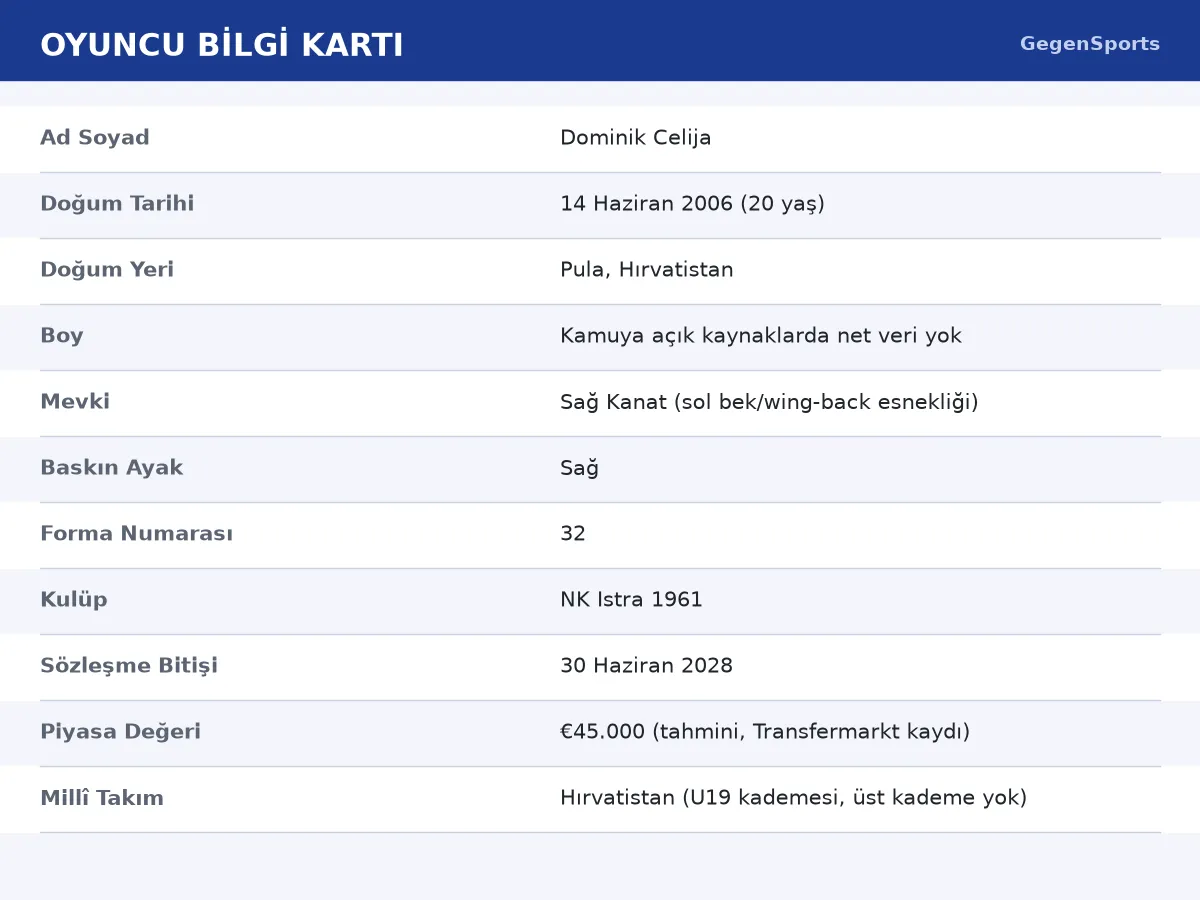
| Full name | Dominik Celija |
| Born | 14 June 2006, Pula, Croatia (age 20) |
| Height | Not published in any major public database (Transfermarkt, Soccerway, Flashscore, club site); this report does not invent a figure. |
| Preferred foot | Right |
| Position | Right winger (primary); trialled at left wing-back in July 2026 pre-season |
| Shirt number | 32 |
| Club | NK Istra 1961 (SuperSport HNL) |
| Contract | Until 30 June 2028 |
| Market value | ~€45,000-46,000 (Transfermarkt-style estimate — no fee has ever been officially disclosed) |
| National team | Croatia U19; no senior or U21 call-up to date |
Club context: why Istra keeps producing this profile
Istra 1961, based in Pula and playing out of the Aldo Drosina Stadium, has spent recent seasons camped in the upper-mid table of the HNL without ever committing to marquee spending. Instead, the club leans on converting academy graduates into first-team assets before selling — a pattern this report series has already documented through midfielder Antonio Maurić. Celija fits the template exactly: recruited from local side Veli Vrh, cycled through every youth age group, farmed out on short development loans when senior minutes weren’t available, and eventually locked into a multi-year deal once the club decided he was worth the paperwork.
Head coach Javier Cabello’s own background reinforces that reading. The Spaniard arrived at Istra after stints at Cieza, Castellón and Cultural Leonesa, plus a spell as Villarreal’s academy coordinator, a period as Elche’s technical director, and time on Deportivo Alavés’ coaching staff — a CV built almost entirely around player development rather than results-first management. Cabello succeeded Krešimir Režić, who himself had only taken the final six rounds of 2025/26 after Oriol Riera’s exit; Celija is therefore entering 2026/27 under his third different head coach inside a year, which naturally slows down role clarity for any fringe squad player.
Career and transfer history
Celija joined Istra’s academy in 2020/21 after leaving NK Veli Vrh and worked through every age category before becoming a regular for the club’s B team. On 23 July 2025 he signed his first professional contract, tying him to the club through 2028 — part of a deliberate policy of prioritising academy integration over external recruitment. His path hasn’t been linear: after 2 HNL appearances in 2024/25 he was sent on a short loan to second-tier Uljanik Pula, where he made 1 appearance and scored 1 goal, then returned for another loan spell there in 2025/26 (3 appearances) while also logging HNL minutes for Istra in the same window (sources vary on the exact split — BeSoccer records 2 HNL appearances, Flashscore and Soccerway show a wider window totalling around 6; this report cites the broader range and flags the discrepancy rather than picking one figure silently). He entered 2026/27 fully integrated into the first-team group and made his left wing-back debut in a 2-2 pre-season friendly against Romania’s Arad in July 2026.
| Season | Club | League | Transfer / note |
|---|---|---|---|
| 2020/21 – 2023/24 | NK Istra 1961 (academy) | Youth levels | Free academy move from Veli Vrh — no fee disclosed |
| 2024/25 | NK Istra 1961 | HNL | First-team debut, 2 appearances |
| 2024/25 | Uljanik Pula (loan) | Druga NL | Short development loan, 1 app, 1 goal |
| 23 Jul 2025 | NK Istra 1961 | — | First professional contract signed (to 2028) — officially disclosed, no fee |
| 2025/26 | Uljanik Pula (loan) | Druga NL | 3 appearances |
| 2025/26 – 2026/27 | NK Istra 1961 | HNL | Full first-team integration, roughly 6-8 league appearances in total |
Season statistics
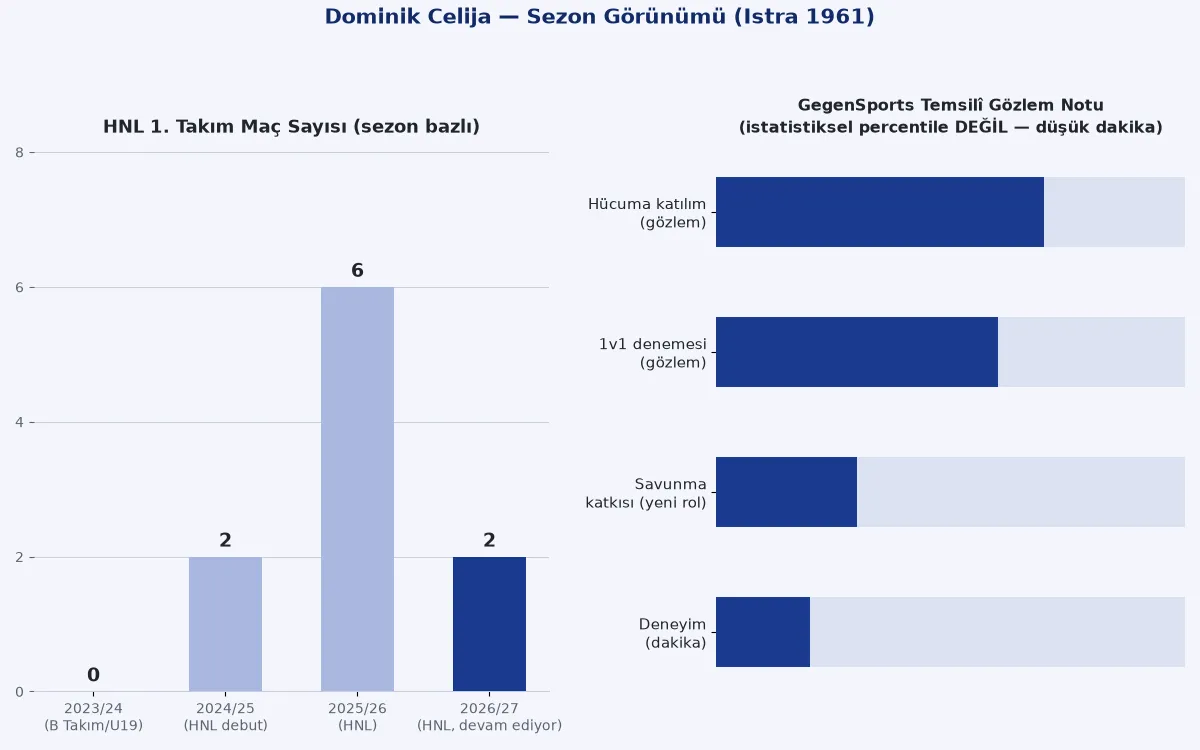
The sample is too small for a conventional stats table, so an honest framing matters more than false precision. Through 22 September 2026, Celija has made 2 HNL appearances in 2026/27, with no goals or assists. Across the wider 2025/26 window (Istra plus Uljanik combined) there is a 2-goal record on file, though sources don’t agree on which competition they came in — this is flagged as raw data, not a rate stat. Standard advanced winger metrics (xG, xA, successful take-ons, progressive passes) simply don’t exist in any reliable form for a player whose total HNL career minutes are estimated in the 150-250 range; no major provider (FBref, Sofascore, WhoScored) carries a usable sample. This report therefore makes no statistical performance claim and instead offers a contextual, observation-based read.
Playing style analysis
Celija’s core identity is a conventional right winger: a right-footed profile built to stretch the touchline and cut inside onto his stronger foot to shoot or thread a final pass. Cabello’s decision to try him at left wing-back in a 3-4-2-1 during July 2026 pre-season — in a role Celija himself called not his “favourite position” — suggests the coaching staff are actively testing whether he can double as a wing/full-back hybrid. That’s a common development pathway for young, one-footed wide players: it teaches defensive shape early and creates squad flexibility in a league where back-three systems are increasingly common. Cabello’s own verdict after the trial, relayed by Glas Istre, was that Celija looked “strong going forward, still developing defensively” — a specific, sourced observation rather than a generic label.
Two development tracks are realistic from here: staying a touchline-hugging winger built around a diagonal shooting threat, or evolving into a more box-to-box wing-back who adds defensive recovery distance. Half-space occupation — the corridor between the touchline and the central channel that modern wingers use to combine centrally — hasn’t shown up clearly in the tiny sample available; it may simply not yet be part of his game, or may be undetectable at this volume of minutes. The same data ceiling applies to press resistance (the ability to retain possession and make a clean decision under an opponent’s pressure): 6-8 HNL appearances isn’t enough to build a credible profile for any outfield player at that level.
In broader tactical terms, the winger-to-wing-back conversion carries a real trade-off. The upside is a player who learns a full-pitch route early, picks up defensive discipline sooner than most attackers, and becomes a flexible squad option as back-three and back-five systems spread through the sport. The downside is technical dilution — Celija risks becoming neither a specialist winger nor a specialist full-back if the trial doesn’t settle quickly. Cabello’s 3-4-2-1 pushes both wing-backs high and looks for central overloads, which at least partially aligns with Celija’s attack-first instincts rather than working against them.
Strengths
- Fee-free academy identity: a player the club developed rather than bought, which keeps squad-building risk and cost low and preserves resale margin.
- Role-flexibility signal: being trialled at two positions at 20 shows the coaching staff see more than one tactical use for him — a real factor in whether fringe young players stick around.
- Long-term security: a contract to 2028 signals the club is treating him as a multi-year project, not a short-term look.
- Early professional exposure: match minutes in both the HNL and the second tier at 18-19 mean his physical and mental adaptation process started relatively early.
Weaknesses
- Extremely small sample: an estimated 150-250 HNL career minutes is not enough to support any technical or physical claim statistically.
- Documented defensive gap: Cabello’s own comment confirms the defensive side of the wing-back trial is “still developing” — a sourced weakness, not speculation.
- Squad competition: established imports like Emil Frederiksen occupying Istra’s wide areas narrow Celija’s path to regular minutes.
- No physical data transparency: the absence of published height and weight on any major platform is an indirect sign he hasn’t yet been fully absorbed into professional scouting infrastructure.
GegenSports scout score: 42/100
Rationale: this is not a “future star” rating — it’s a confidence band built on the available evidence. Celija’s academy pedigree, contract security and the multi-position trial are genuine positives; the near-total absence of verifiable professional performance data keeps the number in the low-middle band. In GegenSports’ methodology, 40-50 represents “worth tracking, not yet gradable” — it doesn’t mean the player lacks talent, only that current data can’t responsibly support a firmer upper or lower bound.
Similar players
- Filip Taraba (Istra 1961): another academy product from the same club navigating limited minutes in a defence/wide role — a direct in-house comparison.
- Toni Brajković (Istra 1961): a fellow young domestic forward at Istra facing a similar development stage and the same minutes constraint.
- Generic profile category — “second-tier Croatian academy winger”: HNL’s small-to-mid budget clubs (Gorica, Varaždin, Šibenik) each sign several similarly-profiled young wingers per season; most either find a permanent squad role between 21-23 or continue their careers on loan in the second tier. Celija currently sits as a typical member of that wider pool.
Süper Lig fit
A direct move to Türkiye’s Süper Lig isn’t realistic at this stage — neither the minutes volume nor the verified performance data give a top-flight Turkish club a defensible risk profile to work with. Over the medium term, two paths make more sense: clubs running structured B-team or youth pathways within the Süper Lig treating this kind of cheap, long-contracted, academy-identity profile as a low-risk scouting bet; or a loan spell in the TFF First League as a more realistic stepping stone toward the top flight later. Suitable Turkish clubs: sides such as Rizespor, Gaziantep FK or Kasımpaşa, which have historically recruited low-cost, development-stage wide players from the Balkan market — this reflects a club-profile fit, not a concrete transfer prediction.
Ideal teammates and adaptation score
The ideal teammate profile for Celija’s development is an experienced winger or attacking midfielder playing ahead of him who provides both a technical reference point and competitive pressure. At Istra, that role is partly filled by Emil Frederiksen, whose centrality to the attack gives Celija a direct benchmark and minutes rivalry. On the defensive side, regular training alongside a young right-back/wing-back such as Rene Hrvatin could accelerate the wing-back experiment. Adaptation score (out of 100): 55 — with minutes volume and physical data both limited, it’s premature to assess an overseas move; this score reflects internal adaptation to Istra’s own squad hierarchy, i.e. how quickly his role settles in-house.
Cost and value scenarios
The estimated market value (Transfermarkt-style, unofficial) sits around €45,000-46,000 — extremely low even by HNL standards, and a clear sign he isn’t yet a “transferable” profile in any conventional sense. Three scenarios: (1) Low-risk, low-cost loan: in the €0-50,000 range, a loan or free-style move to a second-tier club (including Türkiye’s TFF First League) is the most sensible route to banking minutes. (2) Medium-term development transfer: around 2027-2028, if he becomes a regular HNL performer, a €200,000-500,000 fee could become realistic — this is purely a forward projection contingent on future form. (3) A transfer today: no serious club could currently justify investing in this profile on cost/performance grounds; the data gap is itself a risk factor.
Development potential and injury/continuity record
Development-potential assessment has to stay largely provisional given how thin the underlying data set is. The positive signal is structural: the club committing to him through 2028 and actively testing him in multiple roles both indicate the internal scouting staff see upside. On the injury front, there is no documented history of a serious injury or extended absence in any public source (club statements, Glas Istre, Croatian federation records) — a positive continuity signal, though one that shouldn’t be over-read given how little match time there is to draw from.
Foreign player / UK work permit analysis
Celija’s current profile — no senior national-team involvement, minimal league minutes, low market value — falls well short of what the English FA’s Governing Body Endorsement (GBE) points framework requires; GBE scoring leans heavily on national-team level, league strength and club performance (continental competition, league position), and Celija currently carries meaningful weight in none of those categories. The picture in Türkiye is similar: Süper Lig clubs operate under a capped foreign-player quota and typically reserve those valuable slots for more proven profiles, so a realistic path into that quota doesn’t exist for him at this stage.
Suitable leagues
- Croatian second tier (Druga NL): a level he already knows through loan spells — the most natural next step for banking minutes.
- Slovenian PrvaLiga: geographic proximity and HNL-comparable competitiveness could offer a realistic route to regular football.
- Bosnian Premijer Liga: a common regional loan route that represents a reasonable development step.
- Turkish TFF First League: a low-cost, low-risk scouting opportunity for clubs prioritising long-term development.
- Austrian 2. Liga: physical and tactical standards close to the HNL, in a development-league environment.
League context: SuperSport HNL 2026/27
Croatia’s strong FIFA ranking (inside the top 15 as of July 2026) directly shapes the HNL’s European quota — the champion goes into Champions League qualifying, with second and third place also earning continental football. Istra 1961 opened 2026/27 with results like a 2-2 draw away at Hajduk Split and a 2-3 home defeat to Lokomotiva Zagreb, a pattern that suggests a competitive but inconsistent side against the league’s upper tier. In that kind of environment, low-cost, multi-role young players who add squad depth carry real strategic value — and Celija’s integration into the first-team group lines up with exactly that need.
Sporting director summary
Verdict: monitor, don’t act. Celija makes sense as an in-house development project — low cost, long contract, an active multi-role trial. He isn’t, however, a profile an outside club can responsibly put on a transfer table right now; the data volume doesn’t support any serious risk assessment. Recommended action: track the second half of 2026/27 (January-May 2027) and re-assess if his minutes total crosses 500+.
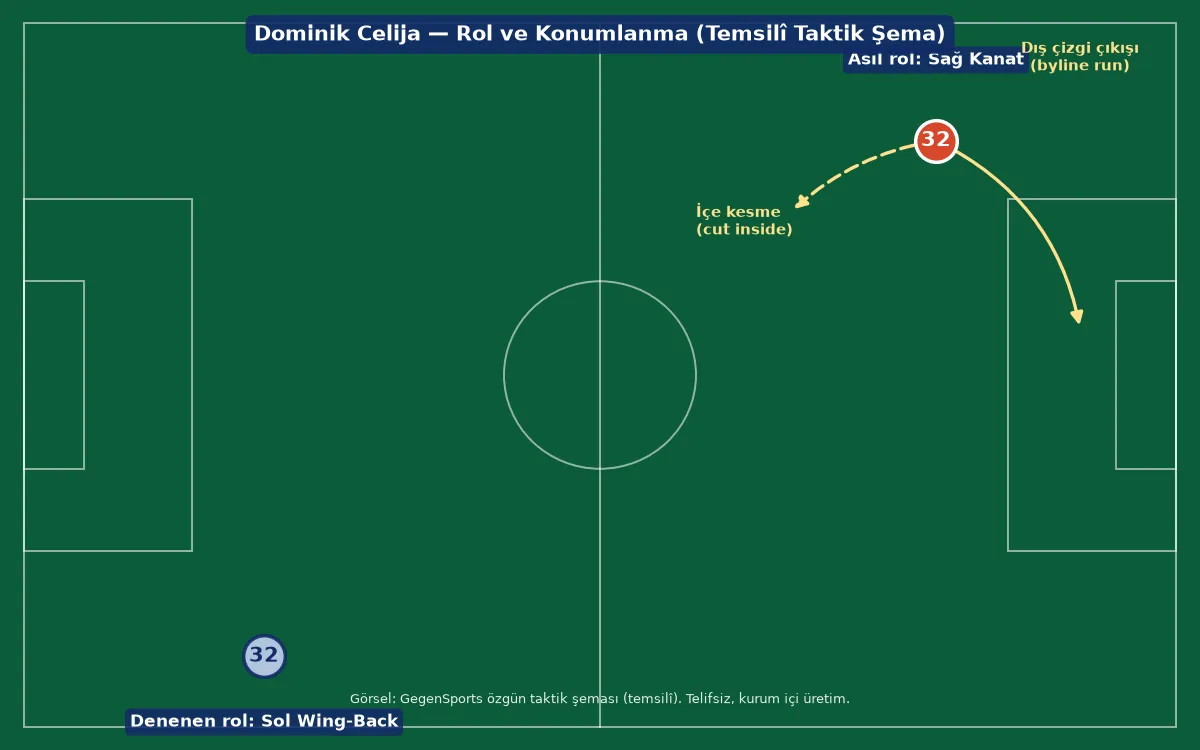
Representative tactical diagram; a projection based on a limited observation sample.
Frequently asked questions
Who is Dominik Celija? NK Istra 1961’s academy-grown right winger, born in 2006.
What position does he play? Primarily right winger; also trialled at left wing-back in summer 2026.
How old is he? 20, as of 22 September 2026.
When does his contract expire? 30 June 2028.
What is his market value? Roughly €45,000-46,000 per Transfermarkt-style estimates; no fee has ever been officially disclosed.
Any national team experience? Croatia U19; no senior or U21 call-up yet.
Why is his statistical record so thin? His HNL career totals 6-8 appearances and an estimated 150-250 minutes — a normal development curve for a fringe academy player.
Could he reach the Süper Lig? Not realistically in the short term; a TFF First League step could plausibly follow if his minutes increase.
Does he have an injury history? No serious documented injury in public sources.
Why does the Uljanik Pula loan matter? It reflects the club’s standard development method — sending young players out for regular match rhythm at a lower level.
Is the wing-back trial permanent? Unclear yet; it’s one of the key tactical storylines to track through 2026/27.
Why is the GegenSports scout score only mid-range? The score reflects the limits of available evidence, not a lack of talent.
Related GegenSports coverage
- Advan Kadušić Scout Report — Istra 1961’s senior right-back
- Emil Frederiksen Scout Report — the Danish winger central to Istra’s attack
- Rene Hrvatin Scout Report — Istra’s young right-back
- Raul Kumar Scout Report — Istra’s 18-year-old centre-back
- Ivica Ivušić Scout Report — Hajduk Split’s World Cup goalkeeper
- Krunoslav Hendija Scout Report — Lokomotiva Zagreb’s No. 1
Sources
- Glas Istre, “Mladi Celija prvi put zaigrao kao wingback i poručio: ‘Bitno je da igram'”, 9 July 2026
- Istrasport.eu, “Dominik Celija potpisao prvi profesionalni ugovor s Istrom 1961”, 23 July 2025
- Flashscore.com — Dominik Celija player profile and season statistics
- Soccerway.com — Dominik Celija player profile and career history
- BeSoccer.com — Dominik Celija player profile
- NK Istra 1961 official website (nkistra.com) — squad and club information
- SuperSport HNL official site (hnl.hr) — Istra 1961 club page
- Novi list, Index.hr, HRT Radio Pula — reporting on Javier Cabello’s appointment as head coach