
Oskar Pietuszewski Scout Report: What Ekstraklasa’s Record Export Is Doing at Porto

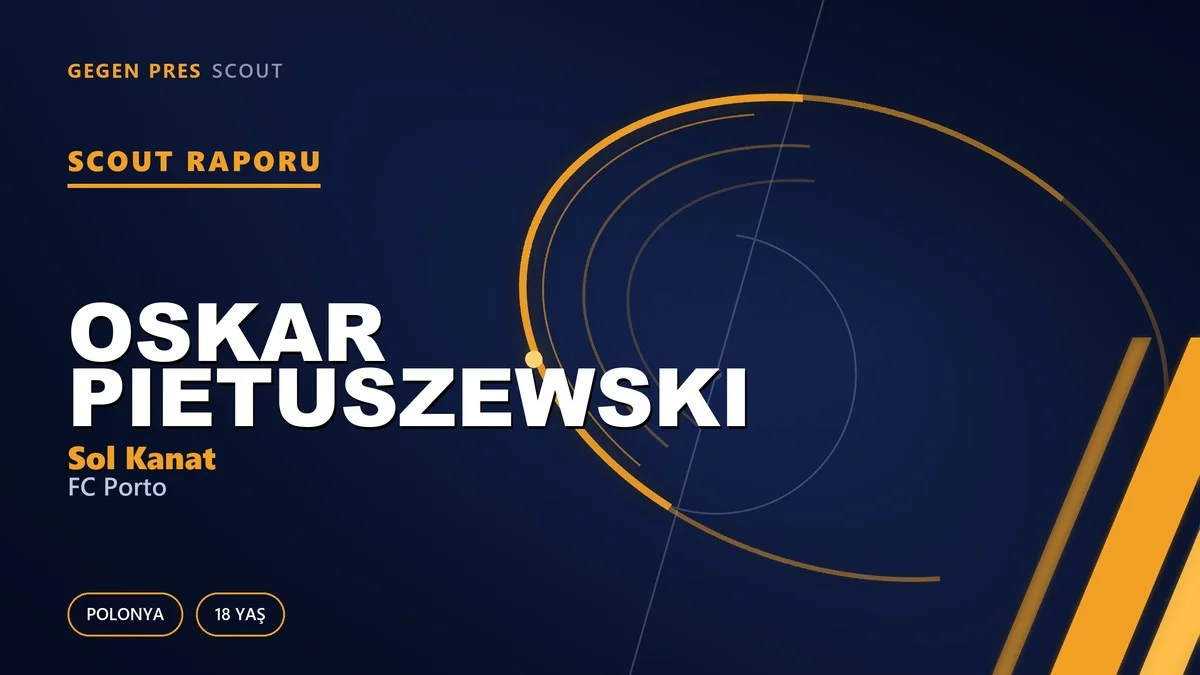

Writing down a Polish winger early is easy; the hard part is judging how much the Ekstraklasa protects him. The league is physical, but defensive density in the final third is not at Portuguese or Dutch level. I first watched Oskar Pietuszewski in Białystok in the autumn of 2024 and wrote a single line in my notebook that day: ‘he looks before he receives.’ That is a rare habit in a sixteen-year-old winger. Two years on, he has become the record sale in Ekstraklasa history, wears Porto’s number 77 and holds a Portuguese league winner’s medal. That is why the file is open again.
| Mevki | Left Winger |
|---|---|
| Kulüp | FC Porto |
| Uyruk | Poland |
| Yaş | 18 |
| Doğum | 20.05.2008 |
| Boy | 1.79 m |
| Ayak | Right |
| Piyasa Değeri | ~€16m (FotMob) |
| Sözleşme | until 30.06.2031 |
The frame: he came through Jagiellonia Białystok’s academy between 2016 and 2024, then made 32 league appearances and scored 4 goals for the first team across two seasons. In January 2026 FC Porto signed him for a reported €10 million — the largest transfer income in Ekstraklasa history. The deal carries a 10 percent sell-on share for Jagiellonia and Porto additionally covered €400,000 in intermediary fees. He won a league title in his first half-season in Portugal.
Strengths
- Pushes the first touch into a pre-chosen direction, beating defenders without losing speed.
- A repeatable curling shot towards the far post from the corner of the box.
- Out-of-possession discipline that is mature for his age, including his relationship with the left-back.
- Has produced in two leagues and two roles: the centre of a team, and a part of a structure.
- Measurable output in a short window: 3 goals in half a season.
Weaknesses
- Disappears for long stretches when the game does not come to him.
- Fluctuating final-ball selection; prefers the hard option over the simple one.
- Low success rate in shoulder-contact duels so far.
- The left foot is not a production foot; asked to stay wide, his impact drops.
Development Areas
First and most urgent is core strength. A winger operating in the narrow corridor between full-back and centre-back in the Primeira Liga has to win contact, and until that column is filled his minutes will be hard to grow. Second is in-game continuity: producing three effective actions and spending the other eighty minutes outside the match is acceptable at eighteen but not at twenty. Third is defensive repetition — Porto’s system demands a high number of recoveries from the flank, and he is currently the weakest link in that workload. All three are age-solvable; none of them is about talent.
Contract Situation
The contract signed at the January 2026 transfer was capped at three years because he was still a minor. After he turned 18 on 20 May 2026, Porto signed him to a new five-year deal on 27 May 2026, running to 30 June 2031 and containing a release clause reported at around £52 million (roughly €60 million). Jagiellonia’s 10 percent sell-on share remains in force. The structure shows the club has kept control of the price.
Career Projection
The usual European timeline for Polish wingers runs late: two seasons in the Ekstraklasa, then a mid-sized European league at twenty-one or twenty-two. Pietuszewski pulled that calendar forward by three years and went straight to one of Portugal’s biggest clubs. The threshold in front of him is clear: taking his minutes from 819 towards the two-thousand mark in 2026-27. If he does, the profile enters the shortlist of major-league clubs looking for an inverted winger. If he does not, he remains a well-protected young squad player behind a release clause — not a bad position at eighteen, but the development curve flattens.
The record sale in Ekstraklasa history; at 18 he has 3 goals in 16 Primeira Liga appearances, is Porto's youngest foreign goalscorer and already a Poland senior international.
Added core strength showing up in contact duels, and a clear rise in minutes during 2026-27.
Musa Özcan — Gegen Pres Eastern Europe scout. Follows youth production in the Polish, Czech, Slovak, Ukrainian and Russian leagues.