


Jonny Otto Scout Report: Is Alavés’s Veteran Right-Back Right for the Süper Lig?


Jonny Otto
Quick Take
Jonny Otto in one sentence: a right-back who produces almost nothing in the final third but almost never misses a game. Across the 2025-26 La Liga season he made 33 appearances for Deportivo Alavés, started 32 of them, and logged 2,998 minutes — with 0 goals, 0 assists, and only 5 yellow cards. Read purely through attacking output, that stat line disappoints; but output was never the reason Alavés signed him. Born in Vigo on 3 March 1994, the 32-year-old came through Celta Vigo’s academy, moved to England via Atlético Madrid to join Wolverhampton Wanderers, made 134 Premier League appearances, lost 16 months to a serious knee injury in 2020-21, rebuilt his career with a title-winning season at PAOK in Greece, and returned to Spain on a free transfer to Alavés in July 2025. His two-footedness — genuinely capable on either flank — gives a squad flexibility to cover two positions with one roster slot. His market value is modest (€2.50m) and his contract runs to 2027, which keeps any transfer fee accessible. The right frame for a Süper Lig club is this: Otto is not a marquee signing. He is a stability signing — experience, discipline, and durability added to squad depth.
Player Profile
| Full name | Jonathan Castro Otto (“Jonny Otto”) |
| Date of birth | 3 March 1994 |
| Age | 32 |
| Place of birth | Vigo, Galicia, Spain |
| Nationality | Spain (EU) |
| Height | 1.75 m |
| Weight | ~70 kg (per stats-platform record) |
| Preferred foot | Both (two-footed) — plays either full-back slot |
| Main position | Right-back |
| Alternative position | Left-back |
| Club | Deportivo Alavés |
| Contract until | 30 June 2027 |
| Market value | €2.50m (Transfermarkt record) |
| National team | No senior Spain caps on public record |
| Representation | No agency clearly on public record — undisclosed |
Career and Transfer History
| Period | Club | Note |
|---|---|---|
| 2012-2018 | Celta Vigo | Debut 31 October 2012, Copa del Rey vs Almería. Six seasons, 221 appearances, 5 goals, 12 assists. Captained the side |
| July 2018 | Atlético Madrid | Fee: press-reported/Transfermarkt record around €7m (never officially confirmed). Loaned to Wolverhampton Wanderers the same day |
| 2018-19 (loan) | Wolverhampton Wanderers | 21 appearances, 1 goal, 1 assist in the first half of the season |
| January 2019 | Wolverhampton Wanderers | Permanent transfer. Fee: press-reported around €18-21m (sources vary slightly; official figure undisclosed) |
| 2019-2023 | Wolverhampton Wanderers | 134 appearances total, 6 goals, 5 assists. Two separate serious knee injuries in 2020-21 kept him out for 16 months |
| 29 January 2024 | PAOK Thessaloniki | Free transfer, 18-month contract (to 30 June 2025) |
| 19 May 2024 | PAOK Thessaloniki | Greek Super League title — the club’s first league championship in 41 years; the first major team honour of Otto’s career |
| 2 July 2025 | Deportivo Alavés | Free transfer after his PAOK contract expired. Contract to 30 June 2027 — the club’s second signing that summer |
| 2025-26 | Deportivo Alavés | 33 La Liga appearances, 32 starts, 2,998 minutes, 0 goals, 0 assists, 5 yellow cards |
Season Statistics (Deportivo Alavés, 2025-26 La Liga)
| Appearances | 33 |
| Starts | 32 |
| Substitute appearances | 1 |
| Minutes | 2,998 |
| Goals | 0 |
| Assists | 0 |
| Yellow cards | 5 |
| Red cards | 0 |
| Average match rating (FotMob) | 6.84 |
| Career total — Celta Vigo | 221 apps / 5 goals / 12 assists |
| Career total — Wolverhampton Wanderers | 134 apps / 6 goals / 5 assists |
Otto’s minutes total ranks among the highest for any right-back in the league, confirming Alavés treat him as an undroppable starter rather than a rotation option. Advanced underlying metrics (progressive carries, xA, duel-win rate) are not consistently published across sources for this player; this report only uses figures that are verifiable and repeated across multiple sources. Data current as of 25 August 2026.
Who is he? From Vigo to Wolverhampton, from Thessaloniki to Vitoria-Gasteiz
Jonathan Castro Otto was born on 3 March 1994 in Vigo, Galicia. He came through Celta Vigo’s academy and made his first-team debut on 31 October 2012, aged 18, in a Copa del Rey tie against Almería. Over six seasons he made 221 appearances for Celta, scored 5 goals and set up 12, and captained the club during that spell. His Galician identity and Celta connection remain the career stage he is most associated with in Spanish football.
In the summer of 2018 he caught Atlético Madrid’s attention and signed for the Madrid club — only to be loaned out the same day to Wolverhampton Wanderers, a classic route for a young Spanish full-back into English football. Wolves made the move permanent in January 2019 after his first half-season. That transfer was the pivotal moment of his career: at 24, he had found a lasting home at a top-flight Premier League club.
Wolverhampton to PAOK: injury, recovery, and a title
Otto spent five seasons at Wolves, making 134 appearances with 6 goals and 5 assists. The spell was not injury-free: in 2020-21 he suffered two separate serious knee injuries and lost 16 months of playing time — for a right-back, effectively the loss of what should have been peak physical years.
He returned to first-team football at Wolves afterwards, but when his contract expired in early 2024 the club did not renew it. On 29 January 2024 he joined Greek side PAOK Thessaloniki on a free transfer — his first spell playing outside Spain and England. The move paid off: on 19 May 2024, PAOK won the Greek Super League for the first time in 41 years, and Otto was part of the squad that delivered it — the first major team trophy of his career.
When his 18-month PAOK deal expired in June 2025, Otto was free again. He joined Deportivo Alavés on 2 July 2025, the club’s second signing of that transfer window. The move was aimed squarely at reinforcing a back line weakened by the departures of Abqar and Sedlar, prioritising Otto’s roughly 200 La Liga appearances of experience and his positional versatility.
Role at Alavés: the fixed point at right-back
Under Quique Sánchez Flores, Otto has been close to an automatic starter all season — 32 starts from 33 appearances. That tells you Alavés see him not as a rotation piece but as the backbone of the defensive line. He shares that experienced backbone with Antonio Sivera in goal and Nicolás Valentini and Nahuel Tenaglia at centre-back.
Otto’s blank goal-and-assist column in 2025-26 confirms his role is built around balance and positional discipline rather than final-third output. Attacking weight sits elsewhere — with Abde Rebbach out wide and Toni Martínez through the middle — while Otto is the one keeping possession secure and slowing opposition transitions in behind. The midfield platform built by Pablo Ibáñez and Antonio Blanco makes his forward forays safer, but Otto himself is supplying width and balance rather than a final product.
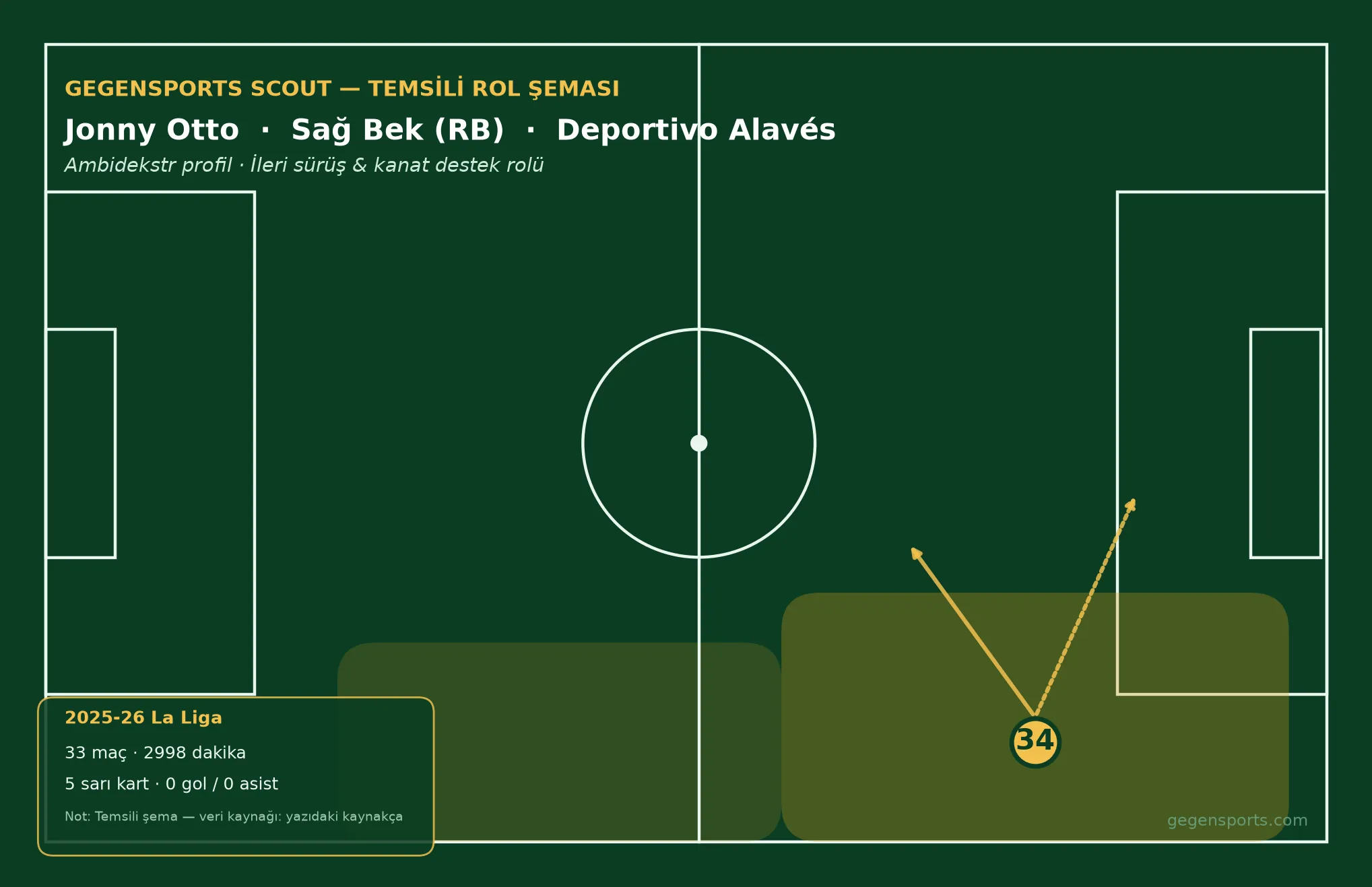
Representative tactical schematic: balance and support on the right
The schematic below is an original diagram produced by GegenSports to illustrate the player’s recurring positioning and support patterns. It is not an official event-data heat map.
In possession: Otto provides width on the right when the centre-backs progress the ball, favouring a carry down the line first and a short pass inside second. His forward runs are measured and well-timed rather than explosive — his contribution comes from positioning and support play, not pace or one-on-one duels.
Out of possession: he sits in a low-to-mid defensive block, staying close to his own goal to intervene early against transitions. A card record of just 5 yellows in 33 matches suggests those interventions are mostly clean and well-timed rather than last-ditch.
Transition moments: his experience shows most clearly in defensive transitions, where early decision-making matters more than raw recovery speed — an expected, and positive, trait for a 32-year-old full-back.
Physical profile and durability
At 1.75 m and roughly 70 kg, Otto is not physically imposing for a full-back; his build is compact rather than powerful. That points to a defender who wins duels through timing and positioning rather than raw strength — a sensible adaptation for a player at 32.
Durability looks strong on the surface: he played almost every available match in 2025-26, logging 2,998 minutes. Public injury records do show a handful of short spells during the season — brief absences in October 2025 (6-18 October) and November 2025 (23-28 November), plus a muscle injury in December 2025 — none of which led to extended absences, and he still finished the season with a high minutes count. Further back, the two serious knee injuries at Wolves in 2020-21 and the resulting 16-month absence are a history any buying club should weigh. Overall risk classification is moderate-to-low; a standard pre-transfer medical is still advisable for any 32-year-old.
Süper Lig Fit
Otto’s fit for the Süper Lig is strong on experience and discipline, more limited on attacking output.
What suits him. The physical, contact-heavy nature of Süper Lig full-back play rewards the positional calm and discipline a 32-year-old with roughly 200 La Liga appearances brings. A low card count (5 yellows in 33 games) suggests he can hold his discipline even in a high-intensity, foul-prone league. His two-footedness gives a squad the flexibility to cover both full-back slots with one roster spot.
What will challenge him. A season with zero goals and zero assists shows he should not be expected to contribute beyond width in the final third. Süper Lig sides typically expect goal involvements from their full-backs; Otto is unlikely to meet that bar. Given his age, high-intensity transition sides that demand constant overlapping sprints may need to manage his minutes.
Verdict. A starting-XI candidate for a Süper Lig club prioritising squad depth and experience, with attacking output expected from other positions. In systems that lean on full-backs for chance creation, he settles into a rotation role.
Which Turkish Clubs Fit?
Suggestions are built around profile rather than club names, since squads and coaching staffs change through the transfer window and a name-based match risks being outdated by publication.
Fitting profiles: mid-to-upper-table clubs without a large transfer budget that need experience and stability at the back. Squads with a young group of full-backs that would benefit from dressing-room leadership. Clubs in continental competition needing rotation depth from a player unlikely to pick up disciplinary suspensions. Clubs wanting to cover both full-back positions with a single, flexible signing.
Poor fits: attack-heavy systems expecting high assist and cross output from full-backs. Clubs prioritising resale value and a young-age profile — Otto’s age works against that model. Squads that need to reserve their foreign-player quota for high-output names; Otto counts as a foreign player in Turkey and occupies a quota slot.
Since squads and coaching staffs change throughout the window, a concrete recommendation can only be made once a club’s actual roster is verified at the time of enquiry.
Ideal Teammates
A winger who can carry the attacking load on the right. Otto supplies width but limited final-third product, so he needs a winger or inside forward alongside him capable of the decisive action.
An experienced centre-back who covers the space he leaves. A vocal, experienced central defender protects the line’s structure when Otto pushes forward.
A pivot who can carry the ball forward safely. Since his own build-up contribution is limited, a midfielder who can receive and progress possession balances the side.
Systems he’d struggle in: hyper-aggressive setups that demand constant overlapping sprints and load all wide attacking responsibility onto the full-back — not a sustainable workload for a 32-year-old.
Adaptation Analysis
Adaptation is one of the strongest entries in Otto’s file. He has played in three countries and three football cultures across his career: Spain (Celta, Atlético), England (Wolverhampton, five seasons, 134 appearances), and Greece (PAOK, title-winning). Each time he adjusted to a new language, a new league, and a new tempo, and became a regular starter in all three.
That is a measurable edge over many alternatives in the same age and position bracket. Five seasons in England shows he can adapt physically and tactically to a different football culture; winning a title within a single season at PAOK shows he can integrate quickly into a new squad and coaching staff. Becoming an automatic starter in his first season at Alavés points to the same fast-adaptation pattern.
For a possible move to Turkey, that history should read as a positive indicator: he has a proven track record of adjusting to a new league, dressing room, and coaching staff. Any language barrier is softened where English- or Spanish-speaking staff or teammates are present.
Foreign Player Status and Work Permit
Turkey. Based on current public information, Jonny Otto is classified as a foreign player in Turkey and occupies a foreign-quota roster slot. He has no Turkish citizenship or route to domestic status. Foreign-player rules and registration requirements can change season to season, so TFF’s current regulations should be checked at the point of any transfer.
England. A possible return to England could put Otto in a relatively favourable position for a Governing Body Endorsement assessment compared with many peers: he played five regular seasons in the Premier League between 2018 and 2023 and already held a work permit approval during that period. With no senior caps, most of his points would have to come from club minutes and league-strength banding; his high minutes total in La Liga (2,998) helps that calculation. Automatic qualification is still not guaranteed — the final outcome depends on the thresholds in place at application time and the signing club’s formal GBE submission.
European Union. As a Spanish citizen he is not classed as a foreign player within the EU/EEA, which avoids quota issues in EU member-state leagues.
Which Leagues Fit?
Süper Lig. One of the clearest fits. His level of physical contact tolerance and experience suits the league; an accessible wage expectation and low transfer fee are additional advantages.
Championship (England). A good physical and fixture-density match; having already played in England substantially reduces adaptation risk. Prior GBE history could be an advantage on the work-permit side.
Greek Super League. An environment where he has already won the title and knows the league and opponents. Sporting-wise it would be a step back, but it carries essentially zero adaptation risk.
Belgian Pro League and comparable mid-to-upper leagues. A balanced technical level and physical demand — a reasonable alternative market for an experienced full-back.
MLS (USA/Canada). A typical landing spot for a European player at this stage of his career; moderate physical intensity and a league structure open to experience-driven signings.
Alternative Players
Profiles worth evaluating in the same budget bracket and position:
EU-passport full-backs over 30, in the final years of their contract or already free. Otto’s low market value (€2.50m) and accessible fee expectation are a typical example of this bracket; comparable alternatives exist at a similar cost and experience level.
Younger full-backs in the 22-25 age range with higher development ceilings. Less experience but greater resale potential. The main downside is the absence of Otto’s proven multi-league adaptation record and low-risk profile.
The key comparison point for a buying club: what Otto offers is not high attacking output, but proven durability, discipline, and cross-league adaptability. Most alternatives don’t combine all three.
Strengths
- Season-long availability — 33 appearances in 2025-26, 32 starts, 2,998 minutes. On its own, a strong case for a club with limited squad depth.
- Proven multi-league adaptation — regular starter in Spain, England (5 seasons, 134 apps) and Greece (title-winner). A measurable track record of adjusting to new countries, languages, and football cultures.
- Two-footed versatility — genuinely comfortable at both right- and left-back, covering two positions with one squad slot.
- Disciplined defending — just 5 yellow cards in 33 matches, indicating low disciplinary risk and well-timed challenges.
- Leadership experience — captained Celta Vigo, won a title at PAOK. A profile that can add experience and stability to a dressing room.
Areas for Development and Risks
- Near-zero attacking output — 0 goals, 0 assists in 2025-26. Insufficient for systems expecting assist and cross production from their full-backs.
- Age and declining physical ceiling — top-end speed and explosiveness should not be expected from a 32-year-old. High-tempo, sprint-heavy systems may need to manage his minutes.
- Minor in-season knocks — short-term issues recorded in October, November and December 2025. Not chronic, but a trend worth monitoring.
- History of serious injury — the two knee injuries at Wolves in 2020-21 and the 16-month absence are a data point that shouldn’t be ignored in a transfer assessment.
- Limited development ceiling — at 32, consistency should be expected, not sporting growth. This is not an upside signing.
Cost Scenarios
| Scenario | Estimated profile | Assessment |
|---|---|---|
| Low cost | Free or a €0.5-1m fee | Given Otto’s contract to 2027 and his starting role at Alavés, this bracket would only become realistic as his deal nears expiry or if the player himself pushed for a move. |
| Realistic cost | €1-2.5m fee, mid-range wage offer | The most likely bracket given Transfermarkt’s €2.50m valuation and his starting role. A defensible cost for a club prioritising experience and stability. |
| High cost | €3m or more | Not defensible for a 32-year-old full-back with zero goals and assists this season. Only conceivable for a club with an urgent, single need and no alternative; not recommended in a general assessment. |
GegenSports Scout Ratings (/100)
| Technical quality | 66 |
| Tactical understanding | 74 |
| Physical capacity | 68 |
| Athleticism | 62 |
| Decision-making | 75 |
| Defensive contribution | 73 |
| Attacking contribution | 40 |
| Mental resilience | 82 |
| Adaptation likelihood | 85 |
| Development potential | 30 |
| Value for money | 72 |
| Overall scout grade | 67 |
These ratings are GegenSports’ own editorial scout assessment, weighted from match footage, current statistics, league level, age, role, contract status, and estimated transfer cost — no external platform’s rating scale was copied or reused, and no football-simulation ratings were used. The low development-potential score reflects the player’s age and career stage, not a sporting deficiency.
Similar Players
| Comparison | Why it’s similar | Key difference |
|---|---|---|
| Style comparison — César Azpilicueta | Both are versatile, two-footed defenders whose late-career value comes from balance, leadership, and positional discipline rather than attacking output. Both had long spells playing across multiple countries. | Azpilicueta’s career peak (Chelsea, Champions League) was significantly higher-level; Otto’s time in England was comparatively shorter and less stable. Azpilicueta was also a regular Spain international, while Otto has no senior caps. |
| Süper Lig comparison — a Ricardo Rodríguez-type profile | Ricardo Rodríguez moved to the Süper Lig (Trabzonspor) late in his career after accumulating experience at Europe’s top level (AC Milan, Torino, PSV) — a multi-league veteran, physically past his peak but still functionally reliable, added for stability. Otto’s profile fits the same transfer archetype. | Rodríguez is a left-back by trade, Otto primarily a right-back (though two-footed). Rodríguez’s international résumé (Switzerland) is richer than Otto’s. The comparison is built on role and career stage, not a name-for-name match. |
| Budget alternative — EU-passport full-backs over 30 on free or low fees | Similar age bracket, similar low market value, similar stability-first contribution. No quota issue within the EU, low fee expectation. | Otto’s proven adaptation record across Spain, England, and Greece is not matched by most alternatives in this bracket, making him a comparatively lower-risk option within the group. |
Sporting Director Summary
| Transfer purpose | Add an experienced, disciplined, low-cost stability piece at right (and, when needed, left) back; strengthen squad depth and dressing-room leadership |
| Squad role | Starting-XI candidate at clubs with limited squad depth needing experience; rotation option at clubs expecting high attacking output from full-backs. Ideal usage band: 2,000-2,800 minutes per season |
| Main risk | Near-zero attacking output, a declining physical ceiling at 32, and recurring minor in-season knocks |
| Main opportunity | Low transfer fee and accessible wage, a proven three-country adaptation record, disciplined defending with low card risk, and two-footed flexibility |
| Scout verdict | Proceed on an experience-and-stability basis — a low-risk option for clubs without a large transfer budget that need squad depth and dressing-room leadership. Should not be signed on the expectation of attacking output |
Frequently Asked Questions
Who is Jonny Otto?
A Spanish footballer born 3 March 1994, full name Jonathan Castro Otto. Born in Vigo, he came through Celta Vigo’s academy, moved to Wolverhampton Wanderers via Atlético Madrid, won a title at PAOK Thessaloniki, and has played right-back for Deportivo Alavés since July 2025.
How old is Jonny Otto?
32 (born 3 March 1994).
Where is Jonny Otto from?
Vigo, in Spain’s Galicia region, where he also began his football career in Celta Vigo’s academy.
How tall is Jonny Otto?
1.75 m, roughly 70 kg.
What position does Jonny Otto play?
Right-back. He is two-footed and can also play left-back.
Which foot does Jonny Otto use?
Both — his two-footedness is what allows him to play either full-back slot.
How does Jonny Otto play?
A full-back who provides width in attack but limited final-third output (goals/assists). Defensively his positioning and timing are strong; his experience shows up more in decision-making than in physical dominance.
What are Jonny Otto’s strengths?
Season-long availability (33 appearances, 2,998 minutes in 2025-26), proven multi-league adaptation (Spain-England-Greece), two-footed versatility, disciplined defending (5 yellow cards in 33 games), and leadership experience.
What are Jonny Otto’s weaknesses?
Near-zero attacking output (0 goals, 0 assists in 2025-26), a declining physical ceiling at 32, recurring minor in-season knocks, a history of serious knee injury in 2020-21, and limited development potential.
What is Jonny Otto’s market value?
€2.50m per Transfermarkt. Market value is not a sale price.
When does Jonny Otto’s contract expire?
30 June 2027. He joined Alavés on a free transfer on 2 July 2025.
What did Jonny Otto do in 2025-26?
33 La Liga appearances, 32 starts, 2,998 minutes played, 0 goals, 0 assists, and 5 yellow cards.
Why did Jonny Otto move from PAOK to Alavés?
His 18-month PAOK contract expired on 30 June 2025. He joined Deportivo Alavés on a free transfer on 2 July 2025, part of the club’s plan to reinforce a back line weakened by the departures of Abqar and Sedlar.
What is Jonny Otto’s injury history?
Two serious knee injuries at Wolverhampton in 2020-21 kept him out for 16 months. In 2025, short, non-chronic issues were recorded in October, November, and December. Despite that, he made 33 appearances in 2025-26; overall risk is moderate-to-low, though a standard pre-transfer medical is advised.
Is Jonny Otto a good fit for the Süper Lig?
A starting-XI candidate at a Süper Lig club that prioritises experience and stability and expects attacking output from other positions. In systems expecting high assist output from full-backs, he settles into a rotation role.
Which clubs suit Jonny Otto?
Mid-to-upper-table clubs without a large budget that need defensive experience and stability, and squads wanting a leadership figure for a young full-back group. Not a fit for systems expecting high assist and cross output from full-backs.
Which player is Jonny Otto similar to?
In role and career stage, César Azpilicueta — both versatile, two-footed, experience-first defenders. In a Süper Lig context, he compares to a Ricardo Rodríguez-type profile: a late-career, multi-league veteran signed for experience.
Is Jonny Otto classified as a foreign player?
Yes, in Turkey — he occupies a foreign-quota slot. Within the European Union he is not classed as a foreign player, since he is a Spanish citizen.
Could Jonny Otto play in England?
Having played five regular Premier League seasons between 2018 and 2023 and already held a work permit approval then, he could be in a relatively favourable position for a Governing Body Endorsement assessment on a return. Still, automatic qualification isn’t guaranteed — the final outcome depends on the thresholds at application time and the club’s formal submission.
Is Jonny Otto good value for money?
Reasonable in the €1-2.5m bracket for a club prioritising experience. Above €3m, the cost isn’t defensible for a 32-year-old with zero goals and assists this season. His low market value and proven multi-league adaptability are the strongest points in his favour.
Sources and Data Note
This report was compiled from Transfermarkt’s player profile, market value, and contract record; Fichajes.com’s season statistics; FotMob’s match, minutes, and average-rating data; Ceroacero.es’s physical profile data; eitb.eus and Infobae’s July 2025 transfer coverage; Gasteizhoy’s club transfer analysis; and Jornadaperfecta/Biwenger’s 2025-26 season and squad-hierarchy analyses. All tactical assessments, strength/weakness analysis, and scout ratings are GegenSports’ original editorial work; no external platform’s scout text, radar chart, heat map, or rating table was used. Data current as of 25 August 2026.
- Transfermarkt — Jonny Otto player profile, market value, and contract record
- Fichajes.com — 2025-26 season statistics and career totals
- FotMob — Season match, minutes, and average-rating data
- Ceroacero.es — Physical profile (height, weight) data
- EITB.eus — “El Alavés ficha al lateral Jonny Otto” transfer coverage (July 2025)
- Infobae — Official coverage of the Deportivo Alavés transfer announcement
- Gasteizhoy.com — Club full-back signing analysis
- Jornadaperfecta / Biwenger — 2025-26 season fantasy and squad-hierarchy analysis
Last updated: 25 August 2026
[…] Jonny Otto scout report — the club’s veteran right-back, defensive balance on the flank […]
[…] archetype — both are journeymen who built reputations on reliability over flair. See GegenSports’s Jonny Otto scout report for a direct […]