
Mikel Rodríguez Scouting Report: The Alavés Runner Who Owns Half a Transfer

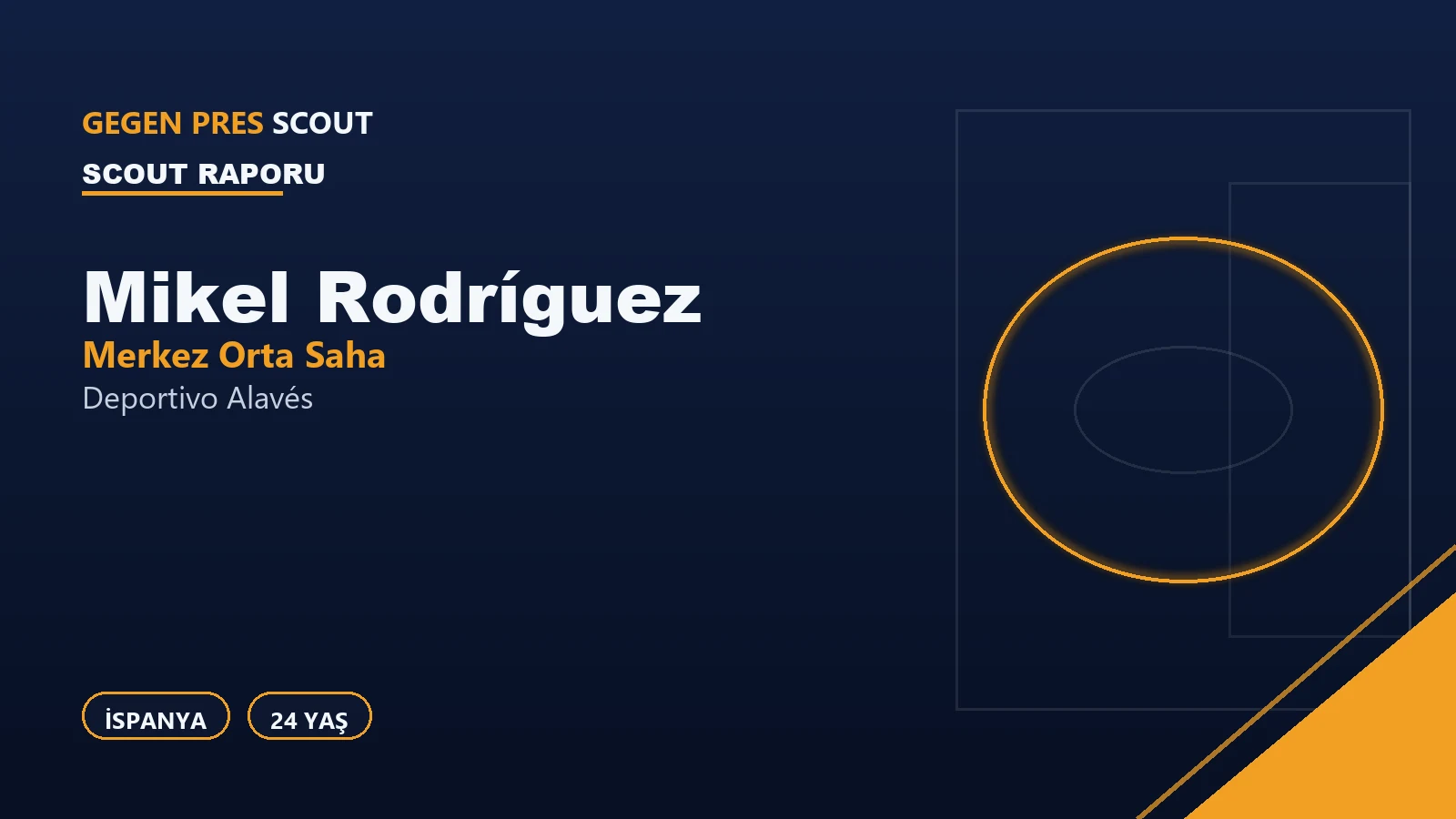

Mikel Rodríguez
Quick Answer
Mikel Rodríguez spent the first twenty-four years of his life in the third, fourth and fifth tiers of Spanish football, and only reached the top flight in July 2026 when Deportivo Alavés bought him from Real Sociedad. The adjustment period barely existed. He came off the bench against Getafe on 15 August 2026 and scored in the ninety-third minute; by matchday two he was a fixed member of the midfield three in Quique Sánchez Flores’s back-five system. He is not a controlling playmaker. He is a runner — an eight who collects second balls and arrives in the box from the second line. His two clearest assets are the ground he covers and his ability to turn out of pressure in tight areas; his clearest weakness is discipline, with thirteen yellow cards and two red cards in the Spanish second division last season. For a club that plays a midfield three and wants running from the number eight, this is a low-cost profile that can compete for a starting place. But the hard part of this file is not on the pitch. Alavés owns only fifty per cent of his economic rights; Real Sociedad retains a buy-back clause and a matching right on any future offer. For a third club, that structure raises a question about feasibility rather than price.
Player Profile
| Full name | Mikel Rodríguez Ulacia |
| Date of birth | 3 April 2002 |
| Age | 24 |
| Place of birth | Getaria (Gipuzkoa, Basque Country, Spain) |
| Nationality | Spain — EU passport |
| Height / weight | 1.75 m / 65 kg (LaLiga official record, consistent with Fichajes.com) |
| Preferred foot | Right |
| Main position | Central midfielder — the number eight in a midfield three |
| Alternative positions | Defensive midfielder, left midfielder, attacking midfielder (secondary positions listed by one statistics platform) |
| Shirt number | 18 (LaLiga official record and English Wikipedia agree). One statistics platform lists 24 and one fantasy site lists 22 — minority records |
| Club | Deportivo Alavés |
| Contract expiry | 30 June 2031 (five-year deal) |
| Joined club | 16 July 2026 — from Real Sociedad |
| Fee | Approximately €2.00m for 50% of the player’s economic rights (reported by Cadena SER). Real Sociedad retains the other 50% |
| Market value | €622,000 – €655,000 range (FotMob and Soccerway records, August 2026) |
| International record | None found — no official caps recorded for Spain at senior or youth level |
| Youth clubs | Antiguoko, then Real Sociedad (Zubieta) from 2020 |
Career and Transfer History
| Period | Club | Notes |
|---|---|---|
| 2020 | Real Sociedad youth | Joined Zubieta from Antiguoko at eighteen |
| 2021-22 | Pasaia KE (loan) | Tercera RFEF — the fifth tier of Spanish football. 32 appearances, 4 goals, 2,389 minutes |
| 2022-23 | Real Sociedad C | Segunda Federación. 18 appearances, 4 goals, 977 minutes |
| 2023-24 | Real Sociedad B (Sanse) | Primera Federación. 20 appearances, 0 goals, 735 minutes — a rotation player |
| 2024-25 | Real Sociedad B (Sanse) | Primera Federación. 36 appearances, 7 goals, 2,310 minutes. Promotion to the second division and a first-choice role |
| 22 January 2025 | Real Sociedad | Contract extended to 2027 |
| 2025-26 | Real Sociedad B (Sanse) | LaLiga Hypermotion — the second division. 33 appearances, 26 starts, 2,183 minutes, 2 goals, 2 assists |
| 16 July 2026 | Deportivo Alavés | Permanent transfer. Around €2.00m for 50% of his rights; contract until 30 June 2031 |
| 15 August 2026 | Deportivo Alavés | La Liga debut: Alavés 3-0 Getafe. Replaced Denis Suárez and scored the third goal in the 93rd minute |
| 2026- | Deportivo Alavés | Started in the midfield three on matchdays two and three |
Season Statistics (2025-26 and the start of 2026-27)
| 2024-25 — Real Sociedad B (Primera Federación) | |
| Appearances | 36 |
| Goals | 7 |
| Minutes | 2,310 |
| 2025-26 — Real Sociedad B (LaLiga Hypermotion) | |
| Appearances | 33 |
| Starts | 26 |
| Minutes | 2,183 |
| Goals / assists | 2 / 2 |
| Yellow cards | 13 (one source records 14) |
| Red cards | 2 |
| Injury absence | 17 November – 5 December 2025 (roughly three weeks) |
| 2026-27 — Deportivo Alavés (first three matchdays) | |
| Appearances / starts | 3 / 2 |
| Minutes | 149 |
| Goals / assists | 1 / 0 |
| Shots | 2 |
| Expected goals (xG) | 0.57 |
| Pass completion | 77.5% |
| Successful dribbles | 4 (80% success) |
| Tackles | 5 |
| Total touches | 76 |
| Average match rating | 7.33 (FotMob) / 7.1 (Soccerway) |
| Yellow / red cards | 0 / 0 |
| Career totals (all tiers) | |
| Appearances / goals | 151 / 18 |
| Total minutes | 8,743 |
The 2026-27 figures here come from the intersection of LaLiga’s official player page with FotMob and Soccerway records; earlier seasons are drawn from the La Preferente career table, FútbolFantasy analysis and Soccerway season records. Three cautions apply. First, one transfer site records 1 goal and 2 assists for the opening three matchdays of 2026-27, while LaLiga’s official page, FotMob and Soccerway all record 1 goal and 0 assists for the same period; this report follows the three sources that agree and flags the difference here. Second, no per-90 rates have been calculated anywhere in this report, because a 149-minute sample cannot support them. Third, the 2025-26 numbers belong to the second division and the 2024-25 numbers to the third; output across different tiers is not directly comparable and does not transfer automatically to the top flight.
Who is he? From Getaria to Vitoria-Gasteiz, five tiers in five years
Mikel Rodríguez Ulacia was born on 3 April 2002 in Getaria, a coastal town of fewer than three thousand people in Gipuzkoa. It is not a recognised production centre for Spanish football, and his route was the classic Basque one: first Antiguoko, the San Sebastián youth club that has produced dozens of professionals, then Real Sociedad’s Zubieta academy in 2020, at eighteen.
What followed is a textbook late-development path. In 2021-22 he was loaned to Pasaia KE in Tercera RFEF, the fifth tier of the Spanish pyramid, where he played 32 matches and 2,389 minutes and scored four goals. He moved up to Real Sociedad C in Segunda Federación in 2022-23, then to Real Sociedad B in Primera Federación in 2023-24 — but in that first season with the B team he managed only 735 minutes across 20 appearances. He was outside the rotation.
The turn came in 2024-25. He became indispensable for Real Sociedad B — Sanse, as the team is known in Spain — with 36 appearances, 2,310 minutes and seven goals, an unusual return for a midfielder at that level. The team won promotion to the second division. On 22 January 2025 the club extended his contract to 2027, the first concrete sign that Real Sociedad now saw him as an asset to protect rather than a squad filler.
Then came the real test. In 2025-26, Sanse played in LaLiga Hypermotion, and Rodríguez started 26 of 33 matches for 2,183 minutes. His output dropped — from seven goals to two, with two assists added. That drop is not a regression but the natural consequence of the step up: a midfielder gets markedly fewer chances to arrive in the box in the second division than in the third. He also missed roughly three weeks between 17 November and 5 December 2025 through injury; the nature of the problem was not disclosed publicly.
The structure of the deal: €2m for half a player
The most important section of this file has nothing to do with the pitch.
On 16 July 2026 Deportivo Alavés announced the signing and handed Rodríguez a five-year contract running to 30 June 2031. According to Spanish radio station Cadena SER, the fee was around €2m — but that figure did not buy the player. It bought fifty per cent of his economic rights. The other fifty per cent stayed with Real Sociedad.
The structure does not stop there. The same report set out a buy-back clause valid for four seasons: €4m in the first two years, rising to €5m in years three and four. On top of that, Real Sociedad holds a matching right — in Spanish, a derecho de tanteo — meaning that if a third club bids for the player, Real Sociedad can match the offer and take him back.
The practical consequence is straightforward. If a Süper Lig club, or any European club, wants Rodríguez in the summer of 2027 or 2028, it must first agree terms with Alavés and then get past Real Sociedad’s fifty per cent stake and matching right. Alavés cannot sell him on its own. Real Sociedad, meanwhile, can simply exercise a €4-5m buy-back if the player develops. In other words, the better he plays, the harder the structure makes it for a third party to buy him at market value.
The scouting conclusion follows directly: this is not a player who can realistically be signed in the short term. He can be watched, tracked and kept on file, but a genuine acquisition window only opens once Real Sociedad’s buy-back period expires, which points towards 2030. Or it never opens at all, because by then he may already have gone back to San Sebastián.
15 August 2026: a La Liga career that started in the 93rd minute
On the opening matchday of 2026-27, Alavés beat Getafe 3-0 at Mendizorroza. The game had broken open early, with Getafe reduced to ten men in the 42nd minute; Tenaglia scored on 73 minutes and Mariano Díaz added a second in the 92nd.
Late on, Quique Sánchez Flores withdrew Denis Suárez and sent on Mikel Rodríguez. In the 93rd minute Rodríguez controlled the ball inside the box and finished for 3-0. It was his La Liga debut and his first top-flight goal, scored minutes after entering the pitch.
The goal made no difference to the result — the match was already over. Its effect on the squad hierarchy was immediate. A week later, on 20 August 2026, away to Rayo Vallecano — a fixture played at Leganés’s Butarque ground because Vallecas was unavailable — Rodríguez started. On 28 August against Villarreal, the same eleven took the field. In the first three weeks of his top-flight career he went from substitute to fixed member of the midfield three.
One goal does not explain that rise on its own. In Sánchez Flores’s 5-3-2 the midfield is Antonio Blanco, Pablo Ibáñez and Rodríguez: Blanco as the pivot, Ibáñez as the runner alongside him, and a third player required to carry the ball forward and turn under pressure. Denis Suárez solves that role with technical quality, but he is thirty-two and his running volume is limited. Volume is precisely what Rodríguez adds.
Playing style: not construction, but volume and verticality
Classifying Rodríguez correctly starts with what he is not. He is not a deep-lying playmaker who sets the rhythm from the base, and he is certainly not a regista. Antonio Blanco does that job at Alavés, and the passing numbers make the distinction obvious: Blanco played last season above 85 per cent pass completion, while Rodríguez opened 2026-27 at 77.5 per cent.
His role sits somewhere between a mezzala and a box-to-box eight. The language the club and the Spanish press used at the time of the transfer points the same way: dynamism, range, ball control and defensive capability. One analysis site described him as a player who “brings continuity to possession” and generates passing lines — a profile built around keeping the ball moving forward rather than holding it.
Three behaviours carry that on the pitch. The first is the late arrival into the box from the second line. The Getafe goal is exactly that: when the ball arrived in the area, he was there as a midfielder coming from deep. Seven goals in 36 third-tier matches in 2024-25, and 18 goals in 151 career appearances, suggest this is a repeated behaviour rather than a one-off.
The second is turning out of tight areas without losing the ball. In the opening three matchdays of 2026-27 he completed four of five dribbles in 149 minutes. The sample is small, but a high dribble-completion rate for a central midfielder is a first indication that he can exit pressure cleanly rather than concede possession.
The third is that his defensive contribution is active rather than passive. He recorded five tackles across the same three matches, and one transfer platform listed him among the team’s leaders for interceptions. A caution is needed here, though: this does not make him a defensive pivot. One analysis source states the point explicitly — he is not a dominant holding midfielder. He goes to win the ball; he is not a player who holds the line, protects space and stays in position.
The discipline file: the most concrete risk in this report
The most important warning attached to this player is not technical. It is disciplinary.
In 2025-26 he played 33 second-division matches for Real Sociedad B and picked up thirteen yellow cards — one source records fourteen, which may be a recording difference. He was also sent off twice in the same season. That is a card roughly every two and a half matches, and it translated into multiple suspensions.
The career picture confirms the pattern rather than softening it. Soccerway records 25 yellow cards and 2 red cards across 97 professional appearances. This is not the residue of one bad season; it is a consistent tendency.
Interpreting the cause requires restraint. A high card count for a midfielder can come from two very different places: heavy use of tactical fouls — stopping counter-attacks for the team — or poor timing in duels, arriving late to the ball. There is not enough detailed public data to separate the two. Given his physical frame (1.75 m, 65 kg), it is reasonable to hypothesise that he resorts to fouling when he loses position in contact. That is a hypothesis to test on video, not a finding.
The positive counterpoint should be recorded too: he took no cards at all in 149 minutes across the opening three matchdays of 2026-27, with a low foul count. That may be an early sign that he has adjusted his behaviour for the top flight — but 149 minutes does not overturn the previous season’s 2,183. In a league where refereeing tolerance for contact differs, such as the Turkish Süper Lig, this item must be reviewed on video before any transfer.
Physical profile and durability
At 1.75 m and 65 kg he has a small frame for a central midfielder. That is not a disqualifier — modern football is full of high-level eights built this way — but it creates limits in two areas: aerial duels and back-to-goal physical contact.
Durability looks better. He played 2,310 and 2,183 minutes in the last two seasons respectively, starting 26 of 33 matches in 2025-26. His career total stands at 8,743 minutes across 151 appearances. He is a player who plays regularly.
Public records show a single absence: roughly three weeks between 17 November and 5 December 2025. The nature of the injury was not disclosed and no recurring pattern was found. One analysis site classified him as a low injury risk ahead of 2026-27.
A caveat is still required. Injury records for spells in the lower tiers are often incomplete, and his top-flight load currently stands at 149 minutes. This report classifies the risk as to be monitored — there is no red flag, but there is no adequate elite sample either. It is also worth noting that he was withdrawn in both of his starts, which is a detail worth tracking on load management.
The competition: where does he stand in the Alavés midfield?
Alavés carries a crowded midfield pool for 2026-27: Antonio Blanco, Pablo Ibáñez, Denis Suárez, Carles Aleñá, Ander Guevara, Lander Pinillos, Carlos Protesoni and Mikel Rodríguez.
Only three of them play in Sánchez Flores’s 5-3-2, and that three stayed unchanged across the opening three matchdays: Blanco as pivot, Ibáñez as the running eight, Rodríguez as the third. That was not the pre-season expectation. Spanish fantasy football coverage described him as a squad player with an outside chance of breaking into the rotation, and as a speculative pick. Three weeks made that assessment obsolete.
The tactical logic is legible. Because Alavés defends with five and both wing-backs (Ángel Pérez and Abde Rebbach) push very high, the ground the three midfielders must cover is unusually large. In that shape, Rodríguez’s running volume is preferred to Denis Suárez’s technical quality. Aleñá, a more advanced profile, has no natural slot in the system at all.
One caution belongs here. Rodríguez’s starting status depends on the system as much as on his own form. If Alavés reverts to a back four, or starts holding more of the ball, the qualities required from the third midfielder may change. A three-week sample does not establish a permanent hierarchy.
Does he fit the Turkish Süper Lig?
Short answer: yes, in the right system and if the discipline item is addressed.
The Süper Lig is a league where transition speed and second-ball contests decide matches. Games frequently contain open, uncontrolled passages, and that is exactly the environment in which a box-to-box eight who covers ground is most useful. Rodríguez’s profile matches that need.
Three risks sit against it. First, discipline: a player who took thirteen yellows and two reds in 33 matches may accumulate even more in the Süper Lig’s interpretation of contact, and losing four or five matches a season to suspension is a real squad-planning cost. Second, physique: a 65 kg midfielder can struggle with the aerial and back-to-goal contact load of the league — a problem that can be offset by the profile alongside him, but not ignored. Third, sample: his top-flight experience amounts to 149 minutes. Signing a player whose elite record is three matches raises the transfer risk on its own.
Adaptation looks like a strength. He has played across five different tiers and became a regular starter within a season at each of them, which is concrete evidence of adjusting quickly to a new environment. He has never played abroad, though; his entire career has been spent within the Basque Country and Álava. A first move to another country is always an additional unknown.
Conclusion: for a Süper Lig side that plays a midfield three, favours transition and wants running from its eight, he is competitive for a starting place. For a possession-heavy team that asks its midfield for passing quality first, he is best read as a rotation option.
Which club profiles suit him?
Teams with three centre-backs and a midfield three: the most natural fit. When wing-backs push high, the ground the midfield must cover expands, and that is exactly where his volume earns its value. His Alavés role transfers directly.
Transition teams that spend less time on the ball: the scenario he knows. Both Real Sociedad B and Alavés were usually the side with less possession. A similar model shortens his adaptation period.
Lower-budget clubs that develop young players: on paper an ideal file for this bracket — a top-flight midfielder aged twenty-four, EU-registered, with a market value recorded below €700,000. The obstacle is the ownership structure, not the profile.
Where he does not fit: possession-dominant teams that want rhythm, passing volume and tempo control from midfield. His 77.5 per cent pass completion sits below the band that role requires — not a deficiency, but a different job description. He is also the wrong name for a single-pivot system that demands high positional discipline from that pivot.
Ideal team-mates and formation
Most effective formation: 3-5-2 or 5-3-2, with a pivot and another eight beside him and width supplied by wing-backs. The shape Alavés uses.
Workable formation: a double-eight 4-3-3, or the advanced role in a 4-2-3-1 double pivot — in both cases with a balancing player behind him.
Where he struggles: the single-pivot role in a 4-3-3. That role requires positional discipline, aerial presence and high passing volume; his current profile is not that.
Ideal team-mates:
- A high-completion pivot. Antonio Blanco performs that function at Alavés. Because Rodríguez’s job is to move the ball forward, he needs someone behind him who sets the rhythm and absorbs turnovers.
- A centre-back strong in the air. The second balls a 65 kg midfielder loses have to be answered behind him.
- Wing-backs who provide width. Rodríguez runs from the centre into the box; if nobody occupies the channels, his space disappears.
- A striker who pins centre-backs. Late runs from deep need a forward creating room ahead of them; at Alavés, Toni Martínez and Lucas Boyé provide that.
Cost, ownership and value for money
Pricing this player cannot follow a standard fee calculation.
Market value records range from €622,000 to €655,000. That is a low figure for a twenty-four-year-old top-flight midfielder, and the reason is clear: his La Liga history is three matches long, and the data platforms have not yet repriced him as a first-division player. Alavés paid around €2m — but for fifty per cent of his rights, implying a valuation of roughly €4m for the whole player.
What really decides the price are Real Sociedad’s three retained rights: a fifty per cent economic stake, a four-season buy-back (€4m in years one and two, €5m in years three and four), and a matching right on future offers. Together these close off almost all negotiating room for a third club. When a bid arrives, Real Sociedad either matches it and takes the player back, or banks half the fee; either way, an agreement with Alavés alone is not enough.
On the Alavés side the contract runs to 30 June 2031, giving the club five seasons of full negotiating strength. No verified public figure was found for a release clause, and none is estimated here.
Value-for-money note: in sporting terms this is a good value file — twenty-four years old, EU status, a low market value and concrete evidence of breaking into a top-flight starting eleven. But he cannot be labelled overpriced either, because there is no purchasable price on the table: he is not realistically available in the short term. The correct classification is a watchlist entry.
Foreign player status and work permits
Turkey: as a Spanish national, Rodríguez counts as a foreign player in Turkey. Born on 3 April 2002, he falls outside the young-foreigner thresholds for 2026-27 and would occupy a place in the group without an age restriction. That cost belongs in the squad-planning calculation.
England: a work permit depends on the Governing Body Endorsement points system, which weighs international appearances, the band of the player’s league, continental competition and club minutes over the previous twelve months. Rodríguez has no international record, spent most of the last twelve months in the second division, and has 149 La Liga minutes to date. Automatic eligibility should not be assumed on that basis. A club would need specialist assessment against current thresholds before any formal application; no legal opinion is offered here.
European Union: as an EU national he is registered outside foreign-player quotas within EU member states, which lowers the effective cost of a transfer.
Which leagues suit him?
Süper Lig (Turkey): competitive for a starting place at teams playing a midfield three and a transition game. Card profile and physical contact are the items to monitor.
LaLiga (current level): the natural level for sides like Alavés — lower-mid table and comfortable without the ball. This is where he is now, and there is no obligation to move early.
Primeira Liga (Portugal): high technical level, low language barrier and a strong resale market. A natural second destination for a midfielder.
Belgian Pro League: a buy-develop-sell model. Twenty-four is close to the ceiling for that model but still inside it, and the tempo suits his profile.
Eredivisie (Netherlands): a possession-led league, which would test the passing item more directly. Moderate probability of a clean fit.
LaLiga 2 (Spain): a step backwards; he cleared that tier in the summer of 2026.
If you are studying this player, read these files too
- Antonio Blanco scouting report — the pivot playing directly behind Rodríguez; the division of roles is clearest in that file.
- Pablo Ibáñez scouting report — the other running eight in the midfield three and his most direct role rival.
- Denis Suárez scouting report — the player he replaced against Getafe; the other side of the technical-quality-versus-running-volume debate.
- Ángel Pérez scouting report — the right-hand channel Rodríguez feeds from midfield.
- Lucas Boyé scouting report — the striker profile that opens space for late runs from deep.
- Abde Rebbach scouting report — the left channel and another component of the same back-five structure.
Strengths
- Running volume and ground coverage — In a back-five system with two high wing-backs, the ground the midfield three must cover is unusually large. Sánchez Flores chose Rodríguez’s range over Denis Suárez’s technical quality for that job, and the choice held through the opening three matchdays. Dynamism and range were also the first qualities the club highlighted at the time of the transfer.
- Late arrival into the box — The debut goal against Getafe is the example: when the ball arrived in the area he was there as a midfielder coming from deep. Seven goals in 36 third-tier matches in 2024-25 and 18 goals in 151 career appearances support the idea that this is a repeated movement rather than an accident.
- Turning out of pressure — He completed four of five dribbles in 149 minutes across the opening three matchdays. The sample is small, but for a central midfielder a high dribble-completion rate is an early indicator of exiting pressure without conceding possession.
- Active defensive contribution — Five tackles across the same three matches, and one transfer platform listed him among the team’s leaders for interceptions. He goes to win the ball rather than waiting for it.
- A record of becoming a regular at every tier — He has played across five tiers, from the fifth division to the first, and became a regular starter within a season at each. Outside the rotation at Zubieta, then indispensable in 2024-25, then 26 starts in the second division, then into a La Liga eleven within three weeks. That is concrete evidence of adaptability.
- Durability and availability — 2,310 and 2,183 minutes across the last two seasons, and 8,743 minutes across 151 career appearances. Public records show a single absence (November-December 2025, roughly three weeks) with no recurring pattern.
- Status and contract — EU national, twenty-four years old, contracted to 2031, market value recorded below €700,000. No foreign-quota cost for a buying club and low depreciation risk for the selling one.
Development Areas and Risks
- Card discipline — Thirteen yellows (fourteen in one source) and two reds in 33 second-division matches in 2025-26. Career totals of 25 yellows and 2 reds in 97 professional appearances. This is a consistent tendency rather than one bad season, and it means multiple suspensions per campaign.
- A very thin top-flight sample — His entire La Liga career amounts to 149 minutes. That volume cannot support per-90 rates, cannot measure defensive behaviour and cannot confirm that the role will hold. What exists is a three-match opening impression.
- Not a dominant holding midfielder — One analysis source makes the distinction explicitly: he goes to the ball, but he is not a number six who holds the line, protects space and stays in position. In a single-pivot system, the space he vacates becomes a risk.
- Physical frame — At 1.75 m and 65 kg he has a small build for the position. Aerial duels and back-to-goal contact are the two items that would be tested in a high-contact league such as the Süper Lig.
- Pass completion below the playmaking band — 77.5 per cent at the start of 2026-27. This is a consequence of the job description rather than a deficiency — his task is to move the ball forward — but it is limiting for a possession-heavy team that wants rhythm from midfield.
- No international record — No official caps found for Spain at senior or youth level. That is not a quality indicator, but it is a direct disadvantage in the English work-permit scoring system.
- An ownership structure that locks the transfer — Fifty per cent of his rights sit with Real Sociedad, alongside a four-season buy-back and a matching right. For a third club, this raises a question about whether a deal is possible at all rather than what it would cost.
Cost Scenarios
| Scenario | Estimated profile | Assessment |
|---|---|---|
| Low cost | €1.5-2.5m band | In sporting terms this band would be a strong opportunity. For that figure to reach the table, Real Sociedad would have to decline its matching right and Alavés would have to agree to sell a starting player under a five-year contract — neither is realistic today. |
| Realistic cost | €4.0-6.0m band | Real Sociedad’s buy-back (€4m in the first two years) sets a de facto floor. Above that band, the likelihood of Real Sociedad exercising its matching right rises. Negotiating room for a third club is narrow. |
| High cost | €7.0m and above | Expensive risk. A three-match La Liga sample, no international record and the disciplinary history leave the evidence base too thin to support that figure. |
GegenSports Scouting Scores (/100)
| Technical quality | 71 |
| Tactical understanding | 70 |
| Physical capacity | 68 |
| Athleticism | 78 |
| Decision making | 69 |
| Defensive contribution | 72 |
| Attacking contribution | 70 |
| Mental resilience | 74 |
| Adaptation probability | 79 |
| Development potential | 72 |
| Value for money | 74 |
| Overall scouting score | 72 |
These scores are GegenSports’s editorial scouting assessment and are estimates. They are not copied from any football simulation, player database or third-party scouting platform. The scoring weighs match viewing, current statistics, league level, age, role, contract status and transfer cost together. The adaptation score is relatively high because the player has become a regular starter at five separate tiers; the decision-making score is relatively low not because of any incapacity but because of the disciplinary record and the thinness of the top-flight sample. Both items can move in either direction as the sample grows.
Comparable Profiles
| Comparison | Basis of similarity | Key difference |
|---|---|---|
| Style comparison — the Zubieta running-interior template | Real Sociedad’s academy has produced the same midfield mould for years: technically sufficient, high running volume, arriving in the box from the second line. Rodríguez is a direct product of that pipeline. | Most of the notable names from that mould went straight into the first team and were accumulating top-flight minutes at twenty-one or twenty-two. Rodríguez arrived three years later and currently has 149 minutes. |
| Süper Lig comparison — the running eight in a midfield three | At Turkish clubs playing with three midfielders, the players alongside the pivot are the closest equivalent: construction sits with the pivot, running and box arrival with this player. | Rodríguez’s advantages over that group are age and cost; his disadvantages are the card load and a top-flight record of only three matches. |
| Economic alternative — 23-25 year-old interiors stepping up from LaLiga Hypermotion and Primera Federación | Similar age band, a €1-3m fee expectation, EU nationality and a comparable point in the progression curve. | Most of that group have no La Liga minutes at all. Rodríguez’s advantage is that he has already entered a first-division eleven; his disadvantage is that the ownership structure complicates any deal. |
Sporting Director’s Note
| Transfer purpose | To add a low-cost number eight who supplies running volume and late arrivals into the box from a midfield three, with scope to appreciate in value over the medium term. |
| Squad role | The running eight alongside a pivot in a midfield three; the advanced role in a double pivot. Not suited to a single-pivot job. |
| Main risk | Card discipline (13 yellows and 2 reds in 33 matches), a top-flight sample limited to 149 minutes, a 65 kg physical frame and — above all — the ownership structure: 50% of his rights sit with Real Sociedad alongside a four-season buy-back and a matching right. |
| Main opportunity | Twenty-four years old, EU national, market value recorded below €700,000 and a place in a first-division starting eleven earned within three weeks. A record of becoming a regular starter at five separate tiers. |
| Scouting decision | Track for another window — the sporting picture is positive but the ownership structure effectively locks the transfer in the short term. He should be scouted live through 2026-27, with particular attention to the disciplinary record and his load across a full season. |
Frequently Asked Questions
Who is Mikel Rodríguez?
Mikel Rodríguez Ulacia is a Spanish central midfielder at Deportivo Alavés. He joined from Real Sociedad in July 2026 and made his La Liga debut on 15 August 2026 against Getafe, scoring in that match.
How old is Mikel Rodríguez and where is he from?
Born on 3 April 2002, he is 24. He is from Getaria in Gipuzkoa, in the Basque Country.
What position does Mikel Rodríguez play?
Central midfield. He plays as the running number eight in the midfield three of Quique Sánchez Flores’s back-five system. One statistics platform also lists defensive midfield, left midfield and attacking midfield as secondary positions.
How does Mikel Rodríguez play?
He is not a controlling playmaker but a high-volume runner: an eight who collects second balls and arrives in the box from the second line. He can turn out of tight areas without losing the ball, and his defensive work is active — he goes to win possession rather than waiting for it.
How tall is Mikel Rodríguez?
1.75 m and 65 kg according to LaLiga’s official record.
What is Mikel Rodríguez’s shirt number?
LaLiga’s official record and English Wikipedia both list 18. One statistics platform lists 24 and one fantasy site lists 22; this report follows the official league record.
What are Mikel Rodríguez’s strengths?
Running volume and ground coverage, late arrival into the box, turning out of pressure, active defensive contribution, a record of becoming a regular at every tier, and durability.
What are Mikel Rodríguez’s weaknesses?
Card discipline, a top-flight sample of only 149 minutes, not being a dominant holding midfielder, a small physical frame and pass completion below the playmaking band.
What is Mikel Rodríguez’s market value?
Data platforms record between €622,000 and €655,000 (August 2026). Alavés paid around €2m, but that fee bought only fifty per cent of his economic rights.
When does Mikel Rodríguez’s contract expire?
30 June 2031, giving Alavés five seasons of negotiating strength. Real Sociedad, however, retains fifty per cent of his rights, a four-season buy-back and a matching right.
Can Real Sociedad buy Mikel Rodríguez back?
Yes. According to the reported structure, Real Sociedad holds a four-season buy-back: €4m in the first two years and €5m in years three and four, plus a matching right on offers from third clubs.
Is Mikel Rodríguez a starter at Alavés?
He started on matchdays two and three of 2026-27 and came off the bench to score on matchday one. A three-week sample does not establish a permanent hierarchy, but the opening picture is positive.
Would Mikel Rodríguez fit the Turkish Süper Lig?
He would be competitive for a starting place at a team playing a midfield three and a transition game. At a possession-heavy side that wants passing quality from midfield first, he reads as a rotation option. The disciplinary record should be reviewed before any transfer.
Would he occupy a foreign player slot in Turkey?
Yes. As a Spanish national he counts as a foreign player and would occupy a place in the group without an age restriction.
Does Mikel Rodríguez have international caps?
No official appearances for Spain at senior or youth level were found in public sources.
What is Mikel Rodríguez’s injury history?
Public records show a single absence, roughly three weeks between 17 November and 5 December 2025. The nature of the injury was not disclosed and no recurring pattern was found. This report classifies the risk as ‘to be monitored’.
Is Mikel Rodríguez good value for money?
In sporting terms yes: twenty-four years old, EU status, a low market value and concrete evidence of breaking into a top-flight eleven. But the ownership structure means he is not realistically available in the short term, so the correct classification is a watchlist entry.
Sources and Data Note
This report was compiled by cross-checking LaLiga’s official player record, public transfer announcements relating to Deportivo Alavés and Real Sociedad, Soccerway and FotMob season records, the La Preferente career table, FútbolFantasy and Jornada Perfecta analysis, the Comuniate squad guide, the Fichajes.com player record, Álava local press and the English Wikipedia career table. Tactical assessments and scouting scores are GegenSports editorial analysis. Source conflicts and sample limits are stated explicitly in the relevant sections. Data valid as of 30 August 2026.
- LaLiga official player page — Mikel Rodríguez profile, 2026-27 season record (appearances, starts, minutes, goals, shots, cards) and shirt number
- FotMob — detailed 2026-27 performance items (xG, pass completion, dribbles, tackles, touches) and market value record
- Soccerway — career totals, card records, injury history and transfer dates
- La Preferente — season-by-season career table (appearances, goals, minutes) and tier information
- FútbolFantasy — official transfer report of 16 July 2026 (Cadena SER-sourced fee, 50% rights, buy-back clause and matching right) and player analysis
- Jornada Perfecta — post-transfer player assessment, disciplinary records and squad competition analysis
- Comuniate — Deportivo Alavés 2026-27 squad guide and midfield competition assessment
- Fichajes.com — player identity record, physical measurements and early 2026-27 statistics
- English Wikipedia — Mikel Rodríguez Ulacia career table, youth records, Pasaia KE loan and La Liga debut
- El Desmarque and Noticias de Álava — confirmed line-ups for matchdays one, two and three of 2026-27
- Turkish Football Federation — Süper Lig foreign player regulations
Last updated: 30 August 2026