
Victor Svensson Scout Report: Uppsala’s Own, Tied Down Until 2031

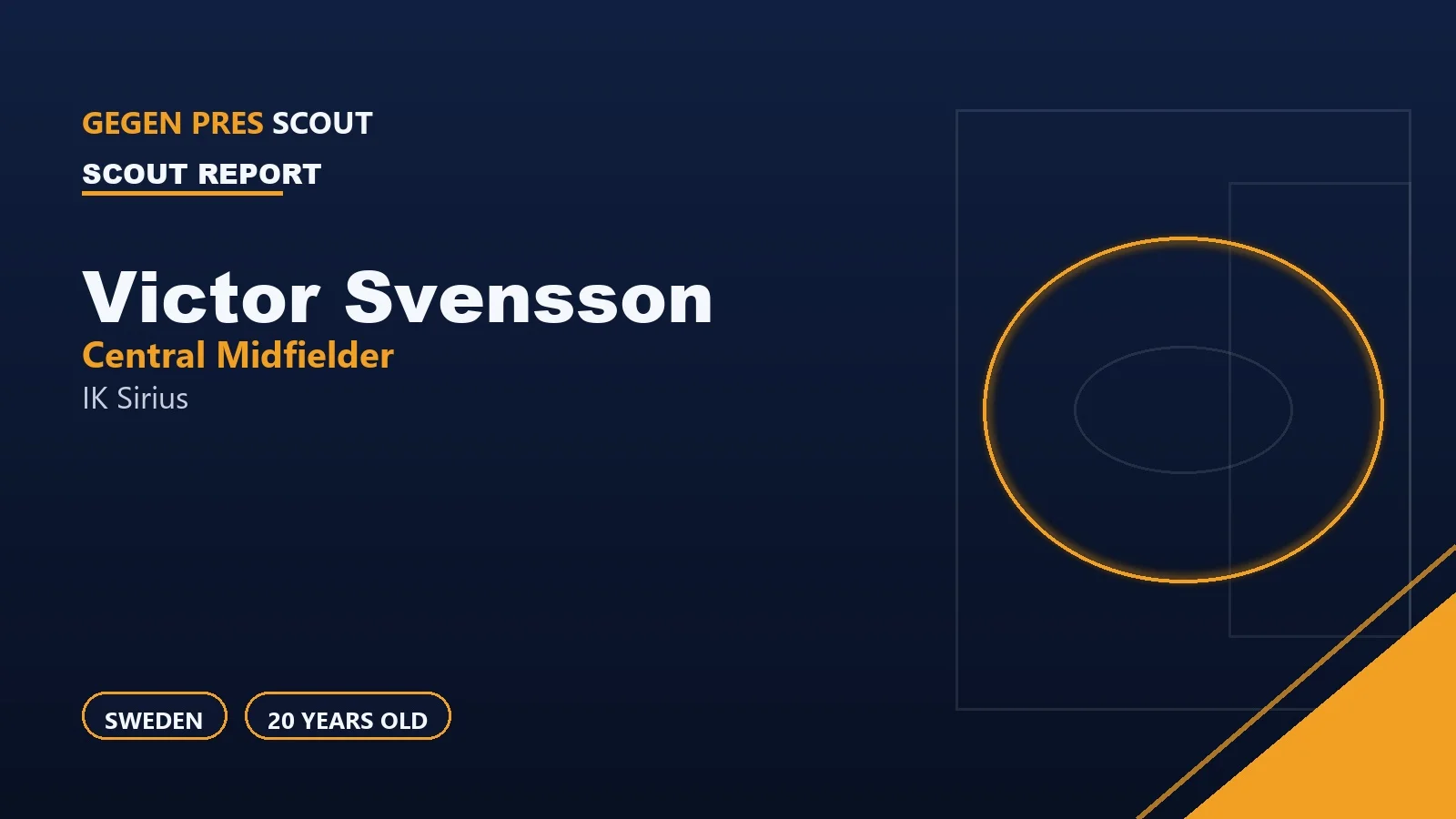

When a Swedish club ties down a player it produced in its own city for five more years, that alone says where he sits in the squad plan. Victor Svensson was born in Uppsala, joined IK Sirius at twelve, spent a spell at Dalkurd in between, and by the spring of 2026 had become a fixed name in the Allsvenskan starting eleven. In June 2026 his contract was extended to the summer of 2031. This report looks at the twenty-year-old’s season data, the areas where he separates himself and the areas where he still falls short.
| Mevki | Central Midfielder |
|---|---|
| Kulüp | IK Sirius |
| Uyruk | Sweden |
| Yaş | 20 |
| Doğum | 10.06.2006 |
| Boy | 1.80 m |
| Ayak | Right |
| Piyasa Değeri | Between €390k and €1.6m (varies by platform) |
| Sözleşme | Until summer 2031 |
The framework: his full name is Victor Max Robert Svensson. Born on 10 June 2006 in Uppsala, he is 1.80 m tall, right-footed and wears the number 24 shirt. He started playing at four with Danmarks IF, joined IK Sirius’s academy at twelve and then moved on to Dalkurd FF. In 2021, aged fifteen, he became the youngest player to make a senior elite-level debut for Dalkurd. His Allsvenskan debut came on 31 March 2025, entering in the 90th minute of a 2-1 win over IFK Varnamo. Five days after that league debut he signed a five-year professional contract with Sirius. In April 2025 he also played for Gefle IF under an under-22 partnership between the two clubs; that spell ended in June 2025. In June 2026 his contract was extended to the summer of 2031. He is part of Sweden’s under-21 setup.
Strengths
- A 1,370-minute Allsvenskan season at twenty: early and high-volume top-flight experience for his age.
- 83rd percentile for shot attempts and 86th for goals: attacking output markedly above the league’s central midfielders.
- Three goals and three assists, a balanced contribution arriving through two routes rather than one.
- A senior elite-level debut at fifteen: a record of adapting early to a large age gap.
- A contract extended to the summer of 2031, placing him as a fixed name in the club’s long-term plan.
Weaknesses
- 75.1 per cent pass completion: low for a central midfielder and a figure that raises turnover risk.
- A 51.9 per cent duel success rate: below the top-league threshold in physical and positional contests.
- 48th percentile for defensive contribution: the gap against his attacking percentiles shows a two-way midfield profile has not yet formed.
- Rotated at the start of the spring: his place in the eleven was earned during the season rather than at the start of it.
- Internationally still at under-21 level, with no measurable data at senior international level.
Development Areas
The development section of Svensson’s file reduces to two clear categories. The first is accuracy in possession: 75.1 per cent is a level that calls into question a central midfielder’s reliability in the build-up. That figure usually drops for one of two reasons, either because the player consistently selects the riskier transfer or because his decision time lengthens under pressure. Given his share of Sirius’s attacking output the first explanation looks stronger, but lifting the number is a compulsory item for any step up. The second area is duels: 51.9 per cent is an indicator a twenty-year-old would be expected to raise alongside physical development, and in its current state it adds load to the team in defensive transitions. The third and more structural area is closing the gap between his defensive and attacking contributions. Today’s profile describes a midfielder whose production is measurable but who sits below average in the defensive phase; for that profile to last in a league above the Allsvenskan he needs either clearer specialisation in one phase or a genuine balance across both.
Contract Situation
Svensson signed a five-year professional contract with Sirius in April 2025, five days after his Allsvenskan debut. In June 2026 that contract was extended to the summer of 2031, meaning the club pushed his commitment five years further while his first full season was still under way. In the youth policy of Swedish clubs this move is a standard protective reflex: under-twenty-one players who stand out in the Allsvenskan are usually exposed early to interest from clubs in the Netherlands, Belgium and the German second tier, and a long contract is the club’s tool for protecting its negotiating position. Market value records range between €390k and €1.6m across platforms, a spread caused by valuation models diverging for young players with limited top-flight history. Because of the length of the contract, movement on this file will depend less on the player’s performance than on the club’s timing of a sale.
Career Projection
What will be measured over the next twelve months is whether the 2026 output rate repeats across a second season. It is common for a midfielder producing three goals and three assists in the Allsvenskan at twenty not to hold those numbers the following year; opponents come to know the player and build their defensive plans around him, which is why a second season is almost always harder than a first. Should Svensson clear that threshold, he settles at twenty-one into the category of the Allsvenskan’s few productive midfielders and the standard transition route from the Nordic leagues to Europe’s mid-tier opens up. Should the passing and duel numbers stay where they are, his ceiling remains defined within the Allsvenskan; the profile of a midfielder who plays in this league for years, contributes production, but does not move up is a category with countless examples in Sweden. Holding his place in the Sweden under-21 squad will be decisive for keeping his visibility in the period ahead.
A central midfielder who closed his first full 1,370-minute Allsvenskan season at twenty with three goals and three assists and sits in the league's upper percentiles for attacking output, but whose pass completion and duel success remain below the top-league threshold.
Pass completion moving into the eighty per cent band and duel success rising measurably in the defensive phase.
This report was prepared by cross-checking data from Swedish Wikipedia, FotMob, Sofascore, the official Allsvenskan player page and Fotbollskanalen. Because the market value item differs across platforms, it is given as a range rather than a single figure. GEGEN SCORE is an editorial assessment score combining technical, tactical, mental, physical, potential and risk components; it is a comparison tool, not a transfer decision on its own. Last updated: 22 September 2026.
Hamza Aydogan — Gegen Pres Scandinavia correspondent. He follows academy output in the Norwegian, Swedish and Danish leagues.