
Juan Musso Scout Report: Atlético Madrid’s New No. 1

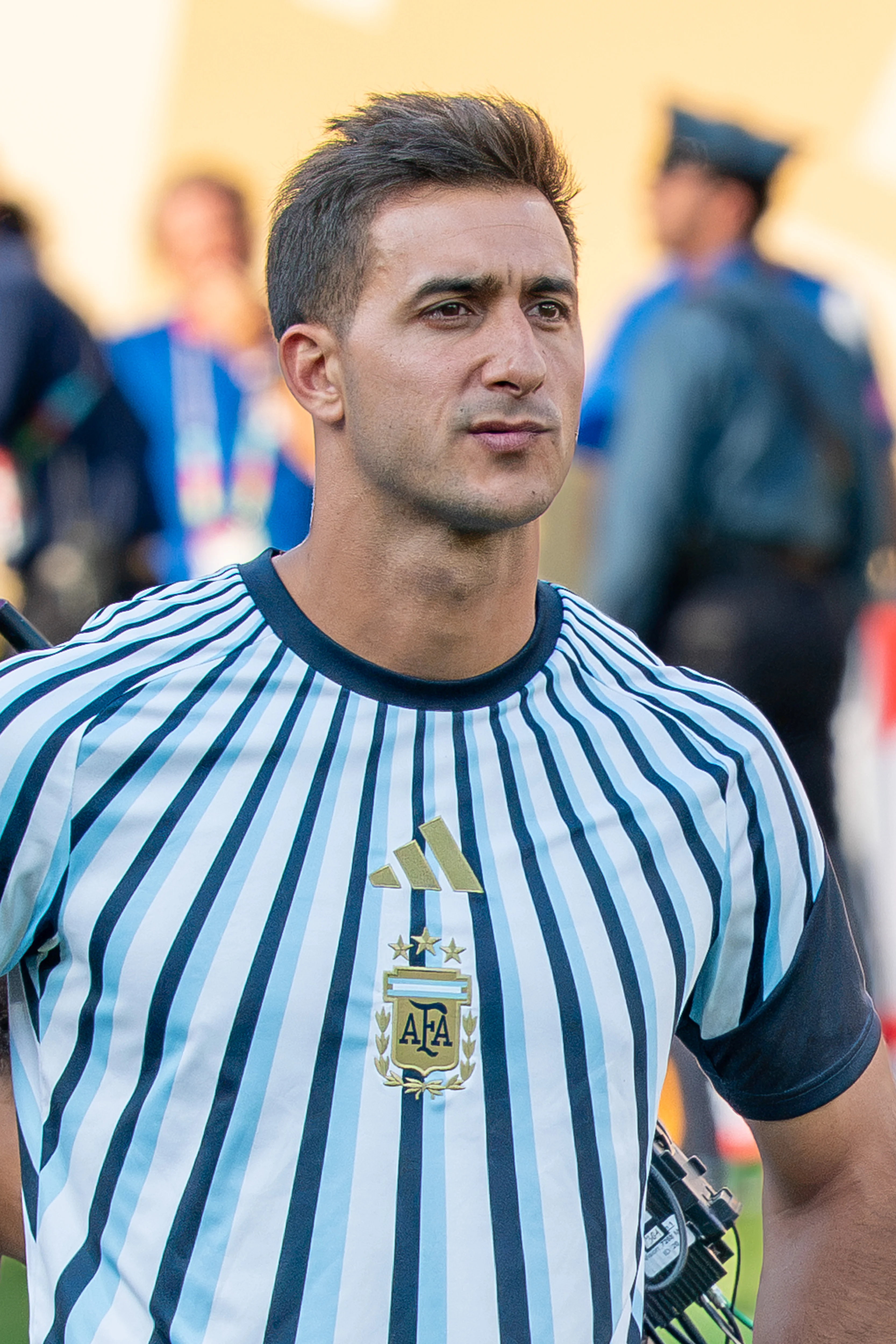

Quick take: When Atlético Madrid revealed its 2026-27 squad numbers, the headline wasn’t a marquee attacking signing — it was a symbolic swap in goal. Jan Oblak, the club’s captain and undisputed No. 1 for fourteen years, moved to the No. 13 shirt, while Argentine goalkeeper Juan Musso inherited the No. 1. GegenSports breaks down the journey that took Musso from Racing Club through Udinese and Atalanta to Madrid, his run to the 2026 World Cup final with Argentina, his playing style, and — crucially — the gap between what the shirt number promises and what has actually happened on the pitch so far.
Who Is Juan Musso?
Juan Agustín Musso was born on 6 May 1994 in San Nicolás de los Arroyos, Buenos Aires Province, Argentina. Standing 1.91m (some sources list 1.93m) and weighing around 93kg, he came through Racing Club’s academy after starting out at Defensores de Villa Ramallo, making his senior debut for Racing in 2017. In July 2018 he moved to Udinese in Serie A, where he made roughly 104 appearances across three seasons before a July 2021 transfer to Atalanta — reportedly worth around €20-20.5m, though neither club has confirmed an exact figure. At Atalanta he won his first major trophy, the 2024 UEFA Europa League, beating Bayer Leverkusen 3-0 in the Dublin final built around an Ademola Lookman hat-trick.
The Move to Madrid
Musso joined Atlético on loan on 27 August 2024, presented explicitly as competition — and a possible long-term successor — for Jan Oblak. The move was made permanent on 10 June 2025 for a reported fee in the region of €3m plus roughly €1m in add-ons, well below the reported €7m buy option in the original loan deal. He signed through 30 June 2028.
Ahead of 2026-27, Atlético restructured its goalkeeper numbering: Musso took the No. 1, Oblak moved to No. 13. It reads as a clear statement of intent. Yet as of 13 September 2026, when this report was compiled, Diego Simeone had started Oblak in every single competitive fixture of the season — La Liga matchdays 1 through 4 (including a heavy 0-3 defeat to Athletic Club) and the opening Champions League group match. Musso had not played a single minute in 2026-27. The number change may point to the future; it has not yet changed the present.
The context for that trust, however, is real. Across 2025-26, Musso made around 18 appearances (roughly 1,650 minutes) as Atlético’s primary Copa del Rey goalkeeper and an occasional Champions League starter. He started the Champions League quarter-final return leg against Barcelona while Oblak recovered from injury, making three notable stops against Yamal-Olmo-Fermín López combinations in the first leg loss as Atlético progressed 3-2 on aggregate. In the April 2026 Copa del Rey final against Real Sociedad, he saved Orri Óskarsson’s extra-time chance and then Óskarsson’s penalty in the shootout — though Atlético still lost 4-3 on spot-kicks after a 2-2 draw.

Playing Style
Musso is not the archetypal modern “sweeper-keeper” who plays a high defensive line and sprays passes from deep — Italian analysts at Atalanta noted he never fully embodied the ball-playing, aggressive-sweeping profile Gian Piero Gasperini wanted. What he does bring is old-school shot-stopping: a big frame used efficiently to close angles at close range, sound positioning, and a calm, “unspectacular but effective” style. His distribution has reportedly improved in Spain, and his reflex work in the Barcelona quarter-final was praised in the Spanish press. Historically his penalty-saving record at Udinese and Atalanta was weak, which makes his shootout save on Óskarsson in the Copa del Rey final a notable outlier rather than a trend. Spanish goalkeeping pundit Santi Cañizares summed him up well: “A magnificent second goalkeeper for Atlético — if he played regularly, at Atlético or elsewhere in La Liga, he’d be among the best in the division.”
Strengths
- Proven composure in high-stakes finals — the 2024 Europa League, the 2026 Copa del Rey final, and a Champions League quarter-final.
- Excellent physical presence for close-range shot-stopping.
- Broad continental experience across Serie A, La Liga and UEFA competitions.
- Trusted dressing-room character, per Simeone’s own public comments about his contribution beyond goalkeeping.
Weaknesses
- No guaranteed starting role even after the number change — zero 2026-27 minutes as of this report.
- Historically inconsistent penalty-saving record.
- Not a natural fit for high-risk, ball-playing sweeper-keeper systems.
- At 32, he’s a short-to-medium-term rotation solution rather than a long-term development project.
GegenSports Scout Rating
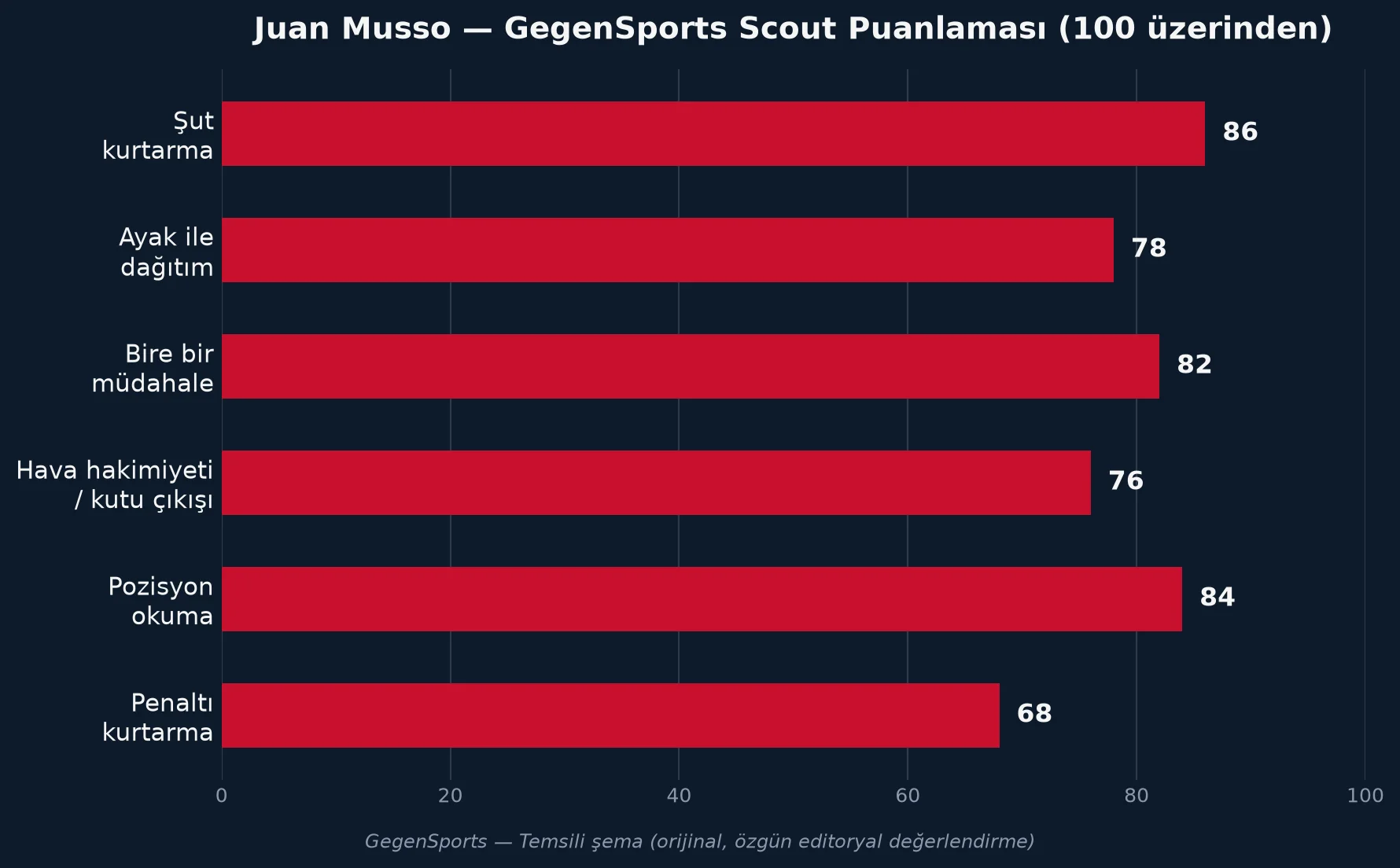
Shot-stopping 86/100, distribution 78/100, one-on-ones 82/100, aerial command/box command 76/100, positioning 84/100, penalty saving 68/100. Overall GegenSports score: 80/100 — an original editorial assessment, not an official league or data-provider rating.
Similar Players
Emiliano Martínez (Aston Villa) — same national team, similar big-game temperament, but a far more established No. 1. Wojciech Szczęsny (Barcelona) — a comparable “elite-level backup” career arc at a major club. Kepa Arrizabalaga (Arsenal) — a similar trajectory from big-money signing to rotation goalkeeper.
Süper Lig Fit
Unlike a 24-year-old world champion, Musso’s profile is a genuinely realistic Süper Lig scenario: an experienced, mid-to-upper-budget goalkeeper whose game time is uncertain at his current club. His reported market value (roughly €2-3m across conflicting sources) sits within reach of the Turkish “big three,” and his continental pedigree would suit clubs targeting a leader for European competition. His contract through 2028 makes an immediate move unlikely, but a departure in 2027 is plausible if his role doesn’t change. Purely as a tactical profile fit, Galatasaray (which has grown used to experienced, charismatic Latin American goalkeepers since the Muslera era), Fenerbahçe (chasing European consistency) and Trabzonspor (with a history of investing in experienced foreign goalkeepers) are worth naming — though no concrete talks or rumours exist as of this report.
Development Outlook & Fitness
At 32, the relevant question isn’t development potential but playing-time potential. He suffered a serious facial/orbital fracture in September 2022 at Atalanta after a collision with Merih Demiral, requiring surgery, but no other significant injury history was found — his limited minutes since have been a tactical choice by his coaches, not an injury issue.
International Status & Work-Permit Notes
As an Argentine, Musso counts against non-EU foreign-player quotas both in the Süper Lig and potentially in the Premier League, where the Governing Body Endorsement (GBE) points system would apply. Argentina’s high FIFA ranking helps in theory, but his very limited senior-cap tally (around four appearances) makes the international-caps route to automatic GBE approval unlikely; a club-career points route, drawing on his Serie A/La Liga/UEFA competition experience, would be the more probable path. This is a general framework, not legal advice.
Suitable Leagues
La Liga, Serie A, the Süper Lig (for clubs wanting a proven leader for European competition), and potentially the Saudi Pro League later in his career.
Sporting Director Summary
Musso offers proven composure in finals, wide European experience and reliable close-range shot-stopping. The 2026-27 number swap makes him Atlético’s symbolic future in goal, but as of this report Oblak remains first-choice on the pitch — making Musso an unusually interesting case of a goalkeeper positioned for a job he hasn’t yet taken. For Süper Lig clubs seeking continental-tested goalkeeping depth at a reasonable price, he’s a realistic target, contract permitting.
FAQ
Who is Juan Musso?
Atlético Madrid’s Argentine goalkeeper, formerly of Udinese and Atalanta, a 2024 Europa League winner and a member of Argentina’s 2026 World Cup final squad.
Why did his shirt number change?
Ahead of 2026-27, Atlético gave Musso the No. 1 and moved longtime captain Jan Oblak to No. 13 — widely read as a symbolic passing of the torch.
Is Musso now Atlético’s starting goalkeeper?
Not yet in practice — as of 13 September 2026, Oblak had started every match of the season despite the number swap.
What trophies has Musso won?
The 2024 UEFA Europa League with Atalanta; he lost the 2026 Copa del Rey final with Atlético on penalties.
Did Musso play at the 2026 World Cup?
He was Argentina’s third-choice goalkeeper behind Emiliano Martínez. Argentina lost the final 1-0 to Spain.
What is Musso’s market value?
Estimates vary widely between roughly €1.8m and €3.4m depending on the source, with most figures clustering around €2-3m.
When does his contract expire?
30 June 2028.
Could Musso move to the Süper Lig?
No concrete talks exist, but his age, price range and experience make it a far more realistic scenario than for most of Atlético’s outfield stars.
Who is Musso statistically similar to?
Emiliano Martínez, Wojciech Szczęsny and Kepa Arrizabalaga are the most commonly cited comparisons.
Has Musso had major injuries?
A facial fracture in September 2022 at Atalanta; no other significant injury history was found.
Related GegenSports Content
- Obed Vargas Scouting Report: From Alaska to Atlético Madrid
- Íñaki Williams Scout Report: Athletic Club’s Ghanaian Captain
- Nico Williams Scout Report: Athletic Club’s World Champion No. 10
- Unai Simón Scout Report: Athletic Club and Spain’s No. 1
- What Is a Sweeper-Keeper? From Manuel Neuer to Modern Football
Sources
- Wikipedia — Juan Musso, 2026-27 Atlético Madrid season, 2026 FIFA World Cup Final
- footballtransfers.com — career statistics
- LaLiga.com, UEFA.com — current squad and shirt numbers
- ESPN, Flashscore, OneFootball — transfer and contract reporting
- La Tercera, Récord, TVAzteca — career profile and World Cup context
- Rivista Undici, French Football Weekly — playing-style and comparative statistical analysis
- Football Italia — 2022 injury reporting