
Cristian Romero Scout Report: Atlético Madrid’s Argentine Captain

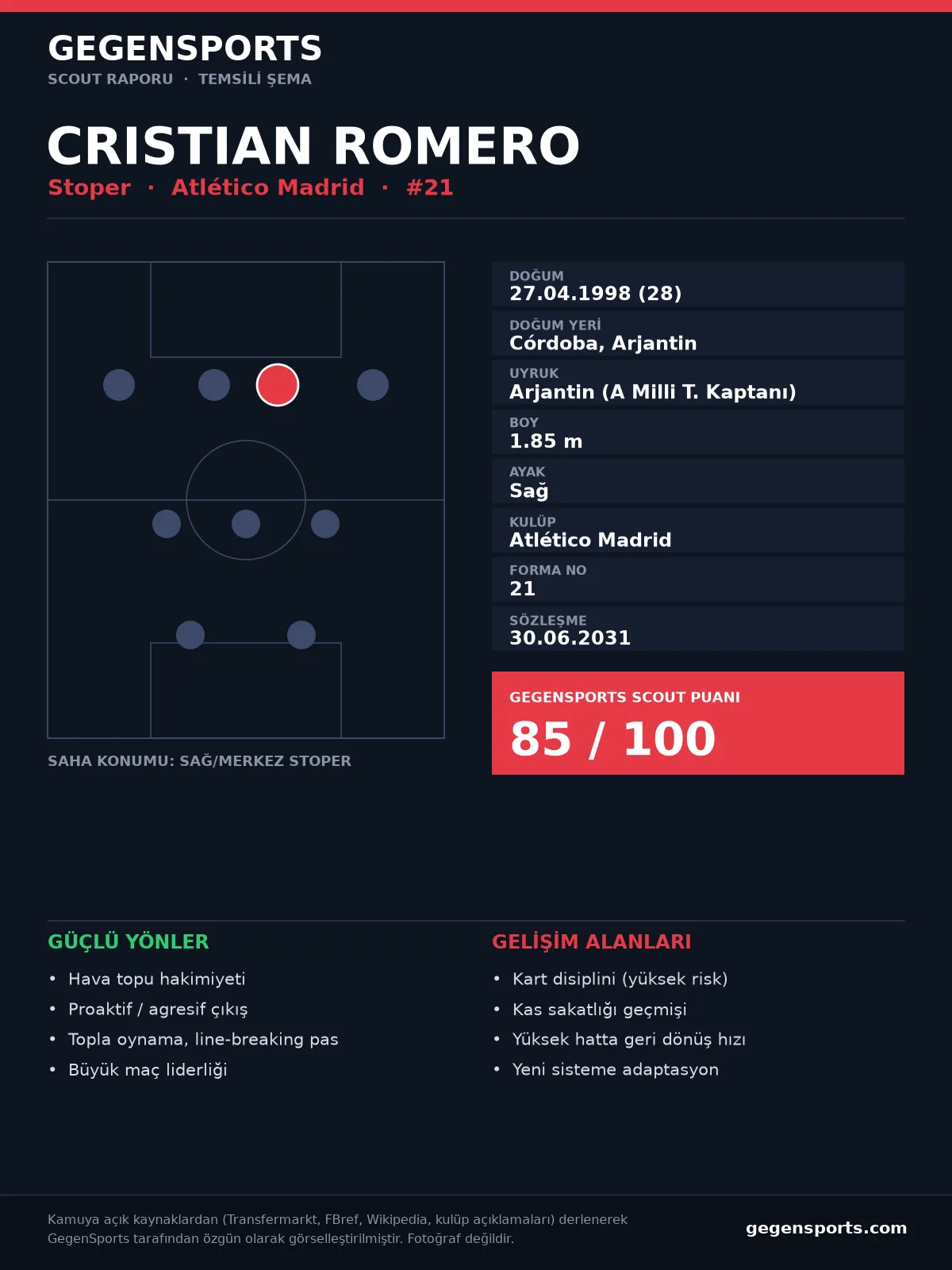

Sources: club statements (Atlético Madrid, Tottenham Hotspur), Transfermarkt, Wikipedia, FBref, Premier League official stats, ESPN, beIN Sports, Soccerway. Full bibliography at the end of this report.
Published: 15 September 2026 — GegenSports Scout Desk
Quick Scout Verdict
Cristian “Cuti” Romero, the 28-year-old Argentine centre-back, joined Atlético Madrid from Tottenham Hotspur in August 2026. A 2022 World Cup winner, two-time Copa América champion and the captain who lifted Tottenham to their first European trophy in 41 years (the 2024-25 UEFA Europa League), Romero arrives in Madrid at the peak of his career, with a profile that fits Diego Simeone’s defensive philosophy almost by design. Across seven European seasons at Genoa, Juventus, Atalanta and Tottenham, he built a reputation as a “proactive”, occasionally reckless centre-back: comfortable stepping out of the defensive line to intercept play early, dominant in the air, and willing to attempt line-breaking passes that start attacks from the back. That aggression is exactly what makes him a natural fit for Simeone’s high-intensity pressing structure — but it also carries the disciplinary baggage that has followed him throughout his career: 12 yellow cards and 2 reds in the Premier League alone in 2025-26. A recurring susceptibility to soft-tissue injuries (hamstring, groin, adductor) has periodically interrupted his availability, yet more than 280 senior appearances and experience in three major finals (the 2022 World Cup final, the 2025 Europa League final, and the 2026 World Cup final) mark him as one of La Liga’s most battle-tested defensive additions. As of mid-September 2026 he is still in the early stages of settling in, having made a brief substitute appearance in Atlético’s away defeat at Athletic Club — but the five-year contract running to 2031 signals the club sees him as a long-term pillar of the back line.
Personal life (verified, public information): Romero has been with Karen Cavaller since 2018 and married her in 2020; the couple have two children, Valentino and Lucy. He was granted special leave from a 2024 World Cup qualifier to be present for Lucy’s birth, a detail widely reported at the time. He has also spoken publicly about buying his mother, Rosa, a home with his first major football salary. No unverified or speculative personal details are included in this report.
1. Identity & Biography
| Info | Detail |
|---|---|
| Full Name | Cristian Gabriel Romero |
| Known As | “Cuti” |
| Date of Birth | 27 April 1998 (age 28) |
| Place of Birth | Córdoba, Argentina |
| Nationality | Argentina (captain of the national team) |
| Height | 1.85 m |
| Foot | Right |
| Position | Centre-back; can also play right-sided centre-back in a back four |
| Current Club | Atlético Madrid |
| Shirt Number | 21 |
| Contract Until | 30 June 2031 |
| Agent | No verifiable, up-to-date public representation info found; omitted accordingly |
| Market Value | Varies by source: recent estimates cluster around €35-45M; the transfer fee Atlético reportedly paid was around €40M / £34.2M |
2. Career & Transfer History
| Period | Club | Transfer Type / Fee | Source Tag |
|---|---|---|---|
| 2014-2016 | Club Atlético Belgrano (Youth) | Academy product | — |
| 28 August 2016 | Belgrano (First Team, Argentina) | Senior debut vs Independiente | — |
| 2016-2018 | Belgrano (First Team) | 16 league appearances, 19 total across two seasons | — |
| July 2018 | Genoa (Italy, Serie A) | First move to Europe; fee not officially confirmed | reported |
| 12 July 2019 | Juventus | Signed for a reported ~€26M, loaned back to Genoa same day | reported |
| 2019-2020 | Genoa (on loan from Juventus) | Season-long loan | — |
| 5 September 2020 | Atalanta (on loan from Juventus) | Season-long loan; named Serie A’s Best Defender 2020-21 | — |
| 6 August 2021 | Atalanta (permanent) | Buy option exercised for a reported ~€16M | reported |
| 15 August 2021 | Tottenham Hotspur (loan from Atalanta, with option to buy) | Season-long loan; debut vs Manchester City | — |
| 30 August 2022 | Tottenham Hotspur (permanent) | Permanent transfer, five-year deal; reported fee around £42-47M | reported |
| 2025-26 season | Tottenham Hotspur | Named club captain; contract extended to 2029 | officially confirmed |
| May 2025 | Tottenham Hotspur | UEFA Europa League title, Man of the Match in the 1-0 final win over Manchester United; named Player of the Tournament | officially confirmed |
| 15 August 2026 | Atlético Madrid | Permanent transfer, five-year contract to 2031; fee reported at around €40M / £34.2M, never officially confirmed by either club | reported |
Note: Both Atlético Madrid and Tottenham confirmed the transfer took place but never disclosed the exact fee. Figures ranging from roughly €35M to £34.2M (about €40M) circulate across sources; readers should treat all fee figures in this report as reported/estimated rather than confirmed.
3. Season Statistics (Last Three Seasons)
| Season | Club | Competition | Apps | Goals | Assists | Minutes | Yellow/Red | Tackles/90 | Interceptions/90 |
|---|---|---|---|---|---|---|---|---|---|
| 2023-24 | Tottenham Hotspur | All competitions | ~34 (approximate, sources vary) | ~2 | Limited data | ~2,900 (approx.) | Limited data | Limited data | Limited data |
| 2024-25 | Tottenham Hotspur | All competitions (PL + UEL + cups) | 40 | 6 | Limited data | 3,254 | 13 / 2 | Limited data | Limited data |
| 2025-26 | Tottenham Hotspur | Premier League (23) + Champions League (8) | 31 (23 PL + 8 UCL) | 5 (4 PL + 1 UCL) | Limited data | Limited data | 12 / 2 (PL only) | 2.78 (PL) | 1.49 (PL) |
| 2026-27 (start) | Atlético Madrid | La Liga | 3 (as of September 2026, brief cameos) | 0 | 0 | Limited (settling-in period) | 0 / 0 | Not yet meaningful | Not yet meaningful |
His 12 yellow and 2 red cards in the Premier League alone during his final full Tottenham season (2025-26) put a concrete number on the disciplinary cost of his aggressive style. His first Atlético appearance came off the bench in a 3-0 defeat at Athletic Club in La Liga matchday 4; the sample is still far too small to draw conclusions.
4. Style of Play
Romero is one of the clearest modern examples of the “proactive centre-back” archetype. Rather than sitting passively and waiting for play to come to him, he regularly steps out of his defensive line — pushing forward to meet the ball or the attacker before an attack fully develops. Combined with a high defensive line, this approach carries both a high ceiling and real risk: a well-timed step kills an attack before it starts, while a mistimed one hands the opponent a gap and, often, a card.
His physicality and timing in the air make him a genuine goal threat at both ends — his 19 career goals for a defender are a notable data point. On the ball, he shows the composure associated with good “press resistance” (the ability to retain the ball and make the right decision under an opponent’s pressure) and is willing to attempt line-breaking passes — vertical balls that cut through a defensive or midfield line — turning him from a purely destructive defender into one who can also initiate attacks. His positional versatility lets him play as either the central or right-sided centre-back in a back four, or slot into a back three.
There is a genuine tactical tension between Simeone’s historically compact, counter-attacking Atlético and Romero’s high-line, proactive instincts. Given that Simeone’s sides have trended toward a more possession-based, higher defensive line in recent seasons, Romero’s profile actually sits right at the centre of that evolution — capable of both traditional Atlético disciplines (tight marking, physical duels) and the more progressive demands of build-up play. How this plays out in practice will depend heavily on role allocation and the chemistry he builds with fellow centre-backs like Le Normand or Hancko. He is also expected to be a factor at both ends of set pieces, and has the physical profile to hold down a starting berth across league and Champions League football rather than remain purely a rotation option.
The flip side of that aggression is a recurring discipline problem — his career yellow/red card tally reflects it directly — and his sprint/recovery speed can occasionally be exposed by elite wide players in behind a high line, particularly the space left when he steps out.
5. Strengths
- Aerial dominance and goal threat: Physicality and timing give him control of both boxes; 19 career goals is a rare tally for a centre-back.
- Proactive, aggressive defending: A willingness to step into midfield and cut attacks off early fits naturally into Simeone’s high-intensity pressing structure.
- Ball-playing and line-breaking passing: Comfortable under pressure, able to launch attacks directly from the back line.
- Big-match and leadership experience: A 2022 World Cup winner, 2026 World Cup finalist, Man of the Match in the 2025 Europa League final, and a former Tottenham captain — a proven big-occasion character.
- Positional flexibility: Capable in both back-four and back-three systems, as either a central or right-sided centre-back.
6. Weaknesses
- Disciplinary risk: 12 yellow and 2 red cards in the Premier League alone in 2025-26 — a concrete cost of his aggressive approach.
- Recurring soft-tissue injuries: Hamstring, groin, adductor and thigh issues have periodically disrupted his continuity.
- Recovery speed behind a high line: Can be exposed by elite pace on the counter, particularly in the space created by his own step-outs.
- Adaptation uncertainty: Still early in his settling-in period at La Liga and under Simeone as of September 2026; too small a sample to judge consistency.
7. Original GegenSports Scout Score: 85/100
This score is derived from a weighted blend of: aerial and physical dominance (9/10), ball-playing and progression quality (8/10), big-match/leadership experience (9/10), discipline and risk management (6/10), and durability/injury history (6.5/10). His elite international pedigree and leadership profile pull the score up; his card discipline and soft-tissue injury history pull it down. This is GegenSports’ own original evaluation methodology and may not align exactly with any third-party rating system.
8. Similar Players
- Nicolás Otamendi (Benfica, Argentina): A fellow “warrior” centre-back from the same national-team culture, sharing Romero’s aggression and leadership traits.
- Milan Škriniar (Fenerbahçe/PSG, Slovakia): A comparable archetype — physically dominant, strong in the air, willing to step forward.
- Marquinhos (PSG, Brazil): Shares the positional versatility and ball-playing quality, though Marquinhos carries noticeably less risk in his decision-making.
9. Süper Lig Fit
Romero’s aggressive, front-footed, aerially dominant profile theoretically suits the Süper Lig’s generally high-intensity, physically combative style. His character would align well with the defensive philosophies of clubs like Galatasaray, Fenerbahçe and Beşiktaş, who compete regularly in European competition — particularly systems that play a high line and look to build from the back. That theoretical fit, however, does not currently translate into a realistic transfer scenario, for the reasons detailed below.
10. Suitable Turkish Clubs
Note: Read this section purely as a profile-fit exercise. Romero signed a contract with Atlético Madrid through 2031 only weeks ago and is positioned as a long-term pillar of the defence — there is no realistic short or medium-term transfer scenario.
- Galatasaray: Regular Champions League football and a budget for high-profile, experienced defenders make it a club that could theoretically use Romero’s leadership and big-match pedigree.
- Fenerbahçe: A stated ambition for European consistency and a need for a physical, front-footed centre-back matches the profile well.
- Beşiktaş: Under high-tempo, combative managerial setups, Romero’s proactive style could add real value.
11. Ideal Teammates
Romero is best paired with a calmer, more positionally disciplined centre-back partner (a Robin Le Normand type) who can cover the space his step-outs create. A goalkeeper comfortable as a “sweeper-keeper” — sweeping up behind a high line — helps offset his risk tolerance, and a disciplined holding midfielder (a Koke or Hjulmand type) who can screen the space left by his forward surges is similarly valuable in preserving defensive balance.
12. Adaptation Score: 78/100
Romero’s track record of successfully adapting to two very different footballing cultures — Serie A and the Premier League — is a strong reference point for his move to Spain. The language barrier should be minimal, given how close Argentine Spanish is to Castilian Spanish. However, Simeone’s tactically disciplined system, which demands strict positional obedience, could create some initial friction with Romero’s more improvisational, risk-taking instincts; as of September 2026 his limited number of appearances suggests he is still early in that adaptation curve.
13. Cost / Value-for-Money Scenarios
| Scenario | Estimated Annual Cost (Wages + Amortisation) | Assessment |
|---|---|---|
| Optimistic | High (elite-league wage level plus significant fee amortisation) | Leadership, aerial dominance and big-match experience justify the outlay quickly if full integration into Simeone’s system is achieved. |
| Base case | High | Periodic injuries and card suspensions create some inconsistency, but overall contribution remains positive as a defensive-line anchor. |
| Pessimistic | High | Recurring soft-tissue injuries and disciplinary issues undermine continuity, straining the cost-to-output ratio. |
Exact wage and amortisation figures have not been officially disclosed, so this table should be read as a qualitative scenario analysis. The five-year contract length allows the club to spread the transfer fee over a longer amortisation period, keeping annual accounting cost relatively manageable in the early years — though a five-year deal for a 28-year-old also carries the classic risk of a performance/age-curve decline in its final seasons.
14. Development Potential
At 28, Romero is past the “development” phase of his career and into its peak/maturity phase. Expectations should therefore focus less on technical growth and more on how efficiently his existing toolkit — leadership, aerial ability, ball progression — can be deployed within a new tactical system. His most realistic area for improvement is discipline and injury-prevention management to maximise time on the pitch; if that improves, the consistency of an already high ceiling should follow.
15. Injury & Availability History
Romero’s medical record is defined by recurring soft-tissue issues: a hamstring injury that sidelined him for 4-5 weeks in December 2023, a thigh injury between December 2024 and March 2025, an ankle issue in November-December 2024, and a brief groin/adductor problem in October 2025 are among the notable entries. None of these have been career-threatening, but collectively they have cost him meaningful match time and remain a real continuity risk. Against that, reaching 40 appearances in 2024-25 shows he can also absorb a heavy workload despite the injury history.
16. Non-EU Quota & UK Work Permit Analysis
As an Argentine national with no publicly verifiable EU/Italian/Spanish passport on record, Romero is expected to occupy a non-EU roster slot in La Liga. In a hypothetical return to England, his five completed Premier League seasons, 58 senior caps for a consistently high-FIFA-ranked Argentina side, and elite tournament pedigree mean he would comfortably clear the automatic-qualification criteria of the UK’s points-based Governing Body Endorsement (GBE) system. In a hypothetical Süper Lig move, he would fall under the Turkish Football Federation’s current foreign-player quota rules, but his profile fits the kind of marquee overseas slot clubs typically reserve for a headline defensive signing.
17. Suitable Leagues
- La Liga (current league): Already a physical and tactical match; the adaptation process is ongoing.
- Premier League: Five successful seasons already prove he is adapted to its pace and physicality.
- Serie A: The league where he first successfully adapted to European football (Genoa, Atalanta), with a tactical culture that suits his discipline needs.
- Süper Lig: A theoretical stylistic fit given his physicality and big-match pedigree, but not realistic in the short term given his current contract status.
18. Sporting Director Summary
Cristian Romero is a centre-back who tends to quickly become one of the leadership voices in any squad he joins, capable of deciding matches in the air and in big occasions, with a risky but effective overall profile. For a sporting director, this should be read less as a guarantee of short-term output and more as a long-term investment in leadership and experience. If his disciplinary record and soft-tissue injuries can be managed, the investment should largely pay for itself; if not, continuity problems could produce a performance level disproportionate to the cost.
19. Frequently Asked Questions (FAQ)
Who is Cristian Romero?
The captain of the Argentina national team and Atlético Madrid’s Argentine centre-back; a 2022 World Cup winner and a key figure in Tottenham’s 2025 UEFA Europa League title.
Why is Cristian Romero called “Cuti”?
It is a common Argentine football nickname; no verifiable, publicly confirmed origin story exists.
When and for how much did Romero join Atlético Madrid?
On 15 August 2026, for a reported fee of around €40M (£34.2M), on a five-year contract to 2031; neither club has officially confirmed the exact figure.
What is Romero’s shirt number?
He wears number 21 at Atlético Madrid.
What position does Romero play?
Centre-back; he can play centrally or on the right side of a back four, and also fits into back-three systems.
What is Romero’s biggest strength?
Aerial dominance, a proactive/aggressive defensive approach, and big-match experience stand out as his main strengths.
What is Romero’s biggest weakness?
Card discipline (a high yellow/red card count) and recurring soft-tissue injuries are his main risk areas.
Could Romero move to the Süper Lig?
Not realistically in the short or medium term — his new contract with Atlético Madrid through 2031 and his central role in the club’s defensive plans make this effectively impossible right now. The Süper Lig section in this report is a profile-fit exercise only.
What did Romero achieve at the World Cup?
He won the tournament with Argentina in 2022, and reached the final again in 2026, scoring his first World Cup goal in the round of 16 against Egypt.
Was Romero captain at Tottenham?
Yes — he was named club captain for the 2025-26 season and was Man of the Match in the May 2025 UEFA Europa League final.
Which players are comparable to Romero?
Nicolás Otamendi, Milan Škriniar and Marquinhos are among the names comparable in aggression, aerial strength and leadership.
20. Related GegenSports Reading
- Robin Le Normand Scout Report: Atlético Madrid’s Spanish Centre-Back
- Dani Martínez Scout Report: Atlético Madrid’s Young Centre-Back from Zaragoza
- Marc Pubill Scouting Report: Atlético’s Versatile Right-Back
- What Is a Modern Centre-Back? The Rise of the Ball-Playing Defender
- Süper Lig Scout Notes: What Is a High Defensive Line?
21. Bibliography
- Club Atlético de Madrid, official statements and news page (en.atleticodemadrid.com)
- Tottenham Hotspur, official club site and player profile (tottenhamhotspur.com)
- Wikipedia, “Cristian Romero” entry
- Premier League official statistics database (premierleague.com)
- FBref.com, player statistics page
- ESPN FC, player profile and transfer coverage
- beIN Sports, transfer analysis and club statements
- Soccerway, injury history data