
Pau Cubarsí Scouting Report: Barcelona’s Ball-Playing Centre-Back


Quick Scout Answer
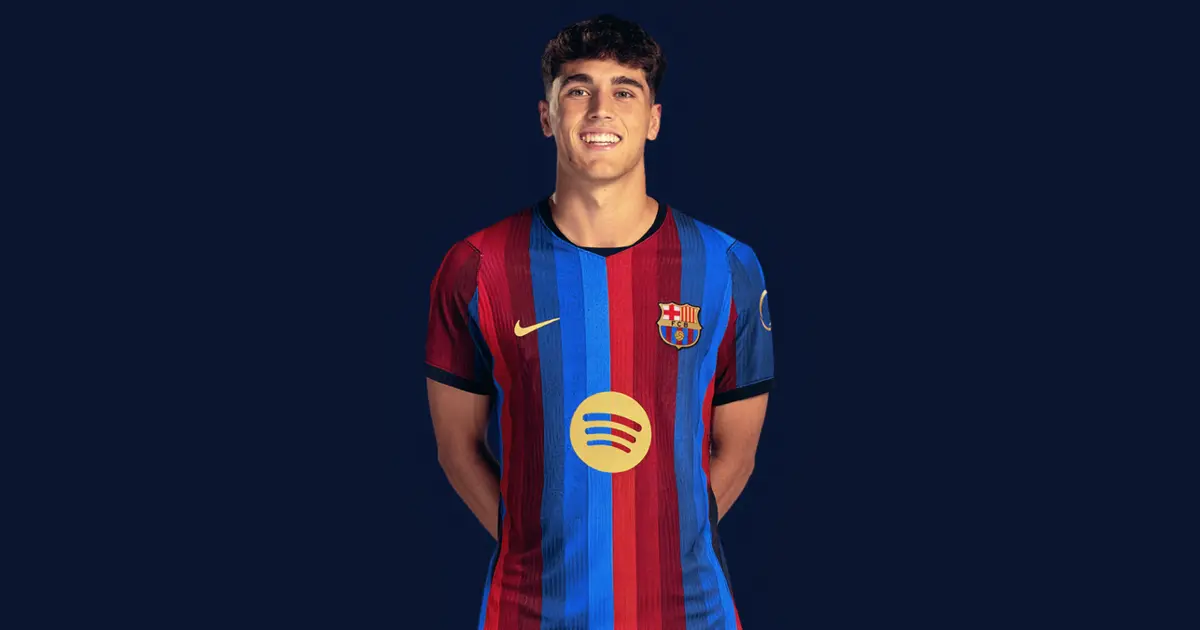
Pau Cubarsí is a right-sided, right-footed (as widely reported) ball-playing centre-back who, at 19, already holds a first-team role at FC Barcelona and in the Spain national team. The headline case is simple: he combines secure, forward-looking distribution from the back with the positional discipline needed to defend a high line, and he has done so in matches that carry real weight, including the 2026 World Cup final. The club lists him at 183 cm and 79 kg, and he is under contract until 30 June 2029 according to a club-adjacent listing.
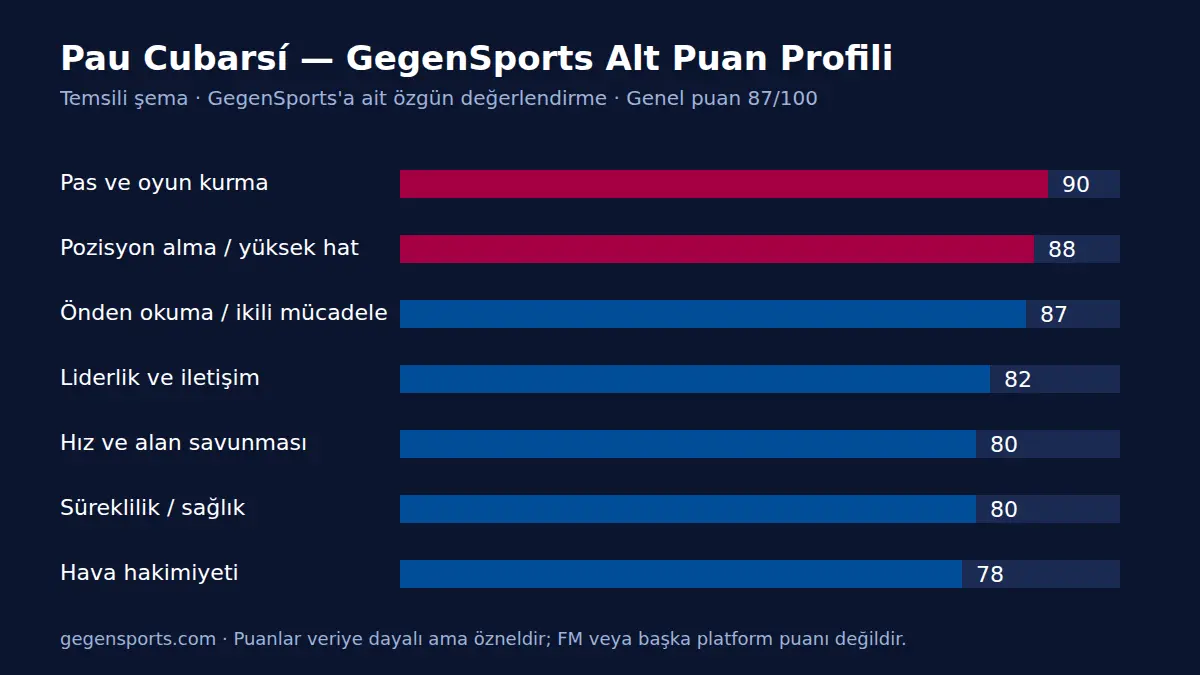
The GegenSports score is 87/100. The strongest component is pass and build-up quality (90), followed by positioning in a high line (88) and anticipation and duels (87). The softer areas are aerial work (78), recovery pace in large spaces (80) and durability (80, a cautious mark because his injuries have all been short, but the sample is still young). The main risks are system dependence, a still-small sample against elite runners in open space, and a mixed aerial record at the start of 2026/27.
For a Süper Lig audience, this is a profile exercise only. A Transfermarkt record of about €80m plus a contract to 2029 means no Turkish club could realistically sign him. We use him to describe what a modern ball-playing centre-back looks like and which Turkish teams’ tactical models would suit that type.
Identity and Biography
The table below keeps to basic, publicly verified biographical information. Where sources disagree, we say so rather than choose silently.
| Item | Detail | Source note |
|---|---|---|
| Full name | Pau Cubarsí | FC Barcelona official site |
| Date of birth | 22 January 2007 (age 19 in October 2026) | FC Barcelona official site |
| Birthplace | Estanyol (club page); Wikipedia gives Bescanó | Sources conflict; both are in the Girona area, and we do not resolve the difference |
| Nationality | Spanish (EU national) | National team records |
| Position | Centre-back, right-sided in a back four | Club listing; side and foot as widely reported |
| Height / weight | 183 cm / 79 kg | FC Barcelona official site |
| Shirt number | 5 (2026/27) | FC Barcelona official site |
| Club | FC Barcelona | Contract to 30 June 2029 (Soccerway / club-adjacent listing) |
| Market value | About €80m (Transfermarkt record, March 2026 update as seen in a search summary); another aggregator lists €81.7m | Aggregator estimates, not fees |
| International | Spain, 22 caps, 0 goals (September 2026) | Wikipedia / Transfermarkt-type listings |
Career Path and Transfer Record
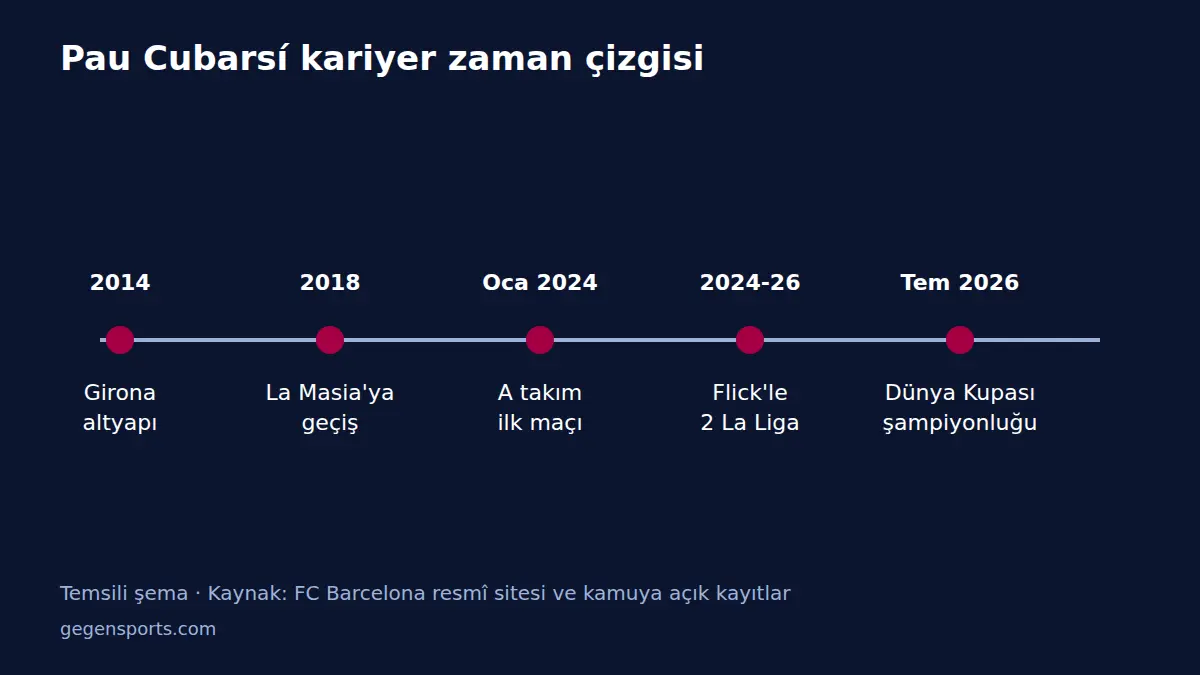
Cubarsí’s route is that of a pure academy product. He spent his early youth years at Girona (2014 to 2018) and joined Barcelona’s La Masia academy in July 2018. He has not been the subject of a conventional transfer fee at senior level, so the table labels each money-related line carefully. Nothing here is an invented figure.
| Date | Step | Fee / value | Label |
|---|---|---|---|
| 2014 to 2018 | Girona youth system | Not applicable | Youth spell |
| July 2018 | Joins La Masia (Barcelona) from Girona | No fee found in the sources we could use | Undisclosed / not reported in our sources |
| 18 January 2024 | First-team debut, Copa del Rey vs Unionistas de Salamanca, aged 16 | Not applicable | Official (club page and Wikipedia) |
| January 2024 | La Liga debut, days later, vs Real Betis | Not applicable | Reported |
| 12 March 2024 | Champions League knockout debut vs Napoli; reported as Player of the Match and youngest to debut in the knockout phase (17 years, 50 days) | Not applicable | Wikipedia, single source |
| March 2024 | Spain senior debut, friendly vs Colombia, aged 17 | Not applicable | Reported |
| 2024 | Olympic gold with Spain | Not applicable | Official (club page) |
| Through 30 June 2029 | Current contract | Terms undisclosed | Undisclosed (end date from a club-adjacent listing) |
| March 2026 | Market value about €80m | About €80m | Transfermarkt record (not a fee); another aggregator shows €81.7m |
| Any future move | Hypothetical | Any figure would be an estimate | Estimated (see the scenarios below) |
Honours
- La Liga: 2024/25 and 2025/26 (club page).
- Copa del Rey: 2024/25.
- Spanish Super Cup: 2024/25 and 2025/26.
- Olympic gold medal with Spain, 2024.
- 2026 World Cup with Spain, including the Best Young Player award.
Season Stats and What They Show
Defender statistics need care. Counting tackles and clearances rewards centre-backs who face many attacks, while a player in a dominant, high-possession team may defend less often but in more exposed situations. We therefore read volume numbers (tackles, clearances) next to context (minutes, system) and avoid ranking him on a single number. We also separate official club figures from aggregator figures, which sometimes disagree.
| Season / scope | Appearances | Other figures | Source type |
|---|---|---|---|
| 2024/25, all competitions | 56, regular starter under Hansi Flick | No further detail in our sources | Official (club) |
| 2025/26, all competitions | 48 (45 starts) | First La Liga goal, vs Girona | Official (club) |
| 2025/26, all competitions (conflicting) | 46 | 1 goal, 3 assists | Aggregator (Sportbusy / Livescore-type). It disagrees with the club count, so treat 46 to 48 as the range. |
| La Liga 2025/26 | 31 (31 starts), 2,703 minutes | 1 goal, 0 assists, 42 tackles (28 won), 30 interceptions, 158 clearances, 25 fouls, 3 yellow cards | Aggregator, via a search summary. Not official. |
| Career, Barcelona (through September 2026) | 90 league apps; 134 total club apps | 1 league goal; 2 total goals | Wikipedia |
| Top-five-league career (90 apps) | 90 | 1 goal, 3 assists, 25 clean sheets, 6 blocked shots | Statmuse (aggregator) |
| La Liga 2026/27, early October | 5 (5 starts), 331 minutes | 23 clearances, 16 aerial duels won and 6 lost | Statmuse (aggregator) |
| Champions League 2026/27, early October | 1, 90 minutes | 7 clearances, 3 aerial duels won and 4 lost | Statmuse (aggregator) |
Reading the numbers
The 2025/26 La Liga line is the most useful one. Thirty-one starts in 31 appearances shows that he was the first-choice option rather than a rotation player. About 2,703 minutes across 31 matches is roughly 87 minutes per appearance, so he rarely came off. His tackle success is 28 of 42, about two-thirds. This is a derived figure from the aggregator numbers, so it carries the same caveat. A centre-back in a high-line team is often defending in space, where a failed challenge can be costly, so a two-thirds rate with only 25 fouls in the season suggests a defender who chooses his moments rather than lunging.
Thirty interceptions and 158 clearances over roughly 31 matches give about one interception and just over five clearances per match. The clearance figure is moderate for a team that spends a lot of time in the opposition half. Those numbers should be read as a sign of how the team is built, not as a sign of defensive passivity.
The 2026/27 sample is tiny. Sixteen aerial duels won against six lost in La Liga is a good ratio (about 73 percent), but three won and four lost in the single Champions League appearance is a reminder that one match is not a trend. We list both because a fair report cannot quote only the flattering one.
International record
For Spain, Cubarsí has 22 caps and no goals as of September 2026. At the 2026 World Cup he played every minute, and Spain beat Argentina 1-0 in the final. Spain conceded one goal in the whole tournament, in the quarter-final against Belgium, with Aymeric Laporte as his centre-back partner. At 19 years and 178 days he is the fourth-youngest player to appear in a World Cup final, behind Pelé (17y 249d), Giuseppe Bergomi (18y 201d) and Lamine Yamal (19y 6d). He also won the Best Young Player award. Wikipedia reports 668 completed passes from 690 (97 percent) across the tournament and 121 passes in the final. This is a single-source figure that should be verified before it is quoted elsewhere. Even if it holds, a pass-completion rate depends heavily on how many of those passes were short and safe, which is why the next section focuses on style.
Playing Style Analysis
The FC Barcelona biography describes him as a centre-back who provides leadership and decisiveness in defence while also being able to bring the ball out. That sentence captures the two halves of the profile. Below we break the role down and explain each term in plain language.
Ball-playing centre-back
A ball-playing centre-back is a defender whose passing and carrying are part of the team’s attack. Instead of clearing the ball long under pressure, he receives it from the goalkeeper or the full-back, and decides whether to pass short, step forward with the ball or play a longer pass to a team-mate in a better position. Cubarsí is a clear example of the type. He is comfortable taking the ball when opponents are close, and his passing choices tend to move the team forward rather than sideways.
Progressive and line-breaking passes
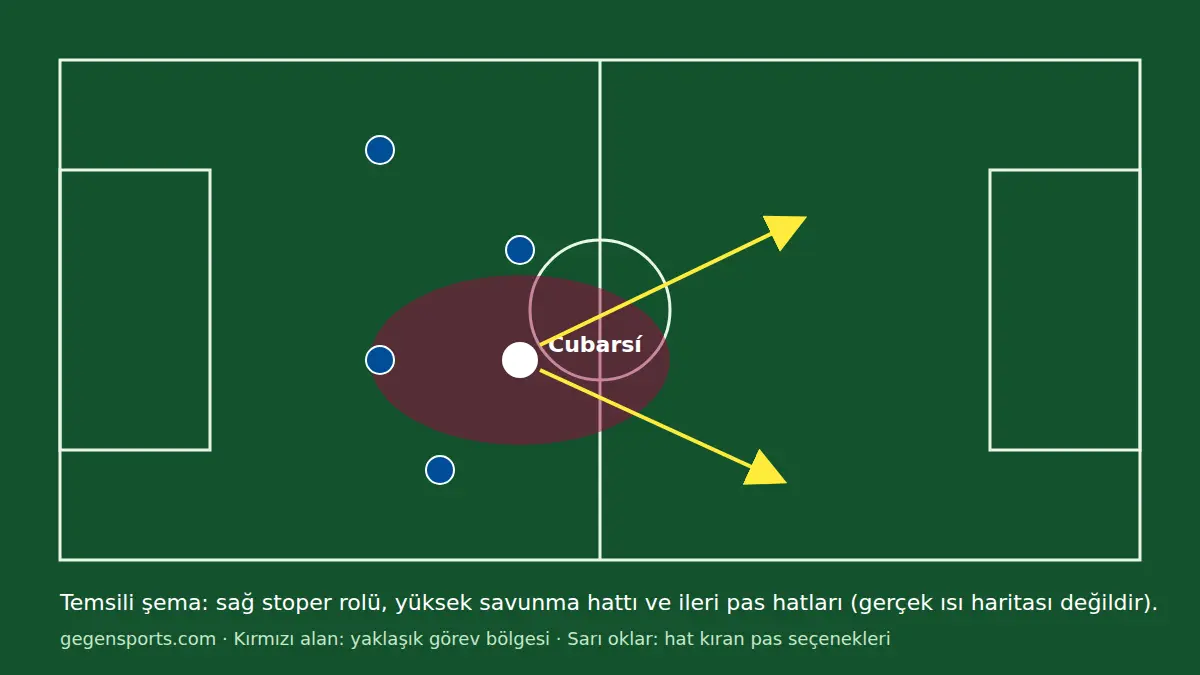
A progressive pass is a pass that moves the ball significantly closer to the opponent’s goal. Providers of data define the threshold slightly differently, but the idea is a forward pass that matters, not a recycled one. A line-breaking pass is more specific: it travels through or over a line of opposing players (for example the midfield line) and reaches a team-mate behind it. This matters because it forces the opposition to recover its shape. Cubarsí’s best moments in possession are of this type, such as a pass from the right side of defence into the feet of a midfielder who has found space between the lines. We do not have official counts of such passes for him, so our judgement here is a scout view, supported by the tournament pass-completion figure and the club description rather than by a direct statistic.
Press resistance
Press resistance is the ability to keep the ball when opponents close in quickly. It involves the first touch, body orientation (positioning the body so that the next pass is available), and the calm to wait for the pressing player to commit before releasing the ball. In the Barcelona system the centre-backs are pressed regularly by teams that want to force mistakes in the first phase of the build-up. Cubarsí’s reported composure in big matches, including a Champions League knockout debut at 17 and a World Cup final at 19, is the best available evidence that this part of his game transfers to high-pressure settings.
High defensive line and the offside trap
A high line means the back four defends far from its own goal, often near the halfway line, which compresses the pitch and keeps the opponents’ attackers further from goal. It is often paired with an offside trap, in which the defenders step forward together to put the attackers in an offside position. Under Hansi Flick, Barcelona use this approach. It puts three demands on a centre-back: reading the moment to step up, communicating with the others in the line (see leadership below) and recovering quickly when a ball is played over the top. The first two are strengths for Cubarsí. The third is the one still to be tested, and we cover it under weaknesses.
Half-spaces and covering
The half-space is the vertical channel between the centre of the pitch and the touchline, roughly the area between the full-back and the centre-back. Opposition attackers like to receive the ball there because defenders have to choose between following the runner and holding their position. A right-sided centre-back like Cubarsí is responsible for the right half-space when the right-back is advanced. His anticipation, meaning his ability to read the pass before it is played and step in, is what makes him effective there. In a team whose full-backs push forward, the right-sided centre-back often ends up defending a wide area with little cover, so this skill is essential.
Anticipation, duels and leadership
Anticipation is about positioning rather than speed: choosing where to stand so that the interception or the block is possible without a sprint. Duels are one-against-one contests, on the ground and in the air. Leadership and communication is how a defender organises the people around him, by calling the line up or down, pointing out a runner or guiding the pressing sequence. The club’s own wording stresses leadership and decisiveness, and the aggregate evidence, with a starter at 17 and a World Cup defence that conceded once, is consistent with that. We score leadership at 82, lower than his passing, because there is little public evidence of how he performs when the team is losing or when a more senior defender is absent.
Strengths
- Press-resistant ball progression from centre-back. The club bio describes the ability to bring the ball out, and the 97 percent tournament pass-completion figure (single-source, to be verified) points the same way. The scout view is that his value lies in the forward share of those passes, not in the raw percentage.
- Reading of play and anticipation. With 30 interceptions and 42 tackles in 31 La Liga appearances in 2025/26 (aggregator), alongside only 25 fouls, he wins the ball without constantly committing to risky challenges.
- Composure in major matches. A Champions League knockout debut at 17, 56 appearances in 2024/25 and 48 in 2025/26 (club), every minute of a World Cup that Spain won, and Best Young Player recognition. The sample is not small any more, even if it is still young.
- Positioning in a high line. Spain conceded one goal across the tournament, and Barcelona won La Liga in both 2024/25 and 2025/26 with him as a regular. A defence is a team product, so we do not credit this to one player alone, but a high line does not work with a centre-back who misjudges depth.
- Availability. Soccerway records four short absences, none of them long (see the injury section). Thirty-one starts in 31 La Liga appearances in 2025/26 supports that picture.
- Early leadership. The club bio highlights it directly, and the trust shown by two head coaches’ systems, from first-team debut at 16 to World Cup minutes at 19, is circumstantial support.
Weaknesses and Risks
- Small sample at peak level. The World Cup was a short tournament, and a strong defensive record over a few weeks is not proof of a stable level over a full season of 50-plus matches. We would like to see more evidence across a full 2026/27 campaign, which has only just started (5 La Liga starts, 331 minutes).
- Aerial record is mixed. In La Liga 2026/27 he has won 16 and lost 6 aerial duels, but in the single Champions League match he won 3 and lost 4. Both samples are tiny, and the aerial score of 78 is our lowest sub-score for that reason. A high line reduces the number of crosses and long balls he faces, so his aerial profile has been tested less than his passing.
- Recovery pace in open space is untested. This is a qualitative scout view, not a measured figure. Against very fast forwards running into large space behind a high line, a 183 cm centre-back must either win the first step or depend on a cover partner. We have no verified sprint-speed data to quantify it, so we do not claim he is slow, only that the evidence at the highest speeds is limited. We score pace and space defending at 80.
- Limited attacking output. One league goal in 90 league appearances (Wikipedia and Statmuse) and no international goals in 22 caps. For a team that also looks for set-piece goals, he is not currently a major attacking-corner threat.
- Foul numbers are modest, not zero. 25 fouls and 3 yellow cards in 2025/26 La Liga (aggregator) are not alarming, but when a defender plays a high line he sometimes needs a tactical foul to stop a counter-attack, and we do not have evidence of how often he does it or whether it is successful.
- System dependence. His data comes from a particular setup: Flick’s high line with Koundé, Christensen, Eric García and other neighbours. Outside that structure, with fewer protective midfielders or a lower line, the same player could look different. That is the main transfer risk, and we return to it under cost and value.
GegenSports Score: 87/100
This is an original GegenSports rating, not an industry standard. Sub-scores are scout judgements informed by the data above.
| Component | Score |
|---|---|
| Passing and build-up | 90 |
| Positioning in a high line | 88 |
| Anticipation and duels | 87 |
| Leadership and communication | 82 |
| Pace and space defending | 80 |
| Durability | 80 |
| Aerial ability | 78 |
| Overall | 87/100 |
The overall figure is not a plain average of the table, because we weight the components for a ball-playing centre-back in a possession team, where build-up and positioning carry more weight than aerial play. A score of 87 places him among the best young defenders we have rated, with the gap to the 90s explained by the lower pace, aerial and leadership marks and by the limited sample.
Similar Players
Comparisons are about specific traits. They do not imply equal quality or career outcome.
Gerard Piqué
The Barcelona lineage is the obvious link. Piqué was also a ball-playing centre-back who emerged at a young age in a possession side. The similarity is limited to build-up skill and anticipation. Piqué was taller and more of a threat at set pieces, and Cubarsí’s physical and aerial profile is different.
Aymeric Laporte
Laporte is his centre-back partner for Spain, so the comparison is easy to check. Both are comfortable with passing range and carrying the ball out. The key difference is footedness: Laporte is left-footed, Cubarsí right-footed, so they naturally balance each other on a back pair. The similarity is limited to passing range.
Marquinhos
Marquinhos became a starter at PSG at a young age and is known for positional intelligence. The link to Cubarsí is in reading the game and in the early trust of a top-level club. It does not extend to physical profile or career path.
Süper Lig Fit and Suitable Turkish Clubs
With a Transfermarkt record of about €80m and a Barcelona contract to 2029, no Süper Lig club could realistically sign Cubarsí, and we know of no approach. What follows is a style-fit exercise, not a transfer rumour, and no club named here has made or been linked with a bid in our sources.
- Galatasaray. A club that tends to play a proactive game with a high defensive line and a lot of possession. This is the closest match to his tactical habitat, because he would be asked to build from the back and defend a high line.
- Fenerbahçe. A possession-based approach where the centre-backs are expected to progress the ball. His passing range would be relevant, although the line height may vary from match to match.
- Beşiktaş. A club in a rebuilding phase. A young, composed centre-back could anchor a new back line, but the system would need to be set up around him rather than the reverse.
- Trabzonspor. A club with a record of working with young talent. The fit is more about development pathway than about financial reach.
Süper Lig adaptation would mainly involve three things: more physical, direct matches than in many European leagues, more frequent long balls into the box, and teams that often sit deep against the bigger clubs, which asks a ball-playing centre-back for patience and unlocking passes. Spain counts as foreign for the Turkish league, so TFF’s current foreign-player rule would need to be checked for the exact squad-registration implications. We do not state a number here.
Ideal Teammates
- An overlapping right-back. When the full-back pushes high, the centre-back can stay compact and step into the half-space only when needed. That is how Barcelona use him.
- A fast, aerially strong cover partner. It does not need to be left-footed, but a partner who is quick over distance and wins long balls covers the two areas where our scout view is cautious. Laporte’s left foot helps with balance in possession, though the aerial and speed cover would need to come from the pairing as a whole.
- A deep-lying midfield pivot. A Frenkie de Jong-type player who offers himself as an easy passing option and shields the back line, so that the centre-back can play forward quickly without risk.
- An alert goalkeeper who sweeps behind the line. A high line needs a goalkeeper who is comfortable coming out of the box. See our scouting reports on Wojciech Szczęsny and Dominik Livaković for two goalkeepers in the same squad.
Within the current Barcelona squad, the neighbours named in our fact base are Jules Koundé, Eric García, Christensen, Gerard Martín and Balde on the defensive line, with Joan García, Szczęsny and Livaković as goalkeepers, and Frenkie de Jong and Pedri in midfield. Cubarsí belongs to the 2007 generation with Lamine Yamal and Marc Bernal. For a closer look at a defensive team-mate, see our Eric García scouting report, and for an attacking teammate in the same squad, our Gabriel Jesus scout report.
Adaptation Score
| Context | Score | Reasoning |
|---|---|---|
| Top five European leagues | 8.5/10 | Technical and tactical profile suits possession-based sides; the main condition is a coach who plays a similar line |
| Süper Lig (theoretical) | 7.5/10 | Style fit with the bigger clubs is good; the more direct, physical match patterns and travel add friction. No transfer is realistic. |
Cost and Value Scenarios
We do not know of any bid or negotiation, and we do not invent one. The scenarios below show how value would be reasoned about, using only two anchors: a Transfermarkt record near €80m (another aggregator: €81.7m) and a contract that runs to 30 June 2029.
- Baseline. A buying club would start from the market-value range of about €80m. This is a reference point, not a price, and selling clubs often ask for more than the listing when the player is young and central to the squad. Any figure above or below it would be an estimate.
- Contract effect. With nearly three years left from October 2026, Barcelona have no time pressure, which tends to raise the asking price. If the remaining term were to shorten without a renewal, the leverage would shift toward the buyer.
- System-risk discount. A buyer would have to ask how much of his production comes from Barcelona’s structure. A club with a lower line or a less controlled midfield would be buying a similar player in a different context, and some buyers would apply a mental discount for it.
- Value upside. At 19, with World Cup and Champions League minutes, the upside is the main argument. If the aerial and pace questions are answered in the next two seasons, the market value could rise further, but we do not forecast a number.
Development Potential
He has already reached a level that most centre-backs reach in their mid-twenties, so the useful question is what remains. Three things stand out. First, aerial dominance, which tends to improve with strength and experience in timing. Second, recovery against fast attackers, where experience in reading the play earlier can offset a lack of top speed. Third, leadership, which should grow naturally as the more senior defenders age. With reasonable luck on injuries, we expect him to remain a first-choice centre-back for many seasons, but projection at 19 always carries uncertainty.
Injury and Durability
Soccerway’s injury page lists four short absences: a face injury (7 to 9 November 2024), an ankle problem (21 to 26 March 2025), an unspecified issue (5 to 9 August 2025) and a knee problem (19 to 20 September 2025). Each lasted days rather than weeks, and no long layoff is recorded. Together with 56 appearances in 2024/25, 48 in 2025/26 and a full World Cup, this supports a durability score of 80. We hold it at 80 rather than higher because a defender who plays this many matches across club and country has a high workload, and the sample is still early in his career. Injury listings on third-party sites can be incomplete, so the picture should be treated as indicative.
Foreign Status and UK Work Permit (GBE)
Cubarsí is a Spanish national and therefore an EU player. In Turkey, a Spanish player counts as foreign (yabancı) under TFF rules, and the current foreign-player regulation should be checked for the exact conditions.
For the Premier League the situation is different from the pre-Brexit period. Players from the EU no longer have automatic work rights in the United Kingdom, and most need a Governing Body Endorsement (GBE), which is a points system based mainly on senior international appearances and the standing of the player’s club and league. The caps for Spain count toward it. With 22 senior caps and a place at a World Cup winning squad, it is likely that he would pass on international appearances, but this is an analytical estimate and not legal advice. The final decision rests with the football authorities and the Home Office, and rules can change.
Suitable Leagues
- La Liga (current). The environment that has produced his best evidence, in a possession-led team.
- Premier League. High tempo and quick transitions would test his recovery pace, but the technical level of the defensive line suits his passing. Work-permit points are discussed above.
- Bundesliga. Several clubs play a high line and press aggressively, which fits the positioning and anticipation profile.
- Serie A. A more tactical league where centre-backs are expected to defend one-on-one more often. It would test the duel side of his game.
- Ligue 1 (for example PSG). A possession-heavy top club would match his style, as the Marquinhos comparison suggests.
Sporting Director Summary
Pau Cubarsí is a 19-year-old, right-sided ball-playing centre-back with an official record of 56 appearances in 2024/25 and 48 in 2025/26 (aggregators show 46 for the latter), two La Liga titles, a Copa del Rey, two Spanish Super Cups, an Olympic gold and a World Cup in which Spain conceded once. His GegenSports score is 87/100. The principal strengths are build-up under pressure, anticipation and composure. The principal questions are aerial consistency, recovery in open space, and how much of his output depends on Barcelona’s system. He is not realistically available: his Transfermarkt record is about €80m and his contract runs to 2029. For a recruitment department, he is best used as a benchmark for what to look for in a modern ball-playing centre-back, and any buyer would need to commission its own tracking data before relying on public numbers.
FAQ
Who is Pau Cubarsí?
He is a Spanish centre-back born on 22 January 2007 who plays for FC Barcelona and Spain. He came through La Masia, the club’s academy, which he joined in July 2018 from Girona.
Where was Pau Cubarsí born?
The FC Barcelona club page gives Estanyol, while Wikipedia gives Bescanó. The sources conflict, so we report both.
What position does he play?
He is a centre-back, usually on the right of a back four. He is widely reported to be right-footed.
How good is he, according to GegenSports?
Our original score is 87/100. The best sub-score is passing and build-up at 90, and the lowest is aerial ability at 78.
How many matches has he played for Barcelona?
According to Wikipedia, 134 total club appearances and 90 league appearances through September 2026. The club lists 56 appearances in 2024/25 and 48 in 2025/26, while an aggregator lists 46 for 2025/26.
Has he scored?
Wikipedia lists 1 league goal and 2 goals in total for Barcelona. His first La Liga goal came against Girona. He has no goals in 22 caps for Spain.
What did he do at the 2026 World Cup?
He played every minute, Spain beat Argentina 1-0 in the final, and he won the Best Young Player award. Spain conceded one goal all tournament. Aged 19 years and 178 days, he is the fourth-youngest player to appear in a World Cup final.
What is his market value?
The Transfermarkt record is about €80m (March 2026 update as seen in a search summary), and another aggregator shows €81.7m. These are estimates and not transfer fees.
How long is his contract?
Until 30 June 2029, according to a club-adjacent listing. The terms are not public.
Could a Süper Lig club sign him?
Not realistically. The value level and the contract length make it a theoretical exercise. Galatasaray and Fenerbahçe have the closest tactical profile in this exercise, but no approach is known.
Would he need a work permit in England?
As a Spanish player he would likely need a Governing Body Endorsement. With 22 caps he would probably score well on international appearances, but this is not a legal opinion and the rules can change.
Has he had serious injuries?
Not according to Soccerway. It lists four short absences, from one to about six days, and no long layoff.
What is a ball-playing centre-back?
A defender who uses his passing and carrying to start attacks rather than only clearing the ball. Cubarsí is a modern example.
Which players is he similar to?
We link him to Gerard Piqué for build-up and anticipation, Aymeric Laporte for passing range and Marquinhos for positional intelligence. These are partial comparisons, not equivalences.
Bibliography and Source Notes
- FC Barcelona official player page: https://www.fcbarcelona.com/en/football/first-team/players/129400/pau-cubarsi
- FC Barcelona, Pau Cubarsí, best young player at the World Cup: https://www.fcbarcelona.com/en/news/4538848/pau-cubarsi-best-young-player-at-the-world-cup
- FC Barcelona, Another record for Lamine Yamal and Cubarsí: https://www.fcbarcelona.com/en/football/first-team/news/4539074/another-record-for-lamine-yamal-and-cubarsi
- FC Barcelona, Class of 2007 dazzling in the first team: https://www.fcbarcelona.com/en/news/4462525/class-of-2007-dazzling-in-the-first-team
- Wikipedia: https://en.wikipedia.org/wiki/Pau_Cubars%C3%AD
- Soccerway injury history: https://www.soccerway.com/player/cubarsi-pau/UgTrNwCF/injury-history
- Statmuse: https://www.statmuse.com/fc/player/pau-cubars%C3%AD-8121
Note on blocked sources. Transfermarkt and FBref could not be retrieved directly (FBref returned a 403 error, Transfermarkt was blocked), and FotMob was not retrievable either. Market-value figures therefore come from search summaries and other aggregators, and detailed defensive statistics come from aggregator summaries rather than the original data providers. Treat them as indicative and verify them before quoting. Other GegenSports resources: GegenSports English home.