
Rene Hrvatin Scout Report: Istra 1961’s Young Right-Back


Quick scout take: Rene Hrvatin is a 19-year-old Slovenian right-back who moved from NK Domžale to NK Istra 1961 in January 2026. At 183 cm and right-footed, he was described by Istra’s sporting director Saša Bjelanović as a player with “pronounced attacking characteristics, great potential and room for further progress.” Having passed through every Slovenian youth level from U17 to U21, Hrvatin arrived in Croatia’s Prva HNL as a raw but athletically capable full-back whose calling card is forward running rather than the finished defensive product. With only around 500 HNL minutes so far, GegenSports views him less as a plug-and-play starter and more as a development bet who, in the right project, could be relevant for the middle tier of the Turkish Süper Lig within two to three years.
Identity & Bio
| Full Name | Rene Hrvatin |
| Date of Birth | 8 December 2006 (age 19) |
| Nationality | Slovenia |
| Height | 183 cm |
| Preferred Foot | Right |
| Position | Right-back (can push into a right-sided midfield role) |
| Squad Number | 44 |
| Current Club | NK Istra 1961 (Croatia, Prva HNL) |
| Contract Until | 2030 (per club’s official statement) |
| National Team | Slovenia U17 / U19 / U21 (youth pathway) |
Career & Transfer History
| Period | Club | League | Fee |
|---|---|---|---|
| 2022–2024 | NK Koper | Slovenian Prva Liga | Academy graduate — fee undisclosed |
| 2024–2026 (Jan) | NK Domžale | Slovenian Prva Liga | Transfermarkt-type record / not officially disclosed |
| Jan 2026–present | NK Istra 1961 | Croatian Prva HNL | Fee undisclosed; estimated market value ~€2.0-2.1m (per Transfermarkt-type sources, estimate only) |
Season Statistics
Hrvatin’s Istra 1961 sample is still small: since his January 2026 move he has played 7 Prva HNL matches for 505 minutes, with no goals or assists and one yellow card. At Domžale in the first half of 2025-26 he made 16 league appearances and scored 2 goals — a notable attacking return for a right-back. Advanced metrics specific to full-backs (overlapping frequency, crosses, 1v1 defensive success rate, ball-winning zones) are not yet available from reliable public sources at club/league level, so this report deliberately stays conservative on anything not directly verifiable.
| Season | Club | Apps | Mins | Goals | Assists | Yellow |
|---|---|---|---|---|---|---|
| 2025-26 (1st half) | NK Domžale | 16 | — | 2 | — | — |
| 2025-26 (2nd half, ongoing) | NK Istra 1961 | 7 | 505 | 0 | 0 | 1 |
Playing Style
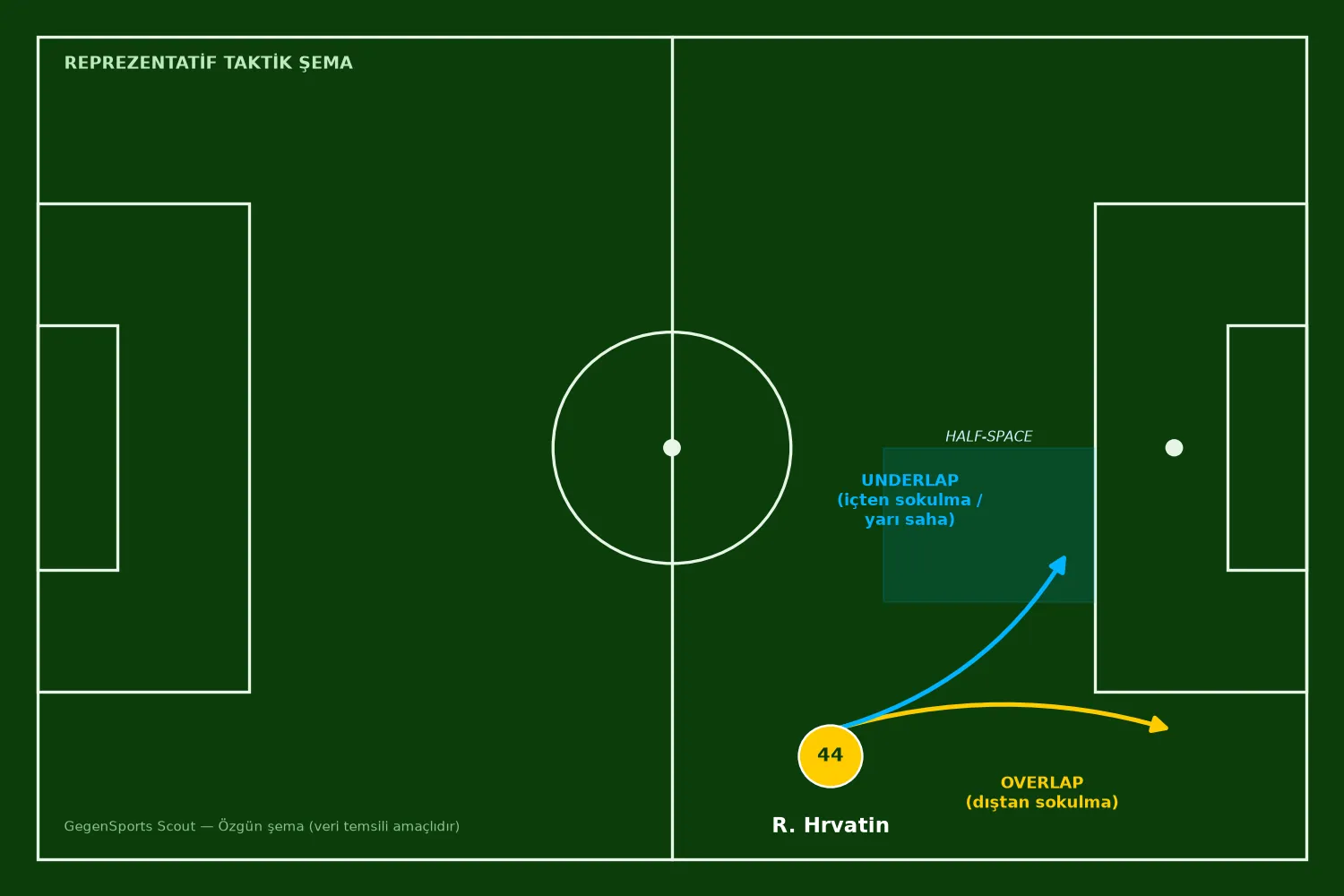
Hrvatin fits the modern “attacking full-back” template rather than a conservative, purely defensive one. The sporting director’s own description — pronounced attacking characteristics — points to a player positioned to push the line forward and join build-up rather than sit deep. Key concepts worth defining for a player of this profile:
- Overlap: the full-back sprinting on the outside of a winger who has drifted inside, to keep the width. Hrvatin’s two goals in half a season at Domžale from right-back suggest timing and composure in these forward bursts.
- Underlap: cutting inside into the half-space while the winger holds the touchline, to combine centrally. This is typically a skill that matures with game intelligence, and Hrvatin is still early in that curve.
- Half-space: the vertical channel between the touchline and the centre of the pitch; full-backs who can receive and progress play there add a second passing/shooting option.
- Press resistance: the ability to retain possession under pressure. For a 19-year-old stepping into the more physical HNL, this is a clear priority development area.
Tactically, he has featured both as a classic right-back in a back four and, when the shape rotates into a back three in possession, as a more advanced wing-back — a useful sign of positional flexibility for a young player. Defensively, the lack of a large sample size means firm conclusions should wait; his consistent selection through Slovenia’s youth ranks up to U21 does suggest a baseline of discipline and positioning that the federation trusts.
Strengths
- Attacking output for the position: 2 goals in 16 league games at Domžale is well above what most right-backs produce.
- Athletic profile: at 183 cm and already handling regular first-team minutes at 19, he shows the physical base for repeated box-to-box running.
- Consistent youth international selection: an unbroken run from U17 to U21 signals trust in his discipline and football intelligence at federation level.
- Cross-league adaptability: moving between Slovenia’s Prva Liga and Croatia’s Prva HNL at 19 and settling in shows an early, positive adaptation signal.
Weaknesses
- Small top-flight sample: roughly 500 minutes at Istra 1961 is not enough to draw firm conclusions on defensive solidity at HNL level.
- Unproven press resistance and final-third quality: public data on ball retention under pressure and delivery in the final third is limited.
- No senior international experience: he remains untested at the highest competitive pressure level.
GegenSports Scout Score
68/100 — this reflects potential-weighted mid-term projection rather than current readiness. Youth, attacking output and federation trust pull the score up; the limited top-level sample and unverified defensive data keep it from going higher.
Similar Players
- Josip Juranović — a Croatian right-back whose HNL-to-elite-league path is a useful stylistic reference point.
- Domagoj Bradarić — a Balkan full-back who moved to Western Europe young while contributing in attack.
- Erik Janža — Slovenia’s experienced attacking full-back, a reference for the pathway out of the Slovenian system.
Süper Lig Fit
The Süper Lig’s physical tempo and wing-driven transitions suit Hrvatin’s forward-running full-back profile. Given his current readiness level, he’s realistically a rotation piece or development project rather than a guaranteed starter for a top-half club. Turkish clubs’ growing interest in Balkan-league young talent (HNL, Slovenia, Serbia) makes a mid-term Süper Lig move a plausible scenario.
Suitable Turkish Clubs
- Kasımpaşa: a consistent track record of identifying and developing high-tempo attacking full-back/winger profiles.
- Hatayspor / Rizespor: mid-budget, development-oriented recruitment approach that could give a young player minutes.
- Gaziantep FK: a club profile that has historically shown patience with promising young foreign signings.
These are profile-based projections built on each club’s general recruitment philosophy, not confirmed interest or offers.
Ideal Teammates
To maximise his attacking value, Hrvatin benefits from a right winger who either holds width when he overlaps or tucks inside to open space for him. A centre-back with strong positional awareness who can cover the space he vacates would let him push forward without excessive risk.
Adaptation Score
6.5/10 — his quick adjustment from Slovenia to Croatia is a positive reference, but the Süper Lig’s physical and tactical intensity is a bigger test. Language and cultural adaptation risk is assessed as moderate.
Cost / Value Scenarios
If the roughly €2m market-value estimate holds, Hrvatin sits in the low-to-mid budget investment bracket. A loan with an option/obligation to buy is the most realistic structure — protecting Istra 1961’s development timeline while limiting risk for an interested club. In a straight permanent deal, Istra 1961’s 2030 contract gives them clear leverage.
Development Potential
Having played in two different national leagues by age 19 is a positive adaptability signal. With regular game time over the next two to three seasons, both his defensive discipline and final-third quality could mature considerably. Much of that curve depends on how much playing time Istra 1961 grants him this season. Comparable young HNL full-backs typically move to Central European leagues or a second-tier “big five” league around age 21-23, and Hrvatin plausibly follows a similar timeline.
Injury & Availability History
No record of a serious or long-term injury appears in public sources. Having played without interruption across two clubs at a young age is, for now, a positive continuity signal, though this assessment should stay cautious given limited public medical/statistical data.
Foreign Player Quota & UK Work Permit Analysis
Holding a Slovenian passport, Hrvatin would count against Süper Lig’s foreign-player quota. For a move to England, the post-Brexit Governing Body Endorsement (GBE) points-based system is the key hurdle: without senior international caps or regular minutes in a high-UEFA-coefficient league, he would not currently meet the automatic GBE threshold. A path to the Premier League or Championship would likely require an Exceptions Panel review or further career progression first.
Suitable Leagues
- Turkish Süper Lig (as a rotation/development signing)
- Austrian Bundesliga
- Belgian Pro League
- Czech Chance Liga
- Polish Ekstraklasa
Sporting Director Summary
At the boardroom level, Hrvatin’s file reads: young, attack-minded, trusted by his federation’s youth setup, but with a limited top-flight sample. For clubs running a low-to-mid budget, development-focused recruitment strategy, a loan or option-to-buy structure makes him a low-risk future bet. He should not be expected to walk straight into a starting XI — this is a patient development profile.
FAQ
1. How old is Rene Hrvatin?
Born 8 December 2006, he is 19 years old.
2. What position does Rene Hrvatin play?
Primarily right-back, occasionally used in a right-sided midfield role.
3. Which club does Hrvatin play for now?
NK Istra 1961 in Croatia’s Prva HNL.
4. What is Hrvatin’s market value?
Estimated at roughly €2 million by Transfermarkt-type sources — an estimate, not an official figure.
5. Has Hrvatin played for the senior national team?
No. He has represented Slovenia’s U17, U19 and U21 sides but has no senior caps yet.
6. When did he join Istra 1961?
In January 2026, from NK Domžale.
7. How does he fit the Süper Lig?
His physical, forward-running profile suits the league’s tempo, but he’s currently a rotation/development piece rather than a ready-made starter.
8. Could Hrvatin move to England?
Not straightforwardly under the current GBE points system; he would likely need an Exceptions Panel review or a step up in level first.
9. What are his main strengths?
Forward-running output, athleticism, consistent youth international selection, and early cross-league adaptability.
10. What does he need to improve?
Press resistance, 1v1 defensive solidity, and simply a bigger sample of top-flight minutes.
11. Which Turkish clubs could suit him profile-wise?
Clubs with a history of developing young foreign talent, such as Kasımpaşa, Hatayspor, Rizespor or Gaziantep FK — a profile match, not a confirmed transfer link.
12. What was his path before Istra 1961?
He came through NK Koper’s academy before playing for NK Domžale, then joined Istra 1961.
Related GegenSports Content
- Raul Kumar Scout Report — Istra 1961’s 18-Year-Old Centre-Back
- Ivan Šaranić Scout Report — Bursaspor’s Croatian Winger
- Ivica Ivušić Scout Report — Hajduk Split’s World Cup Goalkeeper
- Ante Erceg Scout Report — Gorica’s Well-Travelled Forward
- Ville Koski Scouting Report — Alavés’s Finnish Centre-Back
- Giorgi Gocholeishvili Scout Report — Cádiz Stop
Sources
- NK Istra 1961 official website — transfer announcement
- Sofascore — Rene Hrvatin player profile and statistics
- Soccerway — Rene Hrvatin career statistics
- Flashscore — Rene Hrvatin transfer and match records
- BeSoccer — player profile
- Transfermarkt-type sources for market value estimates