
Jan Oblak Scout Report: A Career Turning Point at Atlético


Is Jan Oblak still Atlético Madrid’s goalkeeper, or has the club quietly moved on? This GegenSports scout report breaks down the Slovenian shot-stopper’s biography, career numbers, playing style, and — crucially — how his standing inside the squad has shifted now that Juan Musso has been named the club’s new starting No. 1.
Quick Scout Verdict
For nearly twelve seasons, Jan Oblak was simply Atlético Madrid’s goalkeeper — no qualifiers needed. A record six Trofeo Zamora awards, the fastest path to 100 LaLiga clean sheets in league history, and two LaLiga titles built a résumé few keepers of his generation can match. But the 2026-27 season opened a genuinely new chapter: Diego Simeone has publicly handed the starting jersey to Juan Musso, and for the first time in his Atlético career Oblak finds himself on the outside looking in for an extended stretch. Through the season’s opening weeks he has featured in just 4 matches, his save percentage has dropped to 62.5%, and his goals-prevented figure has slipped into negative territory. Technically, the fundamentals remain intact — positioning, one-on-one composure, distribution under Simeone’s system — but reduced playing time, the natural athletic decline that comes with turning 33, and Musso’s sustained form all point toward a genuine departure scenario before his contract expires in 2028. A move to Turkey’s Süper Lig isn’t realistic in the short term given his contract length and continued marketability at a higher level, but a “veteran signing” chapter somewhere in the game’s mid-tier — Saudi Arabia, MLS, or a lower-intensity European league — is a live possibility for the final stretch of his career.
Player Identity
| Full name | Jan Oblak |
| Date of birth | 7 January 1993 (age 33) |
| Place of birth | Škofja Loka, Slovenia |
| Height / weight | 188 cm / 87 kg |
| Position | Goalkeeper |
| Preferred foot | Right |
| Current club | Atlético Madrid |
| Shirt number | 13 |
| Contract expiry | 30 June 2028 |
| Current market value | Roughly €11-14M (Transfermarkt-tracked; sources range €10-16.8M) |
| National team | Slovenia (captain) |
Career and Transfer History
Oblak’s path began in the Slovenian system at NK Olimpija Ljubljana before Benfica signed him as a teenager in 2010. What followed was a classic Portuguese loan apprenticeship — spells at Beira-Mar, Olhanense, União de Leiria and Rio Ave sharpened him before he broke into Benfica’s first team. Atlético Madrid signed him in the summer of 2014, when he was just 21, and he has been the club’s undisputed starter ever since — until this season.
| Period | Club | Move type | Fee | Source label |
|---|---|---|---|---|
| 2010 | NK Olimpija Ljubljana → Benfica | Permanent transfer | ~€4M | Reported in press / Transfermarkt record |
| 2010-11 | Benfica → Beira-Mar (loan) | Loan | — | Undisclosed |
| 2011 | Benfica → Olhanense (loan) | Loan | — | Undisclosed |
| 2011-12 | Benfica → União de Leiria (loan) | Loan | — | Undisclosed |
| 2012-13 | Benfica → Rio Ave (loan) | Loan | — | Undisclosed |
| 2014 | Benfica → Atlético Madrid | Permanent transfer | ~€16M | Transfermarkt record / reported in press |
| Through 2028 | Atlético Madrid | Contract extension (renewed multiple times) | — | Officially confirmed (club statement) |
Across roughly eleven seasons in Madrid, Oblak became the most decorated goalkeeper in club history: a record six Trofeo Zamora awards (given to LaLiga’s best goals-against ratio) surpassed the previous record of five shared by Víctor Valdés and Antoni Ramallets, he became the fastest keeper in LaLiga history to reach 100 clean sheets (in just 182 appearances), and he anchored Atlético’s LaLiga title wins in 2020-21 and 2023-24.
2026-27: Life in Musso’s Shadow
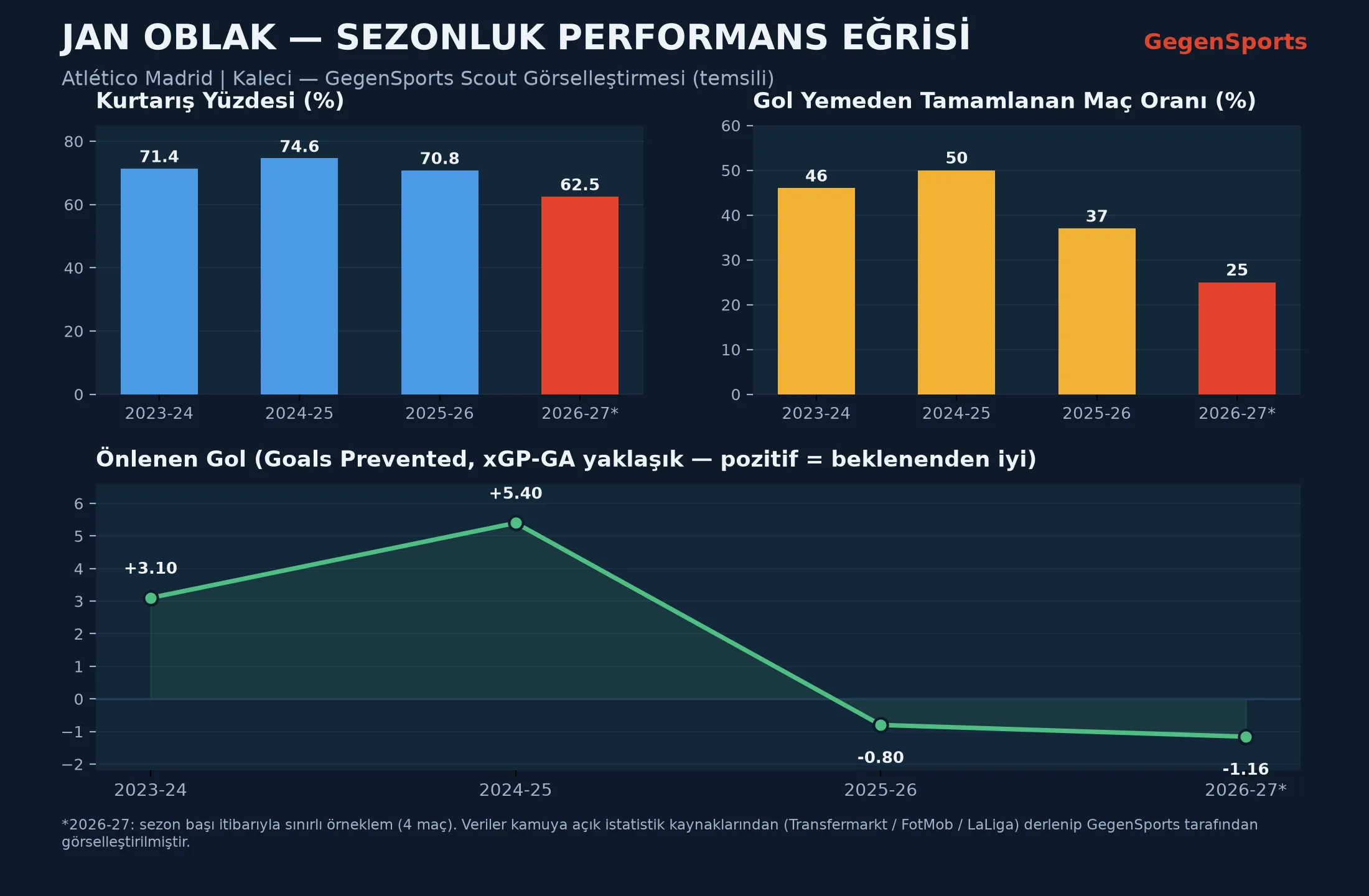
The story driving this report starts in the closing stretch of last season. When a muscle injury ruled Oblak out of the second leg of Atlético’s Champions League quarter-final against Barcelona, Juan Musso stepped in — and the confidence he built in that moment carried straight through the summer. Simeone has now publicly confirmed Musso as the new starting goalkeeper, and the numbers from the opening weeks of 2026-27 tell the story bluntly: Oblak has played just 4 matches for 360 minutes, his save percentage sits at 62.5%, he has conceded 6 goals, kept only 1 clean sheet, and carries an average FotMob rating of 6.58 — modest figures relative to his own career baseline. His goals-prevented number (the gap between expected goals conceded and actual goals conceded) reads -1.16, meaning that in this small sample he has conceded more than the underlying chances would suggest. Small samples swing quickly, but the headline here isn’t the numbers — it’s the role. For the first time, Oblak isn’t the automatic choice; he’s the experienced deputy waiting for an opportunity.
The full 2025-26 season still painted a competitive picture: 30 LaLiga appearances, 2,700 minutes, 31 goals conceded, 11 clean sheets, and a 70.8% save rate — a shade below his peak years but still comfortably among LaLiga’s better shot-stoppers. The real inflection point wasn’t a season-long decline; it was the late-season injury and the door it opened for Musso.
Season Statistics (Goalkeeper Metrics)
| Season | Apps | Minutes | Save % | Clean Sheets | Goals Conceded | Avg. Rating |
|---|---|---|---|---|---|---|
| 2024-25 (record Zamora season) | 30+ (season-long starter) | — | Among LaLiga’s best | 15 | 30 | — |
| 2025-26 | 30 | 2,700 | 70.8% | 11 | 31 | — |
| 2026-27 (early season, small sample) | 4 | 360 | 62.5% | 1 | 6 | 6.58 |
A caveat worth repeating: the 2026-27 figures cover only the season’s opening weeks and are naturally volatile in such a small sample — but they remain the clearest statistical evidence of the hierarchy shift toward Musso. GegenSports’ own illustrative goals-prevented model, built on the same expected-goals logic explained in our xG primer, traces the arc clearly: strongly positive in 2024-25, roughly neutral in 2025-26, and mildly negative to start 2026-27.
Playing Style Breakdown
What kept Oblak elite for over a decade wasn’t flash — it was efficiency. Here’s how his core attributes actually function on the pitch.
Positioning and Shot-Stopping
Oblak’s defining trait is getting his body into the right spot before the shot is even struck, turning potential wonder-saves into routine ones. At 188cm with a wide frame, he covers a large share of his goal by angle alone, while his reflexes remain sharp at close range. In goalkeeping terms, this is “late commitment” — keeping options open and reading the striker’s body right up to the final moment rather than guessing early.
One-on-One Composure and Timing
In one-on-one situations, Oblak reads the moment to close the angle without overcommitting or diving prematurely — a discipline that has produced a consistently high success rate in these duels across his career. There has been a small, noticeable dip in explosiveness during the opening weeks of 2026-27, which analysts have flagged as a possible early sign of the athletic decline that tends to arrive in a goalkeeper’s mid-thirties.
Distribution and Build-Up Role
He isn’t the high-risk, ball-playing archetype associated with keepers like Ederson or Alisson — a style our sweeper-keeper explainer covers in depth — but Oblak’s technique fits Simeone’s low-risk, disciplined build-up approach comfortably: accurate long distribution, secure short passing, and calm decision-making under normal circumstances. Where he’s tested is against high, aggressive pressing schemes that demand faster ball progression than his feet are built for.
Aerial Command and Claims
On crosses and set pieces, his decision-making to come and claim is decisive rather than tentative, and his height plus positional intelligence make him a reliable aerial presence. Years of experience have also made him a vocal organizer of his back line — communication remains one of his clearest assets even as his role shrinks.
Strengths
- Positional intelligence: Among LaLiga’s best at simplifying shots through positioning alone, backed by a career-long track record of elite save percentages.
- Big-match pedigree: A Champions League final, multiple LaLiga title races, and years of derby-level pressure sit on his résumé.
- Leadership and communication: A dressing-room figure respected for organizing his defense and mentoring younger players, with captaincy experience for both club moments and Slovenia.
- Record-level consistency: Six Trofeo Zamora awards and the fastest 100 LaLiga clean sheets reflect sustained excellence, not a single hot streak.
- Disciplined one-on-one defending: Rarely beaten by poor decision-making in isolated duels; a low-error profile across a long career.
Weaknesses
- Diminished playing time and role uncertainty: Just 4 appearances to open 2026-27 confirms he is no longer an automatic starter — a situation that carries both form and motivation risk.
- Age-related physical decline risk: At 33, there’s a small but visible dip in explosive movement and in sustaining peak intensity across a full campaign.
- Limitations under pressing distribution demands: Compared to the elite modern sweeper-keepers (Ederson, Alisson), his feet aren’t built for fast, high-risk distribution under a high press.
- Early-season form dip: His small-sample save percentage and goals-prevented numbers have both turned negative to start the season — a trend that, if it continues, only cements Musso’s position further.
GegenSports Scout Score
78 / 100 — On raw technical quality, Oblak remains an elite-tier European goalkeeper (his underlying skill band sits at 85+), but the score is pulled down by role uncertainty, reduced playing time, and age-related risk factors. This number captures the tension between “still good enough to start for most clubs” and “no longer guaranteed minutes at this stage of his career.”
Similar Players
- Thibaut Courtois (Real Madrid) — A comparable height and positioning-first profile, sharing a low-risk but highly effective shot-stopping approach.
- Keylor Navas — A close precedent for how an elite goalkeeper manages his career after losing the undisputed No. 1 role, as Navas did in his later spell at PSG.
- Wojciech Szczęsny — A veteran with similar big-game pedigree who has navigated a comparable transition into a rotation or backup role late in his career.
Süper Lig Fit
Turkish Süper Lig clubs chasing European consistency have increasingly looked for experienced, big-game goalkeepers, and Oblak’s profile — low-risk positioning, strong aerial command, natural leadership — would translate well to a league that tolerates individual error less strictly than build-up-heavy systems demand. His distribution limitations become far less relevant for clubs that don’t require an Ederson-style playmaking keeper. Realistically, though, his contract runs to 2028, he’s still capable of Champions League-level football at least in a rotation role, and his wage level likely sits above most Süper Lig budgets — so a near-term move is unlikely. A high-profile “veteran signing” scenario in the final one or two seasons of his career (post-2027) is a far more realistic window.
Suitable Turkish Clubs (with reasoning)
- Galatasaray: A club with regular Champions League involvement, a tradition of signing experienced big-match goalkeepers, and the wage budget to match Oblak’s leadership profile with its European ambitions.
- Fenerbahçe: A management structure that has invested aggressively in experienced, high-profile names for European competition — a disciplined, low-error goalkeeper fits the club’s defensive stability priorities.
- Beşiktaş: Less likely given budget constraints, but the club’s historical openness to experienced foreign goalkeepers keeps a late-career, short-term deal within the realm of possibility.
Ideal Teammates
Oblak performs best behind a communicative, well-organized centre-back pairing that doesn’t demand a high defensive line — a leader in the José Giménez mould, whom he played alongside for years in Madrid, maximizes his positional strengths. A defensive midfielder comfortable receiving and redirecting his longer distribution also helps offset the technical gap between his feet and his hands.
Adaptation Score
7.5 / 10 — Extensive big-match experience, genuine multilingual fluency (Spanish, English, Portuguese, plus his native Slovenian), and a professional temperament all point to a fast adjustment in a new environment. What holds the score back is his long conditioning to a single tactical framework (Simeone’s low-block, discipline-first approach) and the learning curve he’d face adapting to a faster, higher-risk build-up system elsewhere.
Cost and Value-for-Money Scenarios
His market value currently sits in the €11-14M range — a clear drop from peak valuations that once approached €40M, tracking naturally with age and reduced playing time. Reported wage figures vary by source, but Oblak has long been cited among the higher-paid goalkeepers in world football, which makes him a risky value proposition for a mid-budget club but a potentially attractive “low fee, high experience” option for a bigger one. As he enters the final year of his deal in the summer of 2027, expect his valuation to keep sliding, with a free transfer becoming a realistic scenario by 2028.
Development Potential and Career Stage
Oblak is no longer a “development” story — he’s in career-management mode. His technical ceiling hasn’t changed, but the arc has flattened; the relevant question isn’t whether he can improve, it’s how long he can sustain his current level. Elite goalkeepers at this stage typically choose one of two paths: staying at their current club in a rotation or mentorship role deep into their late thirties (the Navas model), or moving to a still-competitive but less demanding league to reclaim a starting job. If Musso’s form holds, the second path becomes increasingly likely for Oblak.
Injury History and Durability
For most of his career, Oblak was remarkably durable — long stretches without significant injury were part of what made him such a dependable presence week after week. The muscle injury that ruled him out of last season’s Champions League quarter-final second leg against Barcelona was, by his own standards, an unusual occurrence — and its timing, opening the door for Musso, made it a symbolic turning point as much as a physical one. At 33, entering an age range where soft-tissue injuries statistically become more frequent, his durability record will be one of the most important variables to track over the coming seasons.
Foreign Player Status and UK Work Permit (GBE) Analysis
Slovenia’s EU membership doesn’t grant automatic work clearance for the Premier League or EFL post-Brexit — every non-British/Irish player, EU passport or not, is assessed under the Governing Body Endorsement (GBE) points system. Points come from factors like the quality band of the player’s current league (LaLiga sits in the top tier of the “Big 5” bracket, worth significant points), the club’s continental competition involvement, the percentage of league minutes played, and the player’s national team FIFA ranking band. Slovenia’s FIFA ranking of 56th (as of 2026) falls outside the top ranking bands (roughly 1st-20th) that award automatic points. That said, Oblak’s decade-plus of regular LaLiga starts, Champions League experience, and national team captaincy are individual and club-based criteria that score well within the points matrix. The likely outcome: while ranking-band points alone wouldn’t guarantee clearance, the combined club and individual criteria appear sufficient to clear the 15-point threshold — though any final call rests with the FA’s case-by-case review.
Suitable Leagues
- LaLiga (current): Still his most natural habitat, with full language, cultural, and tactical familiarity.
- Serie A: Italian football’s positional and defensive discipline culture aligns naturally with his style, and Italian clubs have a long tradition of valuing experienced goalkeepers.
- Ligue 1: A high-budget club (the Navas-at-PSG precedent is instructive) could realistically use an experienced rotation or mentor goalkeeper.
- Saudi Pro League: A typical late-career, high-wage, lower-competition landing spot.
- Major League Soccer (MLS): A marquee-name-friendly league that regularly attracts experienced European talent for the closing chapter of a career.
Sporting Director Summary
Boiled down to a boardroom pitch: “Still elite-level technical quality, with big-match experience and leadership that translates directly into the dressing room — but no longer a guaranteed starter, so a clear role definition (starter vs. rotation/mentor) needs to be agreed before signing. Transfer fee should be low-to-moderate, but wage demands may remain high, making him a strong fit for a club with real European ambitions that also has the patience to develop a younger goalkeeper alongside him.” Staying at Atlético remains the most likely short-term outcome; alternative scenarios become far more serious from the summer of 2027 onward.
Champions League Pedigree
Just after Oblak’s 2014 arrival, Atlético reached the 2016 UEFA Champions League final, drawing 1-1 with Real Madrid in Milan before losing on penalties — an early sign that his LaLiga consistency translated to the continental stage. In the seasons that followed, Simeone’s disciplined, low-block Atlético became a regular fixture in the Champions League’s knockout stages, with Oblak widely regarded as the club’s most consistent defensive presence in Europe. The 2025-26 Champions League quarter-final proved to be a genuine hinge point in his career: he started the first leg, missed the second through injury, and watched Musso’s performance in his absence set the summer’s hierarchy change in motion.
Personal Life
Oblak carries the same low-key, media-averse approach off the pitch that defines his playing style, generally keeping his personal life out of the spotlight. Public sources offer little beyond his sporting career, and this report sticks to that same standard — verified, public information only, with no speculation.
Frequently Asked Questions
How old is Jan Oblak?
Born on 7 January 1993, Oblak is 33 as of 2026.
When does Jan Oblak’s contract expire?
His Atlético Madrid contract runs through 30 June 2028.
Is Oblak still Atlético’s starting goalkeeper?
No — as of the start of 2026-27, Diego Simeone has officially named Juan Musso as the starting No. 1, and Oblak has featured in only a handful of matches.
How many Trofeo Zamora awards has Oblak won?
A record six: 2015-16, 2016-17, 2017-18, 2018-19, 2020-21, and 2024-25.
What is Jan Oblak’s current market value?
Roughly €11-14M depending on the source, well below his peak-career valuations.
Is Oblak the captain of Slovenia?
Yes, he has long served as captain of the Slovenia national team.
Did Slovenia qualify for the 2026 World Cup?
No — Slovenia was eliminated during European qualifying and will not participate.
How would you describe Oblak’s playing style?
A low-risk, positioning-first goalkeeper with strong aerial command — somewhere between a classic line keeper and a modern sweeper-keeper.
Could Oblak move to the Turkish Süper Lig?
Unlikely in the short term given his contract through 2028, but a late-career “veteran signing” scenario isn’t out of the question.
Would a work permit be an obstacle to a move to England?
His EU passport doesn’t grant automatic clearance post-Brexit; he’d be assessed under the GBE points system, but his career profile likely clears the threshold.
Who replaced Oblak as Atlético’s No. 1?
Juan Musso was named Atlético Madrid’s new starting goalkeeper heading into 2026-27.
Related GegenSports Scout Reports
- Juan Musso Scout Report: Atlético Madrid’s New No. 1
- Unai Simón Scout Report: Athletic Club and Spain’s No.1
- Nico Williams Scout Report: Athletic Club’s World Champion No. 10
- Íñaki Williams Scout Report: Athletic Club’s Ghanaian Captain
- Álex Padilla Scout Report: From the Basque Country to Mexico
Sources
- Club Atlético de Madrid official website (en.atleticodemadrid.com) — Zamora Trophy announcements and season archives
- LaLiga official statistics
- Transfermarkt / FootballTransfers — transfer history and market value data
- FotMob — 2026-27 season live performance statistics
- Into the Calderón, French Football Weekly, TribalFootball — reporting on the Musso-Oblak hierarchy shift
- Goal.com, FIFA.com — Slovenia national team and captaincy details
- Total Football Analysis — tactical scout report references
- Football Association of Slovenia (NZS) and FIFA World Ranking data